• Produktbild: Islamic Finance and Circular Economy
  • Produktbild: Islamic Finance and Circular Economy
Band 5 - 12%

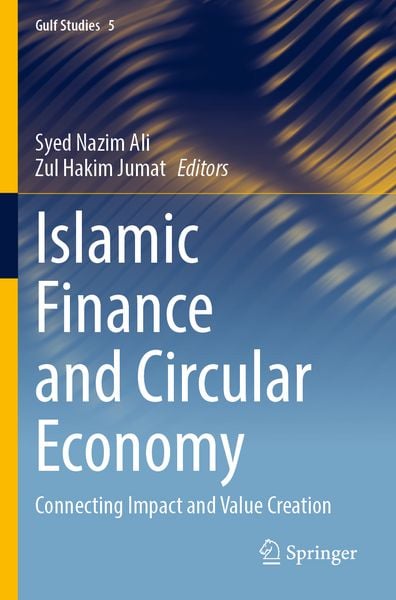
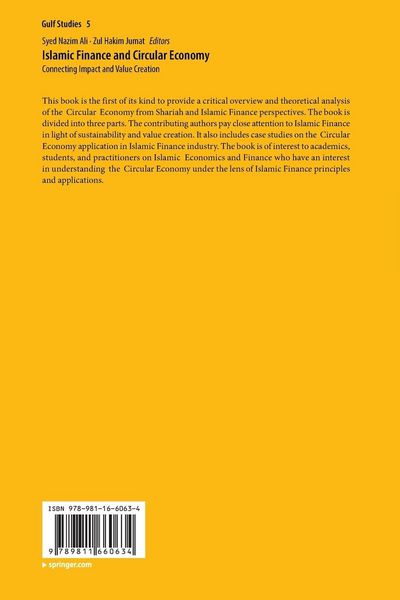
Islamic Finance and Circular Economy Connecting Impact and Value Creation

Aus der Reihe Gulf Studies
12% sparen

163,99 € UVP 186,99 €

inkl. gesetzl. MwSt., Versandkostenfrei


Beschreibung

Produktdetails

Einband

Taschenbuch

Erscheinungsdatum

06.12.2022

Abbildungen

XII, 335 p. 39 illus., 31 illus. in color.

Herausgeber

Syed Nazim Ali + weitere

Verlag

Springer Singapore

Seitenzahl

335

Maße (L/B/H)

23,5/15,5/1,9 cm

Gewicht

528 g

Auflage

22001 Auflage 1st ed. 2021

Sprache

Englisch

ISBN

978-981-16-6063-4

Beschreibung

Portrait


Syed Nazim Ali
 is a Research Professor and the Director for the Research Division and the Center for Islamic Economics and Finance, College of Islamic Studies, at the Hamad Bin Khalifa University, Qatar Foundation. He has spent the last thirty years spearheading research in Islamic Finance and faith-based initiates in Finance. He was Founding Director of the Islamic Finance Project (IFP) at Harvard Law School, Harvard University, since 1995. He has paid special attention to lines of inquiry that seek to examine and interrogate the frontiers, facilitate research and encourage dialogue among various stakeholders and external discussants. He has played a lead role in organizing several conferences and seminars, creating forums for highly intellectual debates on global trends. He has published many books, including 
Takaful and Islamic Cooperative Finance: Challenges and Opportunities (2016); and Shari‘a-Complaint Microfinance (2012).
 

Zul Hakim Jumat
 is a researcher for the Center of Islamic Economics and Finance (CIEF), College of Islamic Studies, Hamad Bin Khalifa University (HBKU), Qatar Foundation. He has been a part of several organizing committees for Islamic Finance conferences and seminars, providing an intellectual platform for industry leaders and academia to discuss global emerging trends and issues. Before joining CIEF, he was a research editor at Dow Jones Risk & Compliance team, focusing on Sanction Ownership Research. He holds an MSc in Islamic Finance (2018) from HBKU, majoring in Islamic Corporate Finance and Asset Management, and a BSc (Hons) in Islamic Jurisprudence and Principles of Jurisprudence (2015) from Kuwait University, minoring in Economics. Currently, he is a Ph.D. candidate in Islamic Economics and Finance at HBKU.


Produktdetails

Einband

Taschenbuch

Erscheinungsdatum

06.12.2022

Abbildungen

XII, 335 p. 39 illus., 31 illus. in color.

Herausgeber

Verlag

Springer Singapore

Seitenzahl

335

Maße (L/B/H)

23,5/15,5/1,9 cm

Gewicht

528 g

Auflage

22001 Auflage 1st ed. 2021

Sprache

Englisch

ISBN

978-981-16-6063-4

Herstelleradresse

Springer-Verlag KG
Sachsenplatz 4-6
1201 Wien
AT

Email: ProductSafety@springernature.com

Noch keine Bewertungen vorhanden

Verfassen Sie die erste Bewertung zu diesem Artikel

Helfen Sie anderen Kundinnen und Kunden durch Ihre Meinung.

Kundinnen und Kunden meinen

Bewertungen (0)

  • Produktbild: Islamic Finance and Circular Economy
  • Produktbild: Islamic Finance and Circular Economy

  • Chapter 1. Islamic Finance and Circular Economy: An Introduction.- Part 1: Islamic Perspective on Circular Economy and Sustainability.- Chapter 2. Islamic Perspective on Circular Economy.- Chapter 3. Environmental Protection and Sustainable Development:  An Islamic Perspective.- Part 2: Convergence of Islamic Finance and Circular Economy.- Chapter 4. Circular Economy Financing: An Islamic Finance Perspective.- Chapter 5. Circular Economy, Green Economy, and Sustainable Development: Establishing The Interconnections and Discoursing The Role of Islamic Finance.- Chapter 6. The Circular Economy and Its Possible Collaboration with Islamic Economics and Finance.- Chapter 7. ESG Analysis and Shariah Screening: Mutual Learnings For A Better Investment Climate.- Chapter 8. Sustainable Investment and Transparency Recommendations in Segmented Markets: An Application to Islamic Investment Accounts.- Chapter 9. Sustainability, Trust and Blockchain Applications in Islamic Finance and Circular Economy: Best Practices and Fintech Prospects.- Chapter 10. Financial Development and Ecological Footprint in OIC Countries: Islamic Perspectives and Empirical Evidence.- Chapter 11. A Consumer Perspective of The Circular Economy: An Empirical Investigation Through Structural Equation Modelling.- Chapter 12. A Multi-Layer Analysis and Solution For Climate Crisis: From The Restructuring of Production to Restructuring of Knowledge.- Part 3: Circular Economy Innovations – Case  Studies.- Chapter 13. Zero Waste Cities in The Developing World:  A Comparative Study.- Chapter 14. Solving The Problem of Water, Sanitation And Hygiene in Nigeria Using Blended Finance.- Chapter 15. The Role of Islamic Finance in Fostering Circular Business Investments in The Case Of Qatar’s Tire Industry.- Chapter 16. Electronic and Electrical Waste Management: Malaysia and Sweden Experiences.