• Produktbild: Bio-Nano Interface
  • Produktbild: Bio-Nano Interface
- 11%

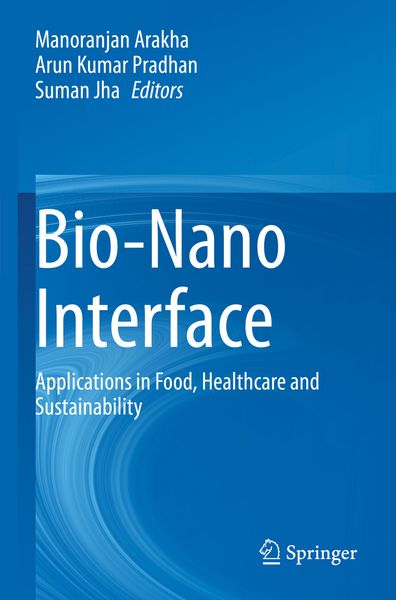
Bio-Nano Interface Applications in Food, Healthcare and Sustainability

11% sparen

154,99 € UVP 175,99 €

inkl. gesetzl. MwSt., Versandkostenfrei


Beschreibung

Produktdetails

Einband

Taschenbuch

Erscheinungsdatum

29.11.2022

Abbildungen

IX, 355 p. 1 illus.

Herausgeber

Manoranjan Arakha + weitere

Verlag

Springer Singapore

Seitenzahl

355

Maße (L/B/H)

23,5/15,5/2 cm

Gewicht

557 g

Auflage

22001 Auflage 1st ed. 2022

Sprache

Englisch

ISBN

978-981-16-2518-3

Beschreibung

Portrait


Dr. Manoranjan Arakha
 is an assistant professor at the Centre for Biotechnology, Siksha' O' Anusandhan (Deemed to be University), Bhubaneswar, Odisha, India. He received his doctorate in Life Science from the National Institute of Technology Rourkela, India, in 2017. Subsequently, He pursued post-doctoral research on Bio-Nano interface at University College Dublin, Ireland. His research interests include green synthesis of different metal nanoparticles and moderate their Physico-chemical parameters for antimicrobial and cytotoxic properties. For antimicrobial, he is mainly interested in nanoformulation effective against biofilm-forming and antimicrobial peptide-resistant bacteria.

Dr. Arun Kumar Pradhan
 is an assistant professor in Centre for Biotechnology, School of Pharmaceutical Sciences, Siksha' O' Anusandhan (Deemed to be University), Bhubaneswar, Odisha, India. He received his Ph.D. degree in 2016 from the Department of Environment & Sustainability, CSIR-Institute of Minerals and Materials Technology, Bhubaneswar, India. His area of interest is microbial biosurfactants and their various biotechnological applications like the effect of biosurfactant on cancer cells, study of biofilm inhibitory capacity of biosurfactants, nanoparticle approach (liposome) of heavy metal detection, etc. Currently, he is working on the green synthesis of various nanoparticles and clinical applications of biosurfactants to cure different disorders.

Dr. Suman Jha
 is an associate professor in the Department of Life Science, National Institute of Technology Rourkela, Odisha, India. He received his Ph.D. from the Department of Physical Chemistry-I, Technical University of Dortmund, Germany, in 2009. He completed his post-doctoral research in protein biophysics from the Department of Molecular and Cell Biology, University of Connecticut, USA (2010-2011). Currently, Dr. Jha investigates different nanoformulations for biological applications like in TIIDM, Parkinson's, and cancer. His research interests involve studying nanoparticle-biomolecular interfacial interactions, protein-metal ions & protein-protein interactions. 

Produktdetails

Einband

Taschenbuch

Erscheinungsdatum

29.11.2022

Abbildungen

IX, 355 p. 1 illus.

Herausgeber

Verlag

Springer Singapore

Seitenzahl

355

Maße (L/B/H)

23,5/15,5/2 cm

Gewicht

557 g

Auflage

22001 Auflage 1st ed. 2022

Sprache

Englisch

ISBN

978-981-16-2518-3

Herstelleradresse

Springer-Verlag GmbH
Tiergartenstr. 17
69121 Heidelberg
DE

Email: GPSR Kontakt

Noch keine Bewertungen vorhanden

Verfassen Sie die erste Bewertung zu diesem Artikel

Helfen Sie anderen Kundinnen und Kunden durch Ihre Meinung.

Kundinnen und Kunden meinen

Bewertungen (0)

  • Produktbild: Bio-Nano Interface
  • Produktbild: Bio-Nano Interface
  • Chapter 1.Impact of isotropic and anisotropic plasmonic metal nanoparticles on healthcare and food-safety management.- Chapter 2. An introduction to different methods of nanoparticles synthesis.- Chapter 3. Classification, Synthesis, and Application of Nanoparticles against Infectious Diseases.- Chapter 4. Nanotechnology in Food Science.- Chapter 5. Facets of Nanotechnology in food processing, packaging and safety: an emerald insight.- Chapter 6. Nanotechnology and its potential application in postharvest technology.- Chapter 7. Nanotechnology mediated detection and control of phytopathogens.- Chapter 8. Nanosystems for Cancer Therapy.- Chapter 9. Phytoplankton mediated nanoparticles for cancer therapy. Chapter 10. Nanotechnology and its potential implications in Ovary Cancer.- Chapter 11. Nanotechnology: An Emerging Field in Protein Aggregation and Cancer Therapeutics.- Chapter 12. Bio-nano interface and its potential application in Alzheimer’s disease.- Chapter 13. Potential of curcumin nanoparticles in tuberculosis management.- Chapter 14. Application of Nanobiosensor in Health care sector.- Chapter 15. Bioactive nanoparticles: A next generation smart nanomaterials for pollution abatement and ecological sustainability.- Chapter 16. Smart nano-materials for bio-imaging applications:An overview.- Chapter 17. Biology of Earthworm in a World of Nano-materials: New Room, Challenges and, Future Perspectives.- Chapter 18. Bioethanol production from agricultural wastes with the aid of nanotechnology.- Chapter 19. Nanotechnology for sustainable bioenergy production.