KI-Beratung Beta

Gutscheinbedingungen

**Gültig bis 09.11.2026 auf tolino shine color (4016621130473), tolino vision color (4016621130183) und tolino vision color weiß (4016621131456) online auf thalia.at, in der Thalia App und in allen Thalia Buchhandlungen in Österreich. In den Buchhandlungen nur gültig auf lagernde Ware. Pro Einkauf einmal einlösbar. Nur gültig gegen Vorlage oder im Onlineshop hinterlegter Bonuscard. Infos zur Einlösung in der Buchhandlung sind auf der Bonuscard-Vorteilspreisseite zu finden. Click & Collect nur bei Onlinevorabzahlung möglich. Keine Einlösung bei Scan & Go-Bezahlung. Keine Barauszahlung. Nicht kombinierbar mit anderen Aktionen und Gutscheinen. Nicht gültig für Geschenkkarten, Versandkosten und Services. Nur solange der Vorrat reicht.

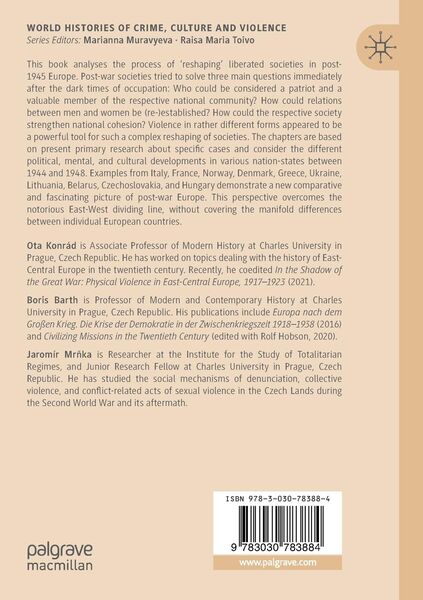
  • Produktbild: Collective Identities and Post-War Violence in Europe, 1944–48
  • Produktbild: Collective Identities and Post-War Violence in Europe, 1944–48
- 13%

Collective Identities and Post-War Violence in Europe, 1944–48 Reshaping the Nation

13% sparen

142,99 € UVP 164,99 €

inkl. gesetzl. MwSt., Versandkostenfrei


Beschreibung

Produktdetails

Einband

Taschenbuch

Erscheinungsdatum

29.11.2022

Abbildungen

XI, 334 p.

Herausgeber

Ota Konrád + weitere

Verlag

Springer

Seitenzahl

334

Maße (L/B/H)

21/14,8/1,9 cm

Gewicht

451 g

Auflage

22001 Auflage 1st edition 2022

Sprache

Englisch

ISBN

978-3-030-78388-4

Beschreibung

Portrait


Ota Konrád 
is Associate Professor of Modern History at Charles University in Prague, Czech Republic. He has worked on topics dealing with the history of East-Central Europe in the twentieth century. Recently, he co-edited 
In the Shadow of the Great War: Physical Violence in East-Central Europe, 1917-1923 
(2021). 

Boris Barth
 is Professor of Modern and Contemporary History at Charles University in Prague, Czech Republic. His publications include 
Europa nach dem Großen Krieg. Die Krise der Demokratie in der Zwischenkriegszeit 1918-1938 
(2016) and 
Civilizing Missions in the Twentieth Century
 (edited with Rolf Hobson, 2020).

Jaromír Mrňka
 is Researcher at the Institute for the Study of Totalitarian Regimes, and Junior Research Fellow at Charles University in Prague, Czech Republic. He has studied the social mechanisms of denunciation, collective violence, and conflict-related acts of sexual violence in the Czech Lands during the Second World War and its aftermath.

Produktdetails

Einband

Taschenbuch

Erscheinungsdatum

29.11.2022

Abbildungen

XI, 334 p.

Herausgeber

Verlag

Springer

Seitenzahl

334

Maße (L/B/H)

21/14,8/1,9 cm

Gewicht

451 g

Auflage

22001 Auflage 1st edition 2022

Sprache

Englisch

ISBN

978-3-030-78388-4

Herstelleradresse

Springer-Verlag GmbH
Europaplatz 3
69115 Heidelberg
DE

Email: ProductSafety@springernature.com

Noch keine Bewertungen vorhanden

Verfassen Sie die erste Bewertung zu diesem Artikel

Helfen Sie anderen Kundinnen und Kunden durch Ihre Meinung.

Kundinnen und Kunden meinen

Bewertungen (0)

  • Produktbild: Collective Identities and Post-War Violence in Europe, 1944–48
  • Produktbild: Collective Identities and Post-War Violence in Europe, 1944–48
  • PART I. RESHAPING THE NATION.- Introduction; Ota Konrád, Boris Barth, Jaromír Mrňka.- The End of the War and the Beginning of the Peace: Where Violence Leaves Off and Reconstruction Begins: Continental Europe, 1944-1947; Norman Naimark.- PART II. JUSTICE.- Redefining National Identities through Justice: A Comparative Analysis of Italy and France; Barbara De Luna and Greta Fedele.- Purges, Patriotism, and Political Violence: The Danish Case, 1944-1945; Henrik Lundtofte.- 'Mentalities of War, Mentalities of Peace': Capital Punishment in the Norwegian ‘Treason Trials’, 1941-1948; Anika Seemann.- PART III. GENDER.- 'German Brats and Tarts': Gender, Sexuality, and Collective Memory in Post-War Norway; Caroline Nilsen.- Gender, Ethnicity, and Multidirectional Violence during the Last Months of German Rule in Lithuania: A Case Study of Local Force Battalions; Justina Smalkyté.- PART IV. NATION AND NATIONALISM.- Assessing National 'Consciousness': The Belarusian Home Guard, 1944-1945; Aleksandra Pomiecko.- Cleansing Greece of the Miasma of its 'Sudeten': Macedonian Slavs as an Unwanted Minority in the Aftermath of the Second World War; Tasos Kostopoulos.- Between Nation and Religion: Czech Protestants and the Transfer of the Sudeten Germans, 1945-1948; Ondřej Matějka.- PART V. CITIZENSHIP.- 'Pure Christians' vs. 'Working Citizens of the Democratic Era': How the Claimants of Jewish Property perceived Citizenship in Hungary; Borbála Klacsmann.- A Glass Half Full or Half Empty? The Postwar Treatment of the German Minority in Denmark; Peter Thaler.- PART VI. CONCLUSION.- Conclusion; Christoph Cornelißen.