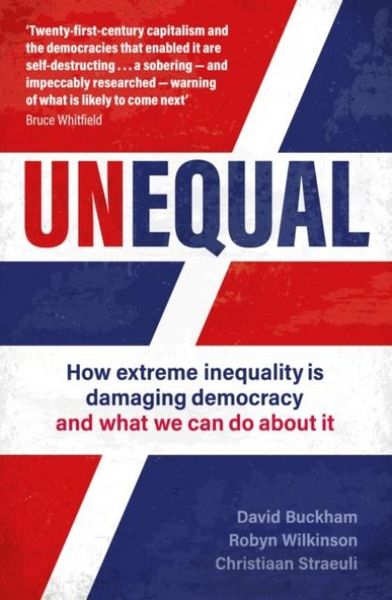
Unequal How extreme inequality is damaging democracy, and what we can do about it
-
- Englisch ausgewählt
16,99 €
inkl. gesetzl. MwSt.,
- Kostenlose Lieferung ab 30 € Einkaufswert
- Versandkostenfrei für Bonuscard-Kund*innen
Beschreibung
Produktdetails
Einband
Taschenbuch
Erscheinungsdatum
13.04.2023
Verlag
Pan macmillan Ltd.Seitenzahl
320
Maße (L/B/H)
23,4/15,5/2,7 cm
Gewicht
412 g
Sprache
Englisch
ISBN
978-1-80247-137-3
The ongoing war in Ukraine, between freedom and totalitarianism, has been brewing since the fall of the Berlin Wall in 1989: the great victory of liberal democracy over communism. In recent decades, authoritarian regimes have proliferated or become emboldened - from Myanmar and North Korea to Venezuela, Saudi Arabia and, of course, China. At the same time, we have seen wildly overpriced stock markets, the emergence of decentralised finance and its associated cryptocurrencies, and the idolization of inordinately expensive things, from watches and customised trainers to rare whiskies and non-fungible tokens (NFTs). The decoupling of capitalism from democracy, which gathered pace in the 1990s, has fostered an economic system powered by greed alone, able to prosper in brutal dictatorships, unchecked even by the financial crisis of 2007/8. Rampant inequality, fuelled by radically increased money supply, has been the result, with a tiny fraction of the world's population owning more than the rest put together. This inequality has incited social unrest and contributed to the undermining of faith in the institutions of the democratic state. The citizens of Western democracies have been left to the mercy of unfettered capitalism, becoming data subjects, endlessly surveilled, marshalled and polarised. Today's extreme capitalism, promoted by Milton Friedman and others, is exemplified by its modern monopolists - Bill Gates, Jeff Bezos, Mark Zuckerberg and Elon Musk, whose fortunes have been built on often immoral, if not illegal actions, and whose headline-grabbing antics appear to be motivated more by ego than any genuine desire to do good for humanity. In the 1990s, an understanding of social justice and an appreciation of democracy still survived, but public discourse has grown increasingly polarised and angry. The authors draw a line from the robber barons of the 1990s tech revolution to Putin's invasion of Ukraine, citing the marginalisation of democratic principles which has enabled the rise of authoritarian populists such as Vladimir Putin, Xi Jinping, Jair Bolsonaro and, of course, Donald Trump and Boris Johnson. An unanticipated fightback in Ukraine, with support from the EU and the West, has the potential to reclaim the lost spirit of freedom inherent in liberal democracy, but will it be enough?
Noch keine Bewertungen vorhanden
Verfassen Sie die erste Bewertung zu diesem Artikel
Helfen Sie anderen Kundinnen und Kunden durch Ihre Meinung.
Kurze Frage zu unserer Seite
Vielen Dank für Ihr Feedback
Wir nutzen Ihr Feedback, um unsere Produktseiten zu verbessern. Bitte haben Sie Verständnis, dass wir Ihnen keine Rückmeldung geben können. Falls Sie Kontakt mit uns aufnehmen möchten, können Sie sich aber gerne an unseren Kund*innenservice wenden.
zum Kundenservice