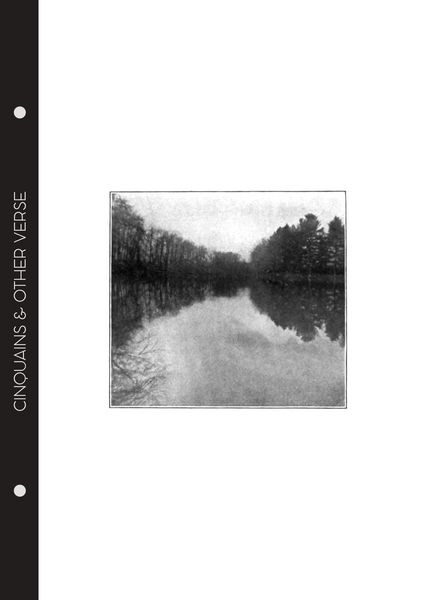
Adelaide Crapsey - Cinquains & Other Verse
-
- Englisch ausgewählt
16,99 €
inkl. gesetzl. MwSt.,
- Kostenlose Lieferung ab 30 € Einkaufswert
- Versandkostenfrei für Bonuscard-Kund*innen
Beschreibung
Produktdetails
Einband
Taschenbuch
Erscheinungsdatum
04.08.2022
Herausgeber
Dick WhyteVerlag
Public Domain PressSeitenzahl
76
Maße (L/B/H)
21/14,8/0,5 cm
Gewicht
112 g
Sprache
Englisch
ISBN
978-0-473-64924-1
New edition designed, edited, and selected by Dick Whyte. Every day, Every day, Tell the hours By their shadows, By their shadows. Adelaide Crapsey (1878-1914) was born and raised in Brooklyn, New York, and attended Vassar College, where she was class poet three years in a row. After graduating, Crapsey taught history & literature at Kemper Hall in Wisconsin, and then studied at the School of Archaeology in Rome. I know Not these my hands And I think there was A woman like me once had hands Like these. Around this time, she began writing 'free verse', drawing inspiration from the French 'vers libre', Japanese hokku and tanka, and the work of Yone Noguchi, among other things. This inspired Crapsey to develop an English-language 5-line poetic form called the 'cinquain', modeled in part on tanka, which led to some of her most memorable verses (written 1911-13). Listen . . . With faint dry sound, Like steps of passing ghosts, The leaves, frost-crisp'd, break from the trees, And fall. Unfortunately, Crapsey's life was plagued with illness, and she died in 1914 at the age of 36. While leaving behind a single slim volume of poetry, Crapsey's terse, unrhymed poems would go on to inspire a number of poets central to the post-1913 'new verse' movement, including Marianne Moore, Lola Ridge, Yvor Winters, and Carl Sandburg (et al.). These be Three silent things: The falling snow . . . the hour Before the dawn . . . the mouth of one Just dead. Public Domain Press is dedicated to producing contemporary editions of out-of-print poets and poetry collections, particularly with regard to compressed and fragmented 'free verse' from the late-1800s and early-1900s. All poems start as facsimiles - to preserve the original fonts - which are then cleaned up, edited for consistency, and spaciously laid-out, adorned with borders, illustrations, and ornaments from the books and magazines they originally appeared in. These are not "reprints" of previously existing books, but newly crafted collection, lovingly edited from public domain material, for the serious poetry lover.
Noch keine Bewertungen vorhanden
Verfassen Sie die erste Bewertung zu diesem Artikel
Helfen Sie anderen Kundinnen und Kunden durch Ihre Meinung.
Kurze Frage zu unserer Seite
Vielen Dank für Ihr Feedback
Wir nutzen Ihr Feedback, um unsere Produktseiten zu verbessern. Bitte haben Sie Verständnis, dass wir Ihnen keine Rückmeldung geben können. Falls Sie Kontakt mit uns aufnehmen möchten, können Sie sich aber gerne an unseren Kund*innenservice wenden.
zum Kundenservice