Gutscheinbedingungen

**Gültig bis 25.06.2026 auf fremdsprachige Bücher online auf thalia.at und in der Thalia App. Einzelne Artikel können ausgeschlossen sein. Ausgenommen sind preisgebundene Artikel & eBooks. Pro Einkauf einmal einlösbar. Click & Collect nur bei Onlinevorabzahlung möglich. Keine Barauszahlung. Nicht kombinierbar mit anderen Aktionen und Gutscheinen. Gutschein wird auf max. 500€ Bestellwert angerechnet. Nicht gültig für Geschenkkarten, Versandkosten und Services.

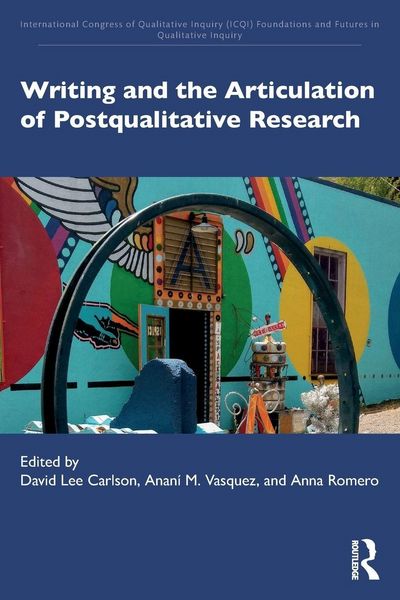
  • Produktbild: Writing and the Articulation of Postqualitative Research
  • Produktbild: Writing and the Articulation of Postqualitative Research

Writing and the Articulation of Postqualitative Research

59,99 €

inkl. gesetzl. MwSt., Versandkostenfrei


Beschreibung

Produktdetails

Einband

Taschenbuch

Erscheinungsdatum

25.04.2023

Abbildungen

schwarz-weiss Illustrationen, Raster, schwarz-weiss, Zeichnungen, schwarz-weiss

Herausgeber

David Lee Carlson + weitere

Verlag

Taylor & Francis

Seitenzahl

206

Maße (L/B/H)

23,4/15,6/1,1 cm

Gewicht

320 g

Sprache

Englisch

ISBN

978-1-03-224892-9

Beschreibung

Rezension

"This is anything but an academic text on writing. This collection, edited by Carlson, Vasquez, and Romero and featuring work from exciting and thought-provoking scholars, brings writing into the conceptual foreground, extending writing beyond its communicative potential. In this collection writing is stretched, explored, and experimented with for its methodologic, creative, and theoretical potential as a mode of qualitative inquiry. The collection reimagines what is possible and permissible for scholarly writing." -- Linda Knight, Associate Professor, School of Education, RMIT University, Australia

"Do we live our theories? Writing and the Articulation of Postqualitative Research worries the wound of theoretical writing, picking at the scab that too often covers up the burning concerns qualitative methods aim to uncover. Have we become too comfortable with the descriptions of how our work changes the field, forgetting to actively forge new ways, embolden new modes? This is an exciting experiment in other ways of living, which is to say, other ways of living our thinking." -- Erin Manning, Research Chair - Speculative Pragmatism, Art, and Pedagogy, Director, SenseLab, Concordia University, Canada

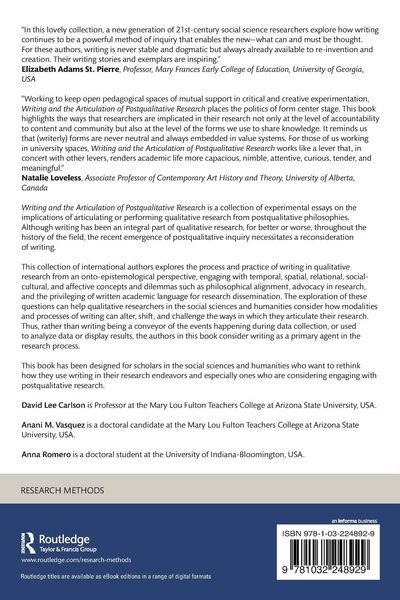
"In this lovely collection, a new generation of 21st century social science researchers explore how writing continues to be a powerful method of inquiry that enables the new-what can and must be thought. For these authors, writing is never stable and dogmatic but always already available to re-invention and creation. Their writing stories and exemplars are inspiring." -- Elizabeth Adams St. Pierre, Professor, Mary Frances Early College of Education, University of Georgia, USA

"This is a thoughtful and inspirational collection of essays on the art of writing in qualitative research. The scholars write with a kind of vulnerability that invites readers into generative thought about their own writing practices. The authors' words will send the reader to write with renewed vigor. A welcome addition to the literature on writing in qualitative research." -- Susan Nordstrom, Associate Professor of Qualitative Research Methodology, The University of Memphis, USA

"This collection of textual compositions is already changing Writing and the Articulation of Postqualitative Research. Each chapter takes writing seriously, interrogates it honestly, and questions it (ir)reverently. The book offers a quantum shift for Novice and experienced researchers, artists, and scholars" -- Francyne M. Huckaby, Associate Provost of Faculty Affairs, Texas Christian University, USA

"Working to keep open pedagogical spaces of mutual support in critical and creative experimentation, Writing and the Articulation of Postqualitative Research places the politics of form center stage. This book highlights the ways that researchers are implicated in their research not only at the level of accountability to content and community but also at the level of the forms we use to share knowledge. It reminds us that (writerly) forms are never neutral and always embedded in value systems. For those of us working in university spaces, Writing and the Articulation of Postqualitative Research works like a lever that, in concert with other levers, renders academic life more capacious, nimble, attentive, curious, tender, and meaningful." -- Natalie Loveless, Associate Professor of Contemporary Art History and Theory, University of Alberta, Canada

Produktdetails

Einband

Taschenbuch

Erscheinungsdatum

25.04.2023

Abbildungen

schwarz-weiss Illustrationen, Raster, schwarz-weiss, Zeichnungen, schwarz-weiss

Herausgeber

Verlag

Taylor & Francis

Seitenzahl

206

Maße (L/B/H)

23,4/15,6/1,1 cm

Gewicht

320 g

Sprache

Englisch

ISBN

978-1-03-224892-9

Herstelleradresse

Produktsicherheitsverantwortliche/r
Europaallee 1
36244 Bad Hersfeld
DE

Email: gpsr@libri.de

Kundinnen und Kunden meinen

0 Bewertungen

Informationen zu Bewertungen

Zur Abgabe einer Bewertung ist eine Anmeldung im Konto notwendig. Die Authentizität der Bewertungen wird von uns nicht überprüft. Wir behalten uns vor, Bewertungstexte, die unseren Richtlinien widersprechen, entsprechend zu kürzen oder zu löschen.

Die Bewertungen sind nach Format, Anzahl Sterne und Datum sortiert.

Verfassen Sie die erste Bewertung zu diesem Artikel

Helfen Sie anderen Kund*innen durch Ihre Meinung

Kundinnen und Kunden meinen

0 Bewertungen filtern

Die Leseprobe wird geladen.
  • Produktbild: Writing and the Articulation of Postqualitative Research
  • Produktbild: Writing and the Articulation of Postqualitative Research
  • 1. Re-Writing the Writer-Subject Qualitatively: A Philosophical Perspective  2. Measure for Measure for Measure: What Counts with Qualitative Research and Writing  3. Thinking-Writing (Pedagogically) Inspired by Post-Philosophies: A Qualitative(ly) Différance 4. In the Studio: Dance Pedagogies as Writing Pedagogies  5. "Genre Failing"  6. Writing Without Method  7. Writing as Uprootedness: Onto-Epistemological Considerations for Qualitative Research  8. Writing Qualitatively Through/With/As Disturbances  9. The Whirlwinds of Writing Qualitatively: From Warrior-Monk to Healing and Compassionate Detachment  10. Writing to Know: A Pathway to Self, Others, and the Social World  11. Writing with Feminist Materialists and Posthumanist Qualitative Inquiry  12. An Epistle Outlining My Queer-Feminist Orientation to Reading/Writing in Qualitative Research  13. Children's Creative Response to Bushfire Devastation and Deforestation Regeneration: An Analysis of an Emergent Curriculum and a Pedagogy of Hope  14. On Anti-Writing (Qualitatively)