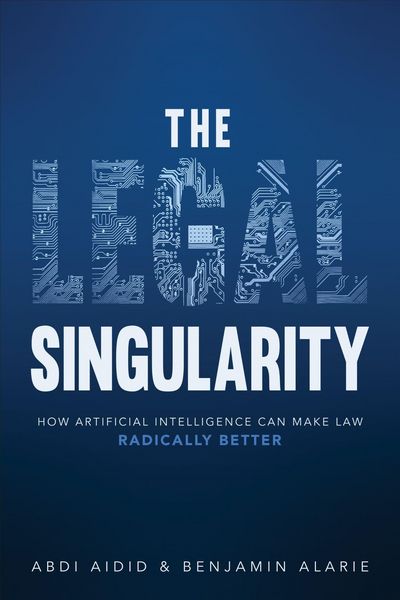
Produktbild: The Legal Singularity

The Legal Singularity How Artificial Intelligence Can Make Law Radically Better

32,99 €

inkl. gesetzl. MwSt., Versandkostenfrei


Beschreibung

Produktdetails

Einband

Gebundene Ausgabe

Erscheinungsdatum

04.07.2023

Verlag

University of Toronto Press

Seitenzahl

226

Maße (L/B/H)

22,9/15,2/1,8 cm

Gewicht

493 g

Sprache

Englisch

ISBN

978-1-4875-2941-3

Beschreibung

Produktdetails

Einband

Gebundene Ausgabe

Erscheinungsdatum

04.07.2023

Verlag

University of Toronto Press

Seitenzahl

226

Maße (L/B/H)

22,9/15,2/1,8 cm

Gewicht

493 g

Sprache

Englisch

ISBN

978-1-4875-2941-3

Herstelleradresse

Libri GmbH
Europaallee 1
36244 Bad Hersfeld
DE

Email: gpsr@libri.de

Noch keine Bewertungen vorhanden

Verfassen Sie die erste Bewertung zu diesem Artikel

Helfen Sie anderen Kundinnen und Kunden durch Ihre Meinung.

Kundinnen und Kunden meinen

Bewertungen (0)

Die Leseprobe wird geladen.
  • Produktbild: The Legal Singularity
  • 1. Introducing the Legal Singularity
    I. Introduction
    II. What Is the Legal Singularity?
    a. The Technological Singularity
    b. The Economic Singularity
    c. The Legal Singularity
    III. Hazards Ahead
    IV. Our Story and Objectives
    V. Orienting Ourselves
    VI. Towards the Legal Singularity

    2. The Nature of Legal Information
    I. Introduction
    II. The Centrality of Information to Law
    a. Law before Text
    b. Prediction and Law’s Information Environment
    III. Analogue, Digital, Computational
    a. The Analog Era
    b. The Digital Era
    IV. The New Information Environment
    a. Impact of Digitalization
    b. Access to Data and Access to Justice
    c. An Open Source Movement?

    3. Computational Law
    I. Introduction
    II. Understanding Artificial Intelligence
    III. Applying AI to the Law: Computational Law
    a. Should Law Be Computed?
    b. On "Computational Values"

    4. Complete Law
    I. Introduction
    II. Incomplete Law and Its Problems
    a. What Is Incomplete Law?
    b. In Search of Specificity
    c. Degradation of Legal Certainty
    III. How Computation Encourages Completeness
    IV. Complete, as in No Gaps - Not Complete, as in Done

    5. Defending the Legal Singularity from Its Critics
    I. Introduction
    II. Is Computational Law Reductionist?
    a. Pasquale, Hildebrandt, and Law’s Unquantifiable Essence
    b. Ideology, Social Context, and the Legal Singularity
    c. The Limits of Techno-Critique
    III. Does the Legal Singularity Threaten the Rule of Law?
    6. Implications for the Judiciary
    I. Introduction
    II. The Pitfalls of the Modern Judiciary
    a. Biases and Human Weaknesses
    b. Courthouse Overcrowding and Delayed Justice
    c. The Implications of Court Design
    III. Computational Solutions in the Courtroom
    a. Human Experts
    b. Legal Research
    c. Document Drafting
    d. Expert Evidence
    e. Changes to Fact-Finding Procedures
    f. Discovery
    g. Predictive Technology
    h. Case Management
    i. Fair Settlements
    IV. The Paradox of Judging in the Computational Era
    a. Beyond Physical Courtrooms and Human Judges
    i. Neural Laces
    ii. Online Courts and Dispute Resolution
    iii. Alternative Dispute Resolution
    V. Possible Roadblocks to Adoption 
    VI. Looking Ahead: The Evolution of the Judiciary

    7. Towards Universal Legal Literacy
    I. Introduction
    II. The Legal Profession’s Problem State
    a. Problem I: The Market for Legal Services
    i. The Unaffordability Problem
    ii. Consequences of Unaffordability
    iii. Responses to the Unaffordability Problem by the Legal Profession
    b. Problem II: Excessive Legal Complexity
    III. The Solution: Universal Legal Literacy
    a. Imagining Universal Legal Literacy
    b. Universal Legal Literacy in the Legal Singularity

    8. Implications for Governments
    I. Introduction
    II. Governments and Technology
    III. Artificially Intelligent Governments
    IV. Current Government Applications of AI
    V. Applications of AI in Service Provision and Regulation
    a. Tax Regulation
    b. Government Benefits Programs
    c. Immigration
    VI. Applications of AI in Legislation
    a. Drafting Legislation
    b. Normative Contributions and Second-Order Modelling

    9. Towards Ethical and Equitable Legal Prediction
    I. Introduction
    II. The Problem Framework
    a. Reflection and Amplification Problems
    b. Techno-Epistemic Problems

    10. Conclusion

    Afterword
    Acknowledgments
    Index