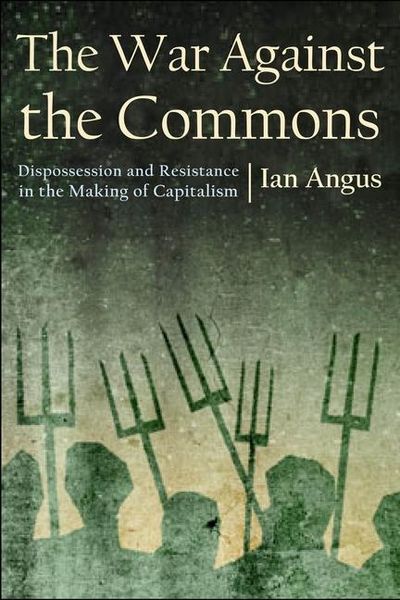
The War Against the Commons Dispossession and Resistance in the Making of Capitalism
-
- Taschenbuch ausgewählt
- eBook
-
Sprache:Englisch
26,99 €
inkl. gesetzl. MwSt.,
- Kostenlose Lieferung ab 30 € Einkaufswert
- Versandkostenfrei für Bonuscard-Kund*innen
Beschreibung
Produktdetails
Einband
Taschenbuch
Erscheinungsdatum
02.05.2023
Verlag
Monthly Review Press,U.S.Seitenzahl
248
Maße (L/B/H)
20,8/13,7/1,7 cm
Gewicht
368 g
Sprache
Englisch
ISBN
978-1-68590-016-8
A unique historical account of poor peoples' self-defence strategies in the face of the plunder of their lands and labor
For five centuries, the development of capitalism has been inextricably connected to the expropriation of working people from the land they depended on for subsistence. Through ruling class assaults known as enclosures or clearances, shared common land became privately-owned capital, and peasant farmers became propertyless laborers who could only survive by working for the owners of land or capital. As Ian Angus documents in The War Against the Commons, mass opposition to dispossession has never ceased. His dramatic account provides new insights into an opposition that ranged from stubborn non-compliance to open rebellion, including eyewitness accounts of campaigns in which thousands of protestors tore down fences and restored common access to pastures and forests. Such movements, he shows, led to the Diggers' call for a new society based on shared ownership and use of the land, an appeal that was more sophisticated and radical than anything else written before the 1800s. Contrary to many accounts that treat the reorganization of agriculture as a purely domestic matter, Angus shows that there were close connections between the enclosures in Britain and imperial expansion. The consolidation of some of the largest estates in England and Scotland was directly financed by the forced labor of African slaves and the colonial plunder of India. This unique historical account of ruling class robbery and poor peoples' resistance offers answers to key questions about the history of capitalism. Was enclosure a "necessary evil" that enabled economic growth? What role did deliberate promotion of hunger play in the creation of the working class? How did Marx and Engels view the separation of workers from the land, and how does resistance to enclosure continue in the 21st century?Noch keine Bewertungen vorhanden
Verfassen Sie die erste Bewertung zu diesem Artikel
Helfen Sie anderen Kundinnen und Kunden durch Ihre Meinung.
Kurze Frage zu unserer Seite
Vielen Dank für Ihr Feedback
Wir nutzen Ihr Feedback, um unsere Produktseiten zu verbessern. Bitte haben Sie Verständnis, dass wir Ihnen keine Rückmeldung geben können. Falls Sie Kontakt mit uns aufnehmen möchten, können Sie sich aber gerne an unseren Kund*innenservice wenden.
zum Kundenservice