KI-Beratung Beta

  • Produktbild: Climate Change and Ancient Societies in Europe and the Near East
  • Produktbild: Climate Change and Ancient Societies in Europe and the Near East
- 15%

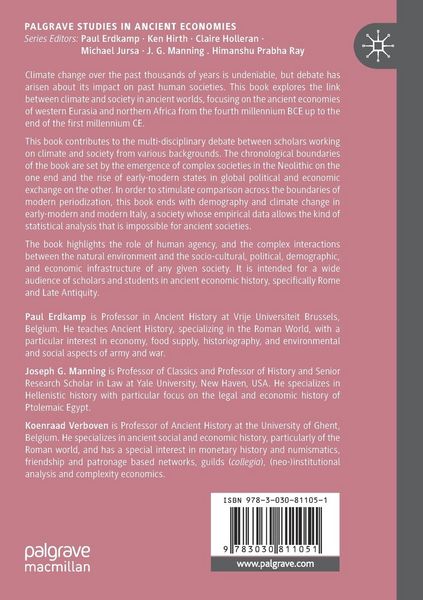
Climate Change and Ancient Societies in Europe and the Near East Diversity in Collapse and Resilience

15% sparen

166,99 € UVP 197,99 €

inkl. gesetzl. MwSt., Versandkostenfrei


Beschreibung

Produktdetails

Einband

Taschenbuch

Erscheinungsdatum

06.11.2022

Herausgeber

Paul Erdkamp + weitere

Verlag

Springer

Seitenzahl

623

Maße (L/B/H)

21/14,8/3,7 cm

Gewicht

865 g

Auflage

1st ed. 2021

Sprache

Englisch

ISBN

978-3-030-81105-1

Beschreibung

Portrait

Paul Erdkamp  is Professor in Ancient History at Vrije Universiteit Brussels, Belgium.  He teaches Ancient History, specializing in the Roman World, with a particular interest in economy, food supply, historiography, and environmental and social aspects of army and war.

Joseph G. Manning  is Professor of Classics and Professor of History and Senior Research Scholar in Law at Yale University, New Haven, USA.  He specializes in Hellenistic history with particular focus on the legal and economic history of Ptolemaic Egypt.

Koenraad Verboven  is Professor of Ancient History at the University of Ghent, Belgium. He specializes in ancient social and economic history, particularly of the Roman world, and has a special interest in monetary history and numismatics, friendship and patronage based networks, guilds ( collegia ), (neo-)institutional analysis and complexity economics.

Produktdetails

Einband

Taschenbuch

Erscheinungsdatum

06.11.2022

Herausgeber

Verlag

Springer

Seitenzahl

623

Maße (L/B/H)

21/14,8/3,7 cm

Gewicht

865 g

Auflage

1st ed. 2021

Sprache

Englisch

ISBN

978-3-030-81105-1

Herstelleradresse

Springer-Verlag GmbH
Tiergartenstr. 17
69121 Heidelberg
DE

Email: ProductSafety@springernature.com

Noch keine Bewertungen vorhanden

Verfassen Sie die erste Bewertung zu diesem Artikel

Helfen Sie anderen Kundinnen und Kunden durch Ihre Meinung.

Kundinnen und Kunden meinen

Bewertungen (0)

  • Produktbild: Climate Change and Ancient Societies in Europe and the Near East
  • Produktbild: Climate Change and Ancient Societies in Europe and the Near East
  • 1. Chapter 1: A historian’s introduction to paleoclimatology.- Chapter 2: A hard row to hoe. Climate change from the crop perspective.- Chapter 3: Who follows the elephant will have problems. Thought on modelling Roman responses to climate (changes).- Chapter 4: Famines, demographic crises and climate in Italy, 1650-1913.- Chapter 5: Collapse and resilience in prehistoric archaeology: Questioning concepts and causalities in models of climate-induced societal transformations.- Chapter 6: Climate, state building and political change in Egypt during the Early Bronze Age: a direct relation?.- Chapter 7: Vulnerability to climate change in Late Bronze Age Peloponnese (Greece).- Chapter 8: Saving up for a rainy day? Climate events, human-induced processes, and their potential effects on people’s coping strategies in the Mycenaean Argive Plain, Greece.- Chapter 9: Peloponnesian land-use dynamics and climate variability in the first millennium BCE.- Chapter 10: Volcanic eruptions, veiled Suns, and Nile failure in Egyptian history: Integrating hydroclimate into understandings of historical change.- Chapter 11: The environmental imperialism of the Roman Empire in northwestern Europe.- Chapter 12: Seasonal drought on Roman rivers: transport vs. irrigation.- Chapter 13: The Antonine crisis: Climate change as a potential trigger for epidemiological and economic turmoil.- Chapter 14: Climate change and the productive landscape in the Mediterranean region in the Roman period.- Chapter 15: Viticulture as a climate proxy for the Roman world? Global warming as a comparative framework for interpreting the ancient source material in Italy and the West (ca. 200 BC–AD 200).- Chapter 16: Risks for farming families in the Roman World.- Chapter 17: Figures in an imperial landscape. Ecological and societal factors on settlement patterns and agriculture in Roman Italy.- Chapter 18: Hydrological changes in Late Antiquity: spatio-temporal characteristics and socio-economic impacts in the Eastern Mediterranean.- Chapter 19: Resilience and adaptation at the end of Antiquity. An evaluation of the impact of climate change in Late Roman western-central Anatolia.- Chapter 20: The social metabolism of past societies. A new approach to environmental changes and societal responses in the territory of Sagalassos (Turkey).