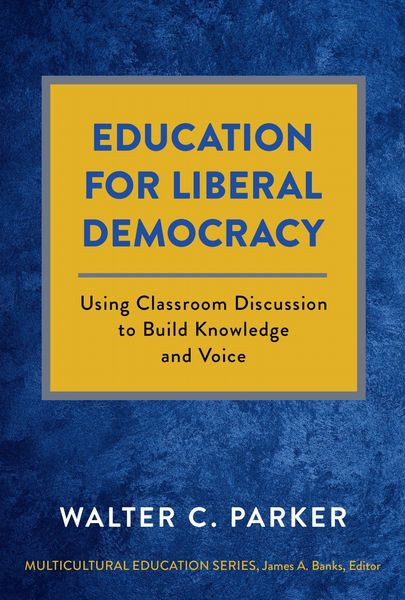
Education for Liberal Democracy Using Classroom Discussion to Build Knowledge and Voice
-
- Englisch ausgewählt
39,99 €
inkl. gesetzl. MwSt.,
Beschreibung
Produktdetails
Einband
Taschenbuch
Erscheinungsdatum
28.04.2023
Verlag
Teachers College PressSeitenzahl
224
Maße (L/B/H)
22,1/16/1,8 cm
Gewicht
295 g
Sprache
Englisch
ISBN
978-0-8077-6818-1
Our democracy is in crisis. Both political trust and a shared standard of truth are broken. In this book, Walter Parker shows why and how a civic education can help. Offering a centrist approach suitable for a polarized society, Parker focuses on two linked curriculum objectives: disciplinary knowledge and voice. He illustrates how classroom discussion, alongside concept formation and deep reading, expand students' minds while developing their ability to speak with others and form opinions. When children come to school, they emerge from the private chrysalis of babyhood and kin to interact with a diverse student body along with teachers, curriculum, instruction, and the school's unique mission: education. Parker argues that these assets make school the ideal place to teach young people the liberal arts of studying and discussing public issues and academic controversies, both in and beyond school. The chapters in this collection, spanning 20 years and coming from one of civic education's most influential scholars, show that voice can be taught right alongside disciplinary knowledge. Drawing students into dialogue with one another on the curriculum's central questions is a teacher's most ambitious goal and, when it happens, teaching's greatest accomplishment.
Book Features:
- Argues that the proper aim of civic education in schools is to shore up liberal democracy.
- Shows how discussion can be a main course, and not a side dish, of classroom instruction.
- Demonstrates how to use discussion to develop voice, defined as the freedom to make and express uncoerced decisions, and disciplinary knowledge, defined as the knowledge that results from a public process of error-seeking, contestation, and validation.
- Explains why students need to learn both disciplinary knowledge and voice if they are to take their place on the public stage and hold the "office of citizen" in a democracy.
- Treats subject-centered and student-centered instruction as partners, not opponents.
Noch keine Bewertungen vorhanden
Verfassen Sie die erste Bewertung zu diesem Artikel
Helfen Sie anderen Kundinnen und Kunden durch Ihre Meinung.
Kurze Frage zu unserer Seite
Vielen Dank für Ihr Feedback
Wir nutzen Ihr Feedback, um unsere Produktseiten zu verbessern. Bitte haben Sie Verständnis, dass wir Ihnen keine Rückmeldung geben können. Falls Sie Kontakt mit uns aufnehmen möchten, können Sie sich aber gerne an unseren Kund*innenservice wenden.
zum Kundenservice