Gutscheinbedingungen

**Gültig bis 06.07.2026 auf fremdsprachige Bücher online auf thalia.at, in der Thalia App ab einem Mindestbestellwert von 30€ und in allen Thalia Buchhandlungen in Österreich. In den Buchhandlungen nur gültig auf lagernde Ware. Einzelne Artikel können ausgeschlossen sein. Ausgenommen sind preisgebundene Artikel & eBooks. Pro Einkauf einmal einlösbar. Nur gültig gegen Vorlage oder im Onlineshop hinterlegter Bonuscard. Infos zur Einlösung in der Buchhandlung sind auf der Bonuscard-Vorteilspreisseite zu finden. Click & Collect nur bei Onlinevorabzahlung möglich. Keine Einlösung bei Scan & Go-Bezahlung. Keine Barauszahlung. Nicht kombinierbar mit anderen Aktionen und Gutscheinen. Gutschein wird auf max. 500€ Bestellwert angerechnet. Nicht gültig für Versandkosten und Services.

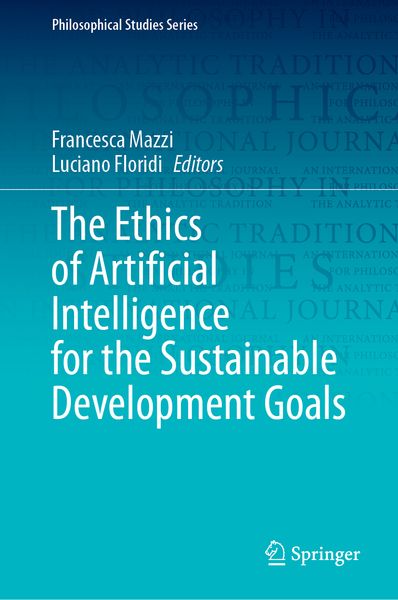
  • Produktbild: The Ethics of Artificial Intelligence for the Sustainable Development Goals
  • Produktbild: The Ethics of Artificial Intelligence for the Sustainable Development Goals
Band 152 - 16%

The Ethics of Artificial Intelligence for the Sustainable Development Goals

16% sparen

127,99 € UVP 153,99 €

inkl. gesetzl. MwSt., Versandkostenfrei


Beschreibung

Produktdetails

Einband

Gebundene Ausgabe

Erscheinungsdatum

04.05.2023

Herausgeber

Francesca Mazzi + weitere

Verlag

Springer

Seitenzahl

490

Maße (L/B/H)

24,1/16/3,3 cm

Gewicht

916 g

Sprache

Englisch

ISBN

978-3-031-21146-1

Beschreibung

Portrait

Francesca Mazzi is a postdoctoral research fellow in AI and Sustainable Development at Saïd Business School, University of Oxford, and a research associate at the Digital Ethics Lab of the Oxford Internet Institute, University of Oxford. She is part of the Oxford Initiative on AI×SDGs, aimed at investigating how artificial intelligence (AI) has been and can in the future be used to support and advance the United Nations Sustainable Development Goals (SDGs). In her research, Francesca analyses existing AI for SDGs projects to map best practices, lessons learned, eventual gaps and potential solutions for the purpose of helping existing and future, public and private stakeholders operating within the sustainable development space. Her research interests range from the intersections between technology, law, and ethics, to policymaking and regulations in relation to challenges and opportunities arising in the Fourth Industrial Revolution era. From 2017 to 2020she was a Marie Sklodowska-Curie Early Stage Researcher within the EIPIN- Innovation Society in a double doctorate program between Queen Mary University of London and Maastricht University. The Ph.D. research project concerned the patentability of AI generated inventions and a case study on the pharmaceutical industry, with two partner organizations, Hovione and the European Federation of Pharmaceutical Industries and Associations. Francesca obtained the CIPP/E (Certified Information Privacy Professional/Europe) Certification from the International Association of Privacy Professionals in April 2018. She holds a LL.M. in computer and communication law from Queen Mary University of London, and a master’s degree in law from Luiss Guido Carli University. She is a qualified lawyer in Italy.

Luciano Floridi is Professor of Philosophy and Ethics of Information at the University of Oxford, where he is Director of the Digital Ethics Lab of the Oxford Internet Institute, and Fellowof Exeter College. He is also Fellow of the Alan Turing Institute, of the Academy of Social Sciences, of the British Computer Society and of the AIBS (the Society for the Study of Artificial Intelligence and the Simulation of Behaviour) and Member of the Académie Internationale de Philosophie des Sciences. His current commitments include being Chair of Ethics Committee of Digital Catapult, the UK Innovation Programme, and member of several organisations, including the Board of the UK Centre for Data Ethics and Innovation. His areas of expertise include digital ethics, the ethics of AI, the philosophy of information, and the philosophy of technology, topics on which he is an internationally renowned authority and has published more than 300 works. They have bene translated into many languages, including Arabic, Chinese, Croatian, Czech, French, German, Greek, Hungarian, Italian, Japanese, Latvian, Macedonian, Persian, Polish, Portuguese, Russian, and Spanish. Among his recent books, all published by Oxford University Press: The Logic of Information (2019), The Fourth Revolution - How the infosphere is reshaping human reality (2014), winner of the J. Ong Award; The Ethics of Information (2013); and The Philosophy of Information (2011). He has received many recognitions, including the Barwise Prize, the Gauss Professorship of the Akademie der Wissenschaften of Göttingen, the Covey Award, the Weizenbaum Award, the J. Ong Award, IBM’s Thinker Award, Premio Aretè, CogX Award, and Premio Socrate, among others.

Produktdetails

Einband

Gebundene Ausgabe

Erscheinungsdatum

04.05.2023

Herausgeber

Verlag

Springer

Seitenzahl

490

Maße (L/B/H)

24,1/16/3,3 cm

Gewicht

916 g

Sprache

Englisch

ISBN

978-3-031-21146-1

Herstelleradresse

Springer-Verlag KG
Sachsenplatz 4-6
1201 Wien
AT

Email: GPSR Kontakt

Noch keine Bewertungen vorhanden

Verfassen Sie die erste Bewertung zu diesem Artikel

Helfen Sie anderen Kundinnen und Kunden durch Ihre Meinung.

Kundinnen und Kunden meinen

Bewertungen (0)

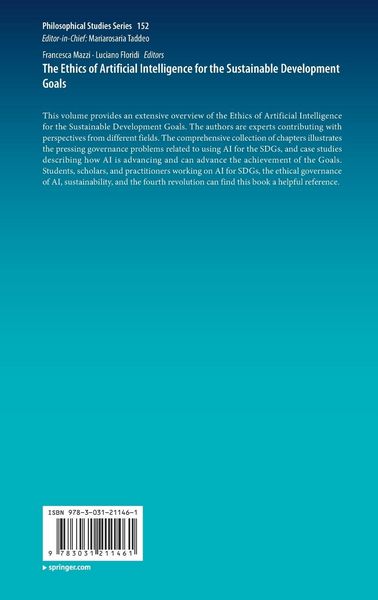
  • Produktbild: The Ethics of Artificial Intelligence for the Sustainable Development Goals
  • Produktbild: The Ethics of Artificial Intelligence for the Sustainable Development Goals
  • Preface.- General Part.- Chapter 1. Setting the scene: Artificial Intelligence for the Sustainable Development Goals.- Chapter 2. The Golden rules for ethical AI.- Chapter 3. AIxSDGs projects.- Chapter 4. Business model desirable to incentivise AIxSDGs projects.- Chapter 5. AI helping decision-making processes to achieve the SDGs.- Chapter 6. AI and circular economy for SDGs.- Chapter 7. Analysis of SDGs that mostly benefitted from an AI approach.- Chapter 8. AI for sustainable industrial growth.- Chapter 9. Case studies on AI for clear water and sanitation.- Chapter 10. The potential of AI for education.