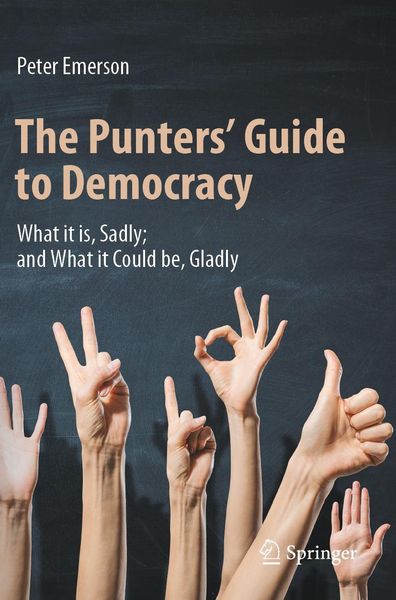
The Punters' Guide to Democracy What it is, Sadly; and What it Could be, Gladly
-
- Taschenbuch
- eBook ausgewählt
-
Form:Einzelkauf Download
-
Sprache:Englisch
36,29 €
inkl. gesetzl. MwSt.Beschreibung
Produktdetails
Format
Kopierschutz
Nein
Family Sharing
Nein
Text-to-Speech
Nein
Erscheinungsdatum
05.10.2022
Verlag
Springer Nature SwitzerlandSeitenzahl
135 (Printausgabe)
Dateigröße
3213 KB
Sprache
Englisch
EAN
9783031069871
This book discusses multiple ways of voting in a democratic system and explains the basis of more consensual politics. Without delving into too much technical argument or too many mathematical examples, it aims to
- show that binary decision-making is blunt, primitive, divisive, and sometimes inaccurate;
- prove that other methodologies are more accurate and, therefore, more democratic;
- highlight more inclusive and effective voting procedures;
- discuss electoral reforms for national parliaments and international forums like the UN Security Council and COP26/27.
The book is written not just for academia, or for the politicians and journalists, or for other specialists; it is for the general public: for students still at school, for voters in society at large, and for activists in umpteen NGOs.
"...the West's relentless pursuit of binary voting... has been a cause of countless tragedies. This book is brilliant: political controversies should rarely if ever be 'resolved' by majority vote."
Arend Lijphart, Professor Emeritus of Political Science, University of California, San Diego
"[for] those who do not believe in a black-or-white world... a very important and extremely timely contribution..."
Vera Stojarová, Associate Professor of Political Science, Masaryk University, Brno, Czech Republic
"Peter's challenge to the binary "win-lose" approach is urgently necessary, as is his proposal for an eminently more reasonable, accountable, and participatory system."
Dr. Valery Perry, Democratization Policy Council, Sarajevo
"...the preferential points vote... would be the more accurate way to make decisions, and the consequences far more peaceful."
Lord Boyce, House of Lords
"He builds a case for a specific version of preferential procedure, not only for elections, but for decision making as well."
Hannu Nurmi, Professor Emeritus of Political Science, University of Turku, Finland
"A particularly strong plea in favour of voting procedures... which go far beyond the usual 'yes or no' ballots. [He uses] an alert prose and a wealth of illuminating and easily graspable examples."
Maurice Salles, Emeritus Professor, Université de Caen Normandie
Noch keine Bewertungen vorhanden
Verfassen Sie die erste Bewertung zu diesem Artikel
Helfen Sie anderen Kundinnen und Kunden durch Ihre Meinung.
Kurze Frage zu unserer Seite
Vielen Dank für Ihr Feedback
Wir nutzen Ihr Feedback, um unsere Produktseiten zu verbessern. Bitte haben Sie Verständnis, dass wir Ihnen keine Rückmeldung geben können. Falls Sie Kontakt mit uns aufnehmen möchten, können Sie sich aber gerne an unseren Kund*innenservice wenden.
zum Kundenservice