Gutscheinbedingungen

**Gültig bis 22.07.2026 ab einem Mindestbestellwert von 40€ auf Spielzeug, Schreibwaren, Filme, Geschenke & Trends, Musik, tolino eReader & Zubehör, Hörbücher und Hörbuch-Downloads (außer Abo), nicht preisgebundene Bücher und Kalender online auf thalia.at und in der Thalia App. Einzelne Artikel können ausgeschlossen sein. Aufgrund der Buchpreisbindung sind deutschsprachige Bücher und eBooks ausgenommen. Zusätzlich ausgenommen sind preisgebundene Artikel, Abos & Flatrates, eBooks, Games, Geschenkkarten/-boxen, Shelfies, Software, Zeitschriften sowie einzelne Artikel von tonies®. Pro Einkauf einmal einlösbar. Click & Collect nur bei Onlinevorabzahlung möglich. Keine Barauszahlung. Nicht kombinierbar mit anderen Aktionen und Gutscheinen. Gutschein wird auf max. 500€ Bestellwert angerechnet. Nicht gültig für Versandkosten und Services. Preisgebundene Artikel sind vom Mindestbestellwert ausgeschlossen.

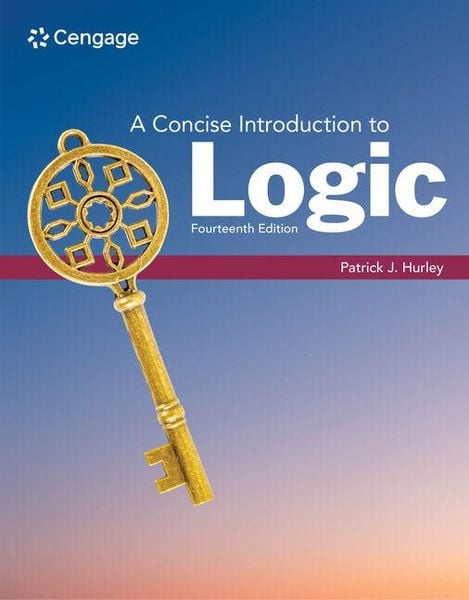
Produktbild: A Concise Introduction to Logic

A Concise Introduction to Logic

129,99 €

inkl. gesetzl. MwSt., Versandkostenfrei


Beschreibung

Produktdetails

Einband

Taschenbuch

Erscheinungsdatum

30.03.2023

Verlag

Cengage Learning

Seitenzahl

752

Maße (L/B/H)

20,4/23,1/2,8 cm

Gewicht

1082 g

Auflage

14. Auflage

Sprache

Englisch

ISBN

978-0-357-79868-3

Beschreibung

Produktdetails

Einband

Taschenbuch

Erscheinungsdatum

30.03.2023

Verlag

Cengage Learning

Seitenzahl

752

Maße (L/B/H)

20,4/23,1/2,8 cm

Gewicht

1082 g

Auflage

14. Auflage

Sprache

Englisch

ISBN

978-0-357-79868-3

Herstelleradresse

Libri GmbH
Europaallee 1
36244 Bad Hersfeld
DE

Email: gpsr@libri.de

Noch keine Bewertungen vorhanden

Verfassen Sie die erste Bewertung zu diesem Artikel

Helfen Sie anderen Kundinnen und Kunden durch Ihre Meinung.

Kundinnen und Kunden meinen

Bewertungen (0)

  • Produktbild: A Concise Introduction to Logic
  • Part I: INFORMAL LOGIC. 1. Basic Concepts. Arguments, Premises, and Conclusions. Exercise. Recognizing Arguments. Exercise. Deduction and Induction. Exercise. Validity, Truth, Soundness, Strength, Cogency. Exercise. Argument Forms: Proving Invalidity. Exercise. Extended Arguments. Exercise. 2. Language: Meaning and Definition. Varieties of Meaning. Exercise. The Intension and Extension of Terms. Exercise. Definitions and Their Purposes. Exercise. Definitional Techniques. Exercise. Criteria for Lexical Definitions. Exercise. 3. Informal Fallacies. Fallacies in General. Exercise. Fallacies of Relevance. Exercise. Fallacies of Weak Induction. Exercise. Fallacies of Presumption, Ambiguity, and Illicit Transference. Exercise. Fallacies in Ordinary Language. Exercise. Part II: FORMAL LOGIC. 4. Categorical Propositions. The Components of Categorical Propositions. Exercise. Quality, Quantity, and Distribution. Exercise. Venn Diagrams and the Modern Square of Opposition. Exercise. Conversion, Obversion, and Contraposition. Exercise. The Traditional Square of Opposition. Exercise. Venn Diagrams and the Traditional Standpoint. Exercise. Translating Ordinary Language Statements into Categorical Form. Exercise. 5. Categorical Syllogisms. Standard Form, Mood, and Figure. Exercise. Venn Diagrams. Exercise. Rules and Fallacies. Exercise. Reducing the Number of Terms. Exercise. Ordinary Language Arguments. Exercise. Enthymemes. Exercise. Sorites. Exercise. 6. Propositional Logic. Symbols and Translation. Exercise. Truth Functions. Exercise. Truth Tables for Propositions. Exercise. Truth Tables for Arguments. Exercise. Indirect Truth Tables. Exercise. Argument Forms and Fallacies. Exercise. 7. Natural Deduction in Propositional Logic. Rules of Implication I. Exercise. Rules of Implication II. Exercise. Rules of Replacement I. Exercise. Rules of Replacement II. Exercise. Conditional Proof. Exercise. Indirect Proof. Exercise. Proving Logical Truths. Exercise. 8. Predicate Logic. Symbols and Translation. Exercise. Using the Rules of Inference. Exercise. Quantifier Negation Rule. Exercise. Conditional and Indirect Proof. Exercise. Proving Invalidity. Exercise. Relational Predicates and Overlapping Quantifiers. Exercise. Identity. Exercise. Part III: INDUCTIVE LOGIC. 9. Analogy and Legal and Moral Reasoning. Analogical Reasoning. Legal Reasoning. Moral Reasoning. Exercise. 10. Causality and Mill's Methods. "Cause" and Necessary and Sufficient Conditions. Mill's Five Methods. Mill's Methods and Science. Exercise. 11. Probability. Theories of Probability. The Probability Calculus. Exercise. 12. Statistical Reasoning. Evaluating Statistics. Samples. The Meaning of "Average." Dispersion. Graphs and Pictograms. Percentages. Exercise. 13. Hypothetical/Scientific Reasoning. The Hypothetical Method. Hypothetical Reasoning: Four Examples from Science. The Proof of Hypotheses. The Tentative Acceptance of Hypotheses. Exercise. 14. Science and Superstition. Distinguishing Between Science and Superstition. Evidentiary Support. Objectivity. Integrity. Abusing Science. Exercise. Answers to Selected Exercises. Glossary/Index.