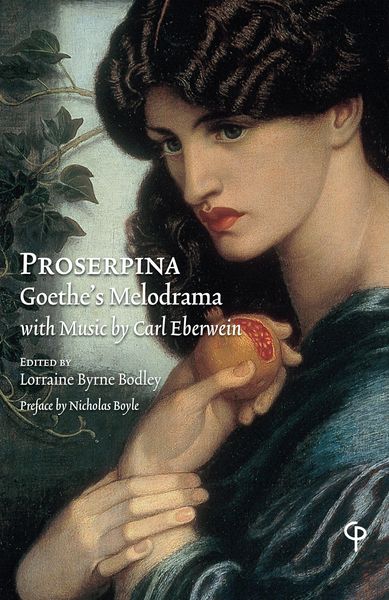
Proserpina Goethe's Melodrama with Music by Carl Eberwein, Orchestral Score, Piano Reduction, and Translation
-
- Taschenbuch
- eBook ausgewählt
-
Form:Einzelkauf Download
-
Sprache:Englisch
-
eBook Format:PDF
- PDF 36,50 € ausgewählt
- ePUB 36,00 €
36,50 €
inkl. gesetzl. MwSt.Beschreibung
Produktdetails
Format
Kopierschutz
Ja
Family Sharing
Nein
Text-to-Speech
Nein
Erscheinungsdatum
09.04.2020
Herausgeber
Lorraine Byrne BodleyVerlag
Peter Lang Ltd, International Academic PublishersSeitenzahl
240 (Printausgabe)
Dateigröße
3671 KB
Auflage
1. Auflage
Sprache
Englisch
EAN
9781789970944
In his early twenties Goethe wrote Proserpina for the Weimar court singer Corona Schröter to perform. His interest in presenting Weimar's first professional singer-inresidence in a favourable light was not the only reason why this monologue with music (now lost) by Seckendorff is important. Goethe's memories of his sister Cornelia, who had recently died in childbirth, were in fact the real catalyst: through this work Goethe could level accusations against his parents about Cornelia's marriage, of which he had not approved. Goethe used the melodramatic form to transform private and cultural issues for women of the time into public discourses and so to manipulate public opinion. His work reveals an astute understanding of musical melodrama and the important impact it had on the cultural dynamics of the late eighteenth and early nineteenth centuries.
Whatever the source of inspiration, it is clear that Goethe was very preoccupied with Proserpina. When he returned to this melodrama forty years later he collaborated closely with Carl Eberwein, the court, theatre, and church music director, who composed a new setting which accords with Goethe's clear understanding of musical declamation in 19th century melodrama. In the intensive collaboration which took place while the production was being prepared in January 1815, Goethe was already anticipating the idea of a Gesamtkunstwerk. He paid close attention to every aspect of the production, especially to its music and its staging. When discussing contemporary settings of the poet's works, scholars often lapse into regret that Goethe did not have someone of comparable rank at his side for musical collaborations. Yet Eberwein's willingness to go along with Goethe's wishes was an advantage here: the selfless striving of the young composer to satisfy the poet's intentions is everywhere apparent in the score and it is the nearest thing we have to a 'composition by Goethe'.
Despite critics' positive reception of the first performance on 4 February 1815, the work has never been published before. Musically and dramatically this unknown melodrama is a superb work for solo voice, choir, and orchestra, and deserves to be brought before the public today.
Noch keine Bewertungen vorhanden
Verfassen Sie die erste Bewertung zu diesem Artikel
Helfen Sie anderen Kundinnen und Kunden durch Ihre Meinung.
Kurze Frage zu unserer Seite
Vielen Dank für Ihr Feedback
Wir nutzen Ihr Feedback, um unsere Produktseiten zu verbessern. Bitte haben Sie Verständnis, dass wir Ihnen keine Rückmeldung geben können. Falls Sie Kontakt mit uns aufnehmen möchten, können Sie sich aber gerne an unseren Kund*innenservice wenden.
zum Kundenservice