KI-Beratung Beta

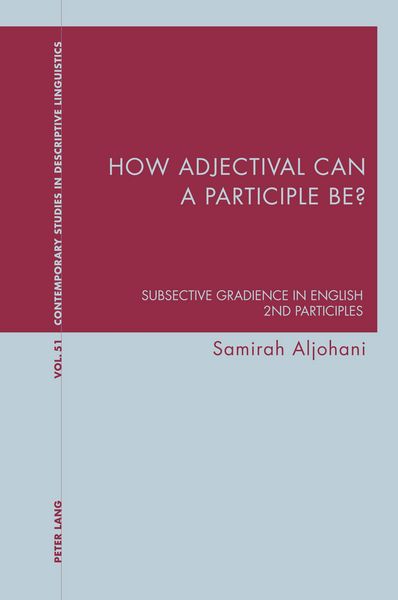
Produktbild: How adjectival can a participle be?
Band 51

How adjectival can a participle be? Subsective Gradience in English 2nd Participles

83,30 €

inkl. gesetzl. MwSt.

Beschreibung

«This book takes theoretical linguistics by storm, moving our understanding of the passive construction onto a whole new level. Samirah Aljohani puts the adjectival passive under the empirical lexico-grammatical microscope, producing numbers which both dazzle and clarify. Inspired science from copious...

Beschreibung

«This book takes theoretical linguistics by storm, moving our understanding of the passive construction onto a whole new level. Samirah Aljohani puts the adjectival passive under the empirical lexico-grammatical microscope, producing numbers which both dazzle and clarify. Inspired science from copious data presented in an accessible style - absolutely brilliant!» (Dr Christopher Beedham, University of St Andrews, Scotland)

Most analyses of the English passive (formed with be + V-ed) claim that there is a verbal passive and an adjectival passive. How can the same form express polar opposite meanings? This study of the adjectival passive reconciles the contradiction using Christopher Beedham's aspect analysis of the passive, in which the so-called actional passive (verbal passive) is said to express an action and its resultant state.

In the study, the author presented approximately one thousand 2nd participles, mainly from transitive verbs, to three native speaker informants in putative noun phrases such as an accepted practice and putative clauses with un-, such as It is unaccepted, and asked the informants to say if they are grammatical, ungrammatical or borderline. She also interrogated her participles in the British National Corpus for their adjectival properties. In this way, she arrived at five adjective-like properties which a 2nd participle can have. Finally, she put her participles into eight groups, ranging from «0% state, 100% action» to «50% state, 50% action», depending on how many and which of the five adjective-like properties they can exhibit. The result is a new gradient scale of adjectival passives.

Produktdetails

Format

PDF

Kopierschutz

Ja

Family Sharing

Nein

Text-to-Speech

Nein

Produktdetails

Format

PDF

Format

eBooks im PDF-Format haben eine festgelegte Seitengröße und eignen sich daher nur bedingt zum Lesen auf einem tolino eReader oder Smartphone. Für den vollen Lesegenuss empfehlen wir Ihnen bei PDF-eBooks die Verwendung eines Tablets oder Computers.

Kopierschutz

Ja

Kopierschutz

Zum Lesen dieses eBooks auf Geräten der tolino Familie sowie auf sonstigen eReadern und am PC benötigen Sie eine ByteBook-ID. Weitere Hinweise zum Lesen von kopiergeschützten eBooks finden Sie unter Hilfe/Downloads.

Family Sharing

Nein

Family Sharing

Mit Family Sharing können Sie eBooks innerhalb Ihrer Familie (max. sechs Mitglieder im gleichen Haushalt) teilen. Sie entscheiden selbst, welches Buch Sie mit welchem Familienmitglied teilen möchten. Auch das parallele Lesen durch verschiedene Familienmitglieder ist durch Family Sharing möglich. Um eBooks zu teilen oder geteilt zu bekommen, muss jedes Familienmitglied ein Konto bei Thalia oder einem anderen tolino-Buchhändler haben. Weitere Informationen finden Sie unter Hilfe/Family-Sharing.

Text-to-Speech

Nein

Text-to-Speech

Bedeutet Ihnen Stimme mehr als Text? Mit der Funktion Text-to-Speech können Sie sich im tolino webReader und in der aktuellen Thalia – Lesen & Hören App das eBook vorlesen lassen. Weitere Informationen finden Sie unter Hilfe/Text-to-Speech.

Erscheinungsdatum

12.05.2022

Verlag Peter Lang Inc., International Academic Publishers
Seitenzahl

438 (Printausgabe)

Dateigröße

47603 KB

Auflage

1. Auflage

Sprache

Englisch

EAN

9781800795259

Barrierefreiheit
  • keine Information zur Barrierefreiheit bekannt

Noch keine Bewertungen vorhanden

Verfassen Sie die erste Bewertung zu diesem Artikel

Helfen Sie anderen Kundinnen und Kunden durch Ihre Meinung.

Kundinnen und Kunden meinen

Bewertungen (0)

Weitere Artikel finden Sie in

Die Leseprobe wird geladen.
  • Produktbild: How adjectival can a participle be?