KI-Beratung Beta

Gutscheinbedingungen

**Gültig bis 18.11.2026 auf englischsprachige Klassiker (klassiker-32728) online auf thalia.at und in der Thalia App. Einzelne Artikel können ausgeschlossen sein. Ausgenommen sind preisgebundene Artikel & eBooks. Pro Einkauf einmal einlösbar. Click & Collect nur bei Onlinevorabzahlung möglich. Keine Barauszahlung. Nicht kombinierbar mit anderen Aktionen und Gutscheinen. Gutschein wird auf max. 500€ Bestellwert angerechnet. Nicht gültig für Geschenkkarten, Versandkosten und Services.

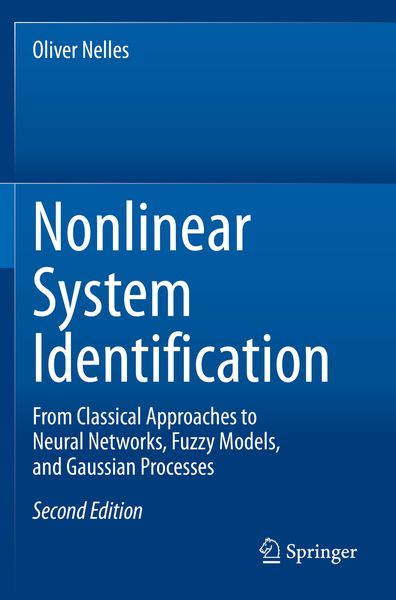
Produktbild: Nonlinear System Identification

Nonlinear System Identification From Classical Approaches to Neural Networks, Fuzzy Models, and Gaussian Processes

95,99 €

inkl. gesetzl. MwSt., Versandkostenfrei


Beschreibung

This book provides engineers and scientists in academia and industry with a thorough understanding of the underlying principles of nonlinear system identification. It equips them to apply the models and methods discussed to real problems with confidence, while also making them aware of potential difficulties...

Beschreibung

This book provides engineers and scientists in academia and industry with a thorough understanding of the underlying principles of nonlinear system identification. It equips them to apply the models and methods discussed to real problems with confidence, while also making them aware of potential difficulties that may arise in practice. 

Moreover, the book is self-contained, requiring only a basic grasp of matrix algebra, signals and systems, and statistics. Accordingly, it can also serve as an introduction to linear system identification, and provides a practical overview of the major optimization methods used in engineering. The focus is on gaining an intuitive understanding of the subject and the practical application of the techniques discussed. The book is not written in a theorem/proof style; instead, the mathematics is kept to a minimum, and the ideas covered are illustrated with numerous figures, examples, and real-world applications. 

In the past, nonlinear system identification was a field characterized by a variety of ad-hoc approaches, each applicable only to a very limited class of systems. With the advent of neural networks, fuzzy models, Gaussian process models, and modern structure optimization techniques, a much broader class of systems can now be handled. Although one major aspect of nonlinear systems is that virtually every one is unique, tools have since been developed that allow each approach to be applied to a wide variety of systems.


Produktdetails

Einband

Taschenbuch

Erscheinungsdatum

02.10.2023

Abbildungen

XXVIII, 1225 p. 161 illus. in color.

Verlag Springer

Produktdetails

Einband

Taschenbuch

Erscheinungsdatum

02.10.2023

Abbildungen

XXVIII, 1225 p. 161 illus. in color.

Verlag Springer
Seitenzahl

1225

Maße (B/H)

15,5/23,5 cm

Gewicht

2060 g

Auflage

Second Edition 2020

Sprache

Englisch

ISBN

978-3-030-47441-6

Herstelleradresse

Springer Nature Customer Service Center GmbH
Europaplatz 3
69115 Heidelberg
DE
ProductSafety@springernature.com

Noch keine Bewertungen vorhanden

Verfassen Sie die erste Bewertung zu diesem Artikel

Helfen Sie anderen Kundinnen und Kunden durch Ihre Meinung.

Kundinnen und Kunden meinen

Bewertungen (0)

  • Produktbild: Nonlinear System Identification
  • Introduction.- Part One Optimization.- Introduction to Optimization.- Linear Optimization.- Nonlinear Local Optimization.- Nonlinear Global Optimization.- Unsupervised Learning Techniques.- Model Complexity Optimization.- Summary of Part 1.- Part Two Static Models.- Introduction to Static Models.- Linear, Polynomial, and Look-Up Table Models.- Neural Networks.- Fuzzy and Neuro-Fuzzy Models.- Local Linear Neuro-Fuzzy Models: Fundamentals.- Local Linear Neuro-Fuzzy Models: Advanced Aspects.- Input Selection for Local Model Approaches.- Gaussian Process Models (GPMs).- Summary of Part Two.- Part Three Dynamic Models.- Linear Dynamic System Identification.- Nonlinear Dynamic System Identification.- Classical Polynomial Approaches.-Dynamic Neural and Fuzzy Models.- Dynamic Local Linear Neuro-Fuzzy Models.- Neural Networks with Internal Dynamics.- Part Five Applications.- Applications of Static Models.- Applications of Dynamic Models.- Desing of Experiments.- Input Selection Applications.- Applications of Advanced Methods.- LMN Toolbox.- Vectors and Matrices.- Statistics.- Reference.- Index.