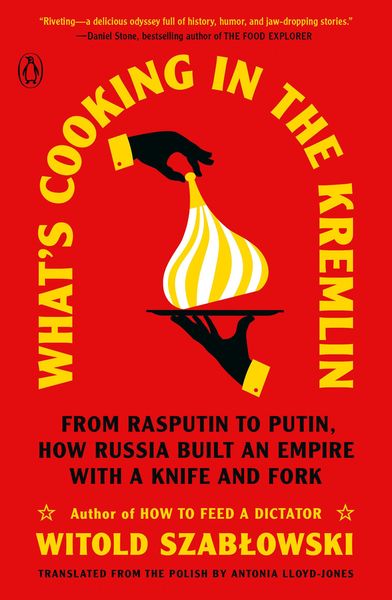
What's Cooking in the Kremlin From Rasputin to Putin, How Russia Built an Empire with a Knife and Fork
-
- Hardcover
- Taschenbuch ausgewählt
- eBook
-
Sprache:Englisch
-
Verlag:Random House N.Y.
- Icon Books 11,99 €
- Random House N.Y. 18,99 € ausgewählt
18,99 €
inkl. gesetzl. MwSt.,
- Kostenlose Lieferung ab 30 € Einkaufswert
- Versandkostenfrei für Bonuscard-Kund*innen
Beschreibung
Produktdetails
Einband
Taschenbuch
Erscheinungsdatum
07.11.2023
Verlag
Random House N.Y.Seitenzahl
384
Maße (L/B/H)
19,3/12,8/2,1 cm
Gewicht
255 g
Übersetzt von
Antonia Lloyd-Jones
Sprache
Englisch
ISBN
978-0-14-313718-4
“Riveting—a delicious odyssey full of history, humor, and jaw-dropping stories. If you want to understand the making of modern Russia, read this book.” —Daniel Stone, bestselling author of The Food Explorer
A high-spirited, eye-opening, appetite-whetting culinary travel adventure that tells the story of the last hundred years of Russian power through food, by an award-winning Polish journalist who’s been praised by both Timothy Snyder and Bill Buford
In the gonzo spirit of Anthony Bourdain and Hunter S. Thompson, Witold Szabłowski has tracked down—and broken bread with—people whose stories of working in Kremlin kitchens impart a surprising flavor to our understanding of one of the world’s superpowers.
In revealing what Tsar Nicholas II’s and Lenin’s favorite meals were, why Stalin’s cook taught Gorbachev’s cook to sing to his dough, how Stalin had a food tester while he was starving the Ukrainians during the Great Famine, what the recipe was for the first soup flown into outer space, why Brezhnev hated caviar, what was served to the Soviet Union’s leaders at the very moment they decided the USSR should cease to exist, and whether Putin’s grandfather really did cook for Lenin and Stalin, Szabłowski has written a fascinating oral history—complete with recipes and photos—of Russia’s evolution from culinary indifference to decadence, famine to feasts, and of the Kremlin’s Olympics-style preoccupation with food as an expression of the country’s global standing.
Traveling across Stalin’s Georgia, the war fronts of Afghanistan, the nuclear wastelands of Chornobyl, and even to a besieged steelworks plant in Mariupol—often with one-of-a-kind access to locales forbidden to foreign eyes, and with a rousing sense of adventure and an inimitable ability to get people to spill the tea—he shows that a century after the revolution, Russia still uses food as an instrument of war and feeds its people on propaganda.
Noch keine Bewertungen vorhanden
Verfassen Sie die erste Bewertung zu diesem Artikel
Helfen Sie anderen Kundinnen und Kunden durch Ihre Meinung.
Kurze Frage zu unserer Seite
Vielen Dank für Ihr Feedback
Wir nutzen Ihr Feedback, um unsere Produktseiten zu verbessern. Bitte haben Sie Verständnis, dass wir Ihnen keine Rückmeldung geben können. Falls Sie Kontakt mit uns aufnehmen möchten, können Sie sich aber gerne an unseren Kund*innenservice wenden.
zum Kundenservice