KI-Beratung Beta

Gutscheinbedingungen

**Gültig am 25.11.2026 auf fremdsprachige Bücher online auf thalia.at und in der Thalia App. Einzelne Artikel können ausgeschlossen sein. Ausgenommen sind preisgebundene Artikel & eBooks. Pro Einkauf einmal einlösbar. Click & Collect nur bei Onlinevorabzahlung möglich. Keine Barauszahlung. Nicht kombinierbar mit anderen Aktionen und Gutscheinen. Gutschein wird auf max. 500€ Bestellwert angerechnet. Nicht gültig für Geschenkkarten, Versandkosten und Services.

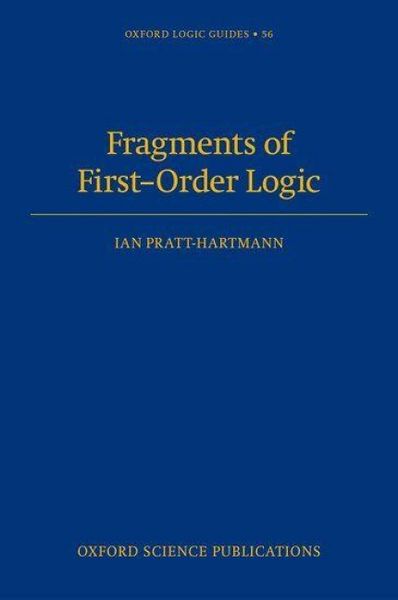
Produktbild: Fragments of First-Order Logic

Fragments of First-Order Logic

228,99 €

inkl. gesetzl. MwSt., Versandkostenfrei


Beschreibung

A sentence of first-order logic is satisfiable if it is true in some structure, and finitely satisfiable if it is true in some finite structure. The question arises as to whether there exists an algorithm for determining whether a given formula of first-order logic is satisfiable, or indeed finitely...

Beschreibung

A sentence of first-order logic is satisfiable if it is true in some structure, and finitely satisfiable if it is true in some finite structure. The question arises as to whether there exists an algorithm for determining whether a given formula of first-order logic is satisfiable, or indeed finitely satisfiable. This question was answered negatively in 1936 by Church and Turing (for satisfiability) and in 1950 by Trakhtenbrot (for finite satisfiability).In contrast, the satisfiability and finite satisfiability problems are algorithmically solvable for restricted subsets---or, as we say, fragments---of first-order logic, a fact which is today of considerable interest in Computer Science. This book provides an up-to-date survey of the principal axes of research, charting the limits of decision in first-order logic and exploring the trade-off between expressive power and complexity of reasoning. Divided into three parts, the book considers for which fragments of first-order logic there is an effective method for determining satisfiability or finite satisfiability. Furthermore, if these problems are decidable for some fragment, what is their computational complexity? Part I focusses on fragments defined by restricting the set of available formulas. Topics covered include the Aristotelian syllogistic and its relatives, the two-variable fragment, the guarded fragment, the quantifier-prefix fragments and the fluted fragment. Part II investigates logics with counting quantifiers. Starting with De Morgan's numerical generalization of the Aristotelian syllogistic, we proceed to the two-variable fragment with counting quantifiers and its guarded subfragment, explaining the applications of the latter to the problem of query answering in structured data. Part III concerns logics characterized by semantic constraints, limiting the available interpretations of certain predicates. Taking propositional modal logic and graded modal logic as our cue, we return to the satisfiability problem for two-variable first-order logic and its relatives, but this time with certain distinguished binary predicates constrained to be interpreted as equivalence relations or transitive relations. The work finishes, slightly breaching the bounds of first-order logic proper, with a chapter on logics interpreted over trees.

Produktdetails

Einband

Gebundene Ausgabe

Erscheinungsdatum

30.06.2023

Verlag Oxford University Press
Seitenzahl

668

Produktdetails

Einband

Gebundene Ausgabe

Erscheinungsdatum

30.06.2023

Verlag Oxford University Press
Seitenzahl

668

Maße (L/B/H)

24,1/16,2/3,8 cm

Gewicht

1256 g

Sprache

Englisch

ISBN

978-0-19-286796-4

Herstelleradresse

Libri GmbH
Europaallee 1
36244 Bad Hersfeld
DE

Email: gpsr@libri.de

Noch keine Bewertungen vorhanden

Verfassen Sie die erste Bewertung zu diesem Artikel

Helfen Sie anderen Kundinnen und Kunden durch Ihre Meinung.

Kundinnen und Kunden meinen

Bewertungen (0)

  • Produktbild: Fragments of First-Order Logic
    • Preface
    • Acknowledgements
    • 1: Introduction
    • Part I: Syntactic Restrictions
    • 2: Roots
    • 3: Variables
    • 4: Guards
    • 5: Prefixes
    • 6: Fluting
    • Part II: Counting Quantifiers
    • 7: Counting with one variable
    • 8: Counting with two variables
    • 9: Guarded counting
    • 10: Omitting graphs
    • Part III: Semantic Constraints
    • 11: Modalities
    • 12: Equivalence
    • 13: Equivalence and counting
    • 14: Transitivity
    • 15: Trees