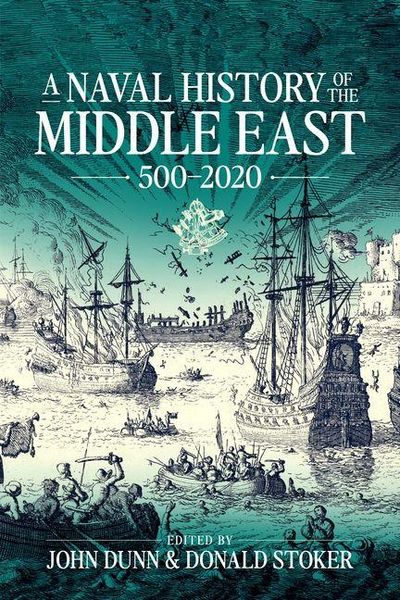
A Naval History of the Middle East 500-2020
Aus der Reihe
Wolverhampton Military Studies
-
- Englisch ausgewählt
44,99 €
inkl. gesetzl. MwSt.,
Beschreibung
Produktdetails
Einband
Gebundene Ausgabe
Erscheinungsdatum
19.10.2025
Herausgeber
Donald Stoker + weitereVerlag
Helion & CompanySeitenzahl
270
Maße (L/B/H)
24/16,3/1,7 cm
Gewicht
656 g
Sprache
Englisch
ISBN
978-1-80451-234-0
A Naval History of the Middle East, 500-2020 examines how sea power impacted on a wide range of nations. But just what is "the Middle East?" The editors' definition is broad, ranging from Morocco to Iran, and the Black Sea to the Indian Ocean. Our start point connects readers to the last war between the Byzantine Empire and Sassanid Iran, results of which benefit the rapid expansion of Islam.
Naval force originally came from warships propelled via oars and sails. These protected sailing ships used to transport soldiers or supplies. Combat mainly involved missile fire and boarding actions. As human rowers pulled the oars, strategy focused on securing food and water. Ships did not carry much of either, and needed frequent resupply.
Ports were prizes of great value, their control allowing admirals to advance, or halt an opponent whose crews seldom had more than a few days of water. Galley warfare had been this way since ancient times, but changed as new technologies like "Greek Fire" added new military options, or larger sailing ships extended storage capabilities, thus expanding an admiral's reach.
Although early Muslim fleets did not have the naval traditions of the Byzantines, their leaders recognized the value of sea power. One might remember that "admiral" comes from Arabic. Muslims fought each other, along with their traditional Byzantine opponents and European volunteers serving during the Crusades.
Fighting ranged from fleet actions to amphibious operations, and piracy. Both Muslim and Christian pirates operated across the Mediterranean and Red Seas, plus the Persian Gulf and Indian Ocean. Pirates continue to operate in the 21st Century.
Major change comes from Ottoman naval expansion in the 1500s. This was also a period of technological innovations with gunpowder weapons and larger sailing vessels supplanting boarding actions and galleys. Steam power, ironclads, torpedoes, aircraft, and missiles speed up these trends during the 19th and 20th Centuries.
We tell this story with a historical overview, supported by specific case studies. Our goal is to show Middle Eastern powers successfully employed navies to enforce national goals, and that powerful traditions support a continuation of naval forces in the 21st Century.
Chapters of the book are as follows:
Introduction: A Naval History of the Middle East (John Dunn)
1 East Roman Naval Warfare and the Military Treatises (Ilkka Syvanne (Syvänne/Syvaenne))
2 The Italian Maritime Republics and the Struggle for the Crusader Coast in Outremer, 1095-1192 (Sebastian Bartos)
3 Rotting Ships and Razed Harbours: The Naval Policy of the Mamluks (Albrecht Fuess)
4 Nader Shah and Persian Naval Expansion in the Persian Gulf, 1700-1747 (Michael Axworthy)
5 The Egyptian Navy of Muhammad Ali Pasha, 1805-1848 (John Houghton)
6 Anarchy in the Archipelago: Piracy during the 1897 Greco-Ottoman War (Leonidas Mylonakis)
7 The Turkish Navy of the Early Republican Era, 1923-1952 (Serhat Güvenç)
8 Building a Navy from Scratch in Just a Decade: The Abu Dhabi Experience,1966-1976 (Athol Yates)
9 Changes in the Israeli Navy's Strategic Concept from Its Inception to 2019 (Eyal Pinko)
Naval force originally came from warships propelled via oars and sails. These protected sailing ships used to transport soldiers or supplies. Combat mainly involved missile fire and boarding actions. As human rowers pulled the oars, strategy focused on securing food and water. Ships did not carry much of either, and needed frequent resupply.
Ports were prizes of great value, their control allowing admirals to advance, or halt an opponent whose crews seldom had more than a few days of water. Galley warfare had been this way since ancient times, but changed as new technologies like "Greek Fire" added new military options, or larger sailing ships extended storage capabilities, thus expanding an admiral's reach.
Although early Muslim fleets did not have the naval traditions of the Byzantines, their leaders recognized the value of sea power. One might remember that "admiral" comes from Arabic. Muslims fought each other, along with their traditional Byzantine opponents and European volunteers serving during the Crusades.
Fighting ranged from fleet actions to amphibious operations, and piracy. Both Muslim and Christian pirates operated across the Mediterranean and Red Seas, plus the Persian Gulf and Indian Ocean. Pirates continue to operate in the 21st Century.
Major change comes from Ottoman naval expansion in the 1500s. This was also a period of technological innovations with gunpowder weapons and larger sailing vessels supplanting boarding actions and galleys. Steam power, ironclads, torpedoes, aircraft, and missiles speed up these trends during the 19th and 20th Centuries.
We tell this story with a historical overview, supported by specific case studies. Our goal is to show Middle Eastern powers successfully employed navies to enforce national goals, and that powerful traditions support a continuation of naval forces in the 21st Century.
Chapters of the book are as follows:
Introduction: A Naval History of the Middle East (John Dunn)
1 East Roman Naval Warfare and the Military Treatises (Ilkka Syvanne (Syvänne/Syvaenne))
2 The Italian Maritime Republics and the Struggle for the Crusader Coast in Outremer, 1095-1192 (Sebastian Bartos)
3 Rotting Ships and Razed Harbours: The Naval Policy of the Mamluks (Albrecht Fuess)
4 Nader Shah and Persian Naval Expansion in the Persian Gulf, 1700-1747 (Michael Axworthy)
5 The Egyptian Navy of Muhammad Ali Pasha, 1805-1848 (John Houghton)
6 Anarchy in the Archipelago: Piracy during the 1897 Greco-Ottoman War (Leonidas Mylonakis)
7 The Turkish Navy of the Early Republican Era, 1923-1952 (Serhat Güvenç)
8 Building a Navy from Scratch in Just a Decade: The Abu Dhabi Experience,1966-1976 (Athol Yates)
9 Changes in the Israeli Navy's Strategic Concept from Its Inception to 2019 (Eyal Pinko)
Kundinnen und Kunden meinen
Verfassen Sie die erste Bewertung zu diesem Artikel
Helfen Sie anderen Kund*innen durch Ihre Meinung
Kurze Frage zu unserer Seite
Vielen Dank für Ihr Feedback
Wir nutzen Ihr Feedback, um unsere Produktseiten zu verbessern. Bitte haben Sie Verständnis, dass wir Ihnen keine Rückmeldung geben können. Falls Sie Kontakt mit uns aufnehmen möchten, können Sie sich aber gerne an unseren Kund*innenservice wenden.
zum Kundenservice