Gutscheinbedingungen

**Gültig bis 06.07.2026 auf fremdsprachige Bücher online auf thalia.at, in der Thalia App ab einem Mindestbestellwert von 30€ und in allen Thalia Buchhandlungen in Österreich. In den Buchhandlungen nur gültig auf lagernde Ware. Einzelne Artikel können ausgeschlossen sein. Ausgenommen sind preisgebundene Artikel & eBooks. Pro Einkauf einmal einlösbar. Nur gültig gegen Vorlage oder im Onlineshop hinterlegter Bonuscard. Infos zur Einlösung in der Buchhandlung sind auf der Bonuscard-Vorteilspreisseite zu finden. Click & Collect nur bei Onlinevorabzahlung möglich. Keine Einlösung bei Scan & Go-Bezahlung. Keine Barauszahlung. Nicht kombinierbar mit anderen Aktionen und Gutscheinen. Gutschein wird auf max. 500€ Bestellwert angerechnet. Nicht gültig für Versandkosten und Services.

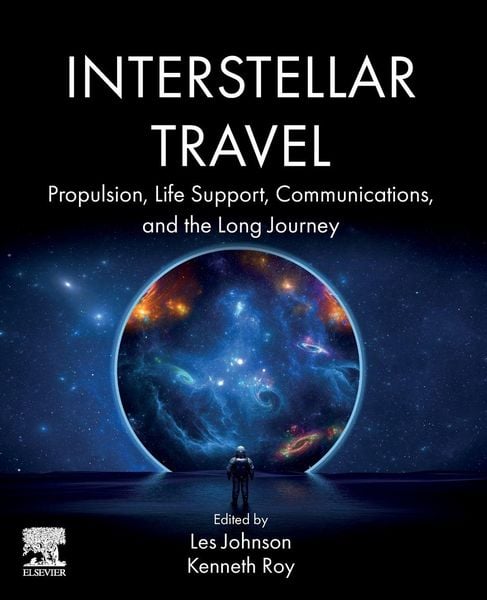
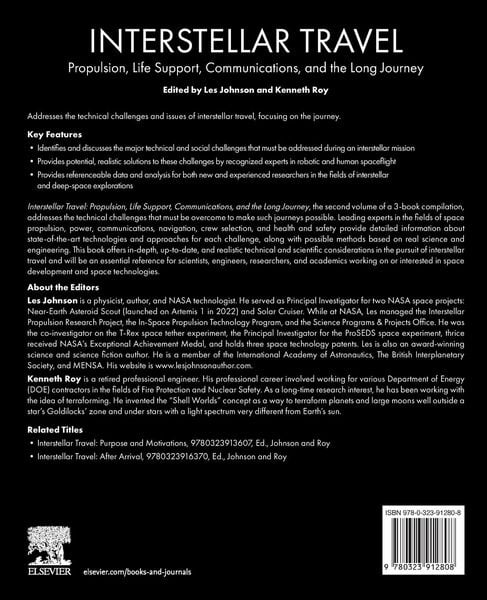
  • Produktbild: Interstellar Travel
  • Produktbild: Interstellar Travel

Interstellar Travel Propulsion, Life Support, Communications, and the Long Journey

207,99 €

inkl. gesetzl. MwSt., Versandkostenfrei


Beschreibung

Produktdetails

Einband

Taschenbuch

Erscheinungsdatum

31.05.2024

Herausgeber

Les Johnson + weitere

Verlag

Elsevier Science & Technology

Seitenzahl

442

Maße (L/B/H)

23,5/19,1/2,3 cm

Gewicht

900 g

Sprache

Englisch

ISBN

978-0-323-91280-8

Beschreibung

Portrait

Les Johnson is a physicist and NASA technologist at the George C. Marshall Space Flight Center where he is the Principal Investigator for flight demonstration of advanced space technology systems including solar sails, power systems, and most recently, space based solar power. He was the co-investigator on the Japanese-led T-Rex space tether experiment that flew in August 2010, the Principal Investigator for the NASA ProSEDS space experiment, received NASA’s Exceptional Achievement Medal three times, and holds 3 space technology patents. His book, Solar Sails, a Novel Approach to Interplanetary Travel was favorably reviewed in the journal Nature (10 April 2008). Graphene: The Superstrong, Superthin, and Superversatile Material That Will Revolutionize the World also appeared in Nature (25 January 2018) and was excerpted in American Scientist (May-June 2018). Les is a member of the International Academy of Astronautics, the British Interplanetary Society, the National Space Society, the Science Fiction and Fantasy Writers of America, and MENSA – and is the Program Chair of the Interstellar Research Group.

Kenneth Roy is a newly retired professional engineer. His professional career involved working for various Department of Energy (DOE) contractors in the fields of Fire Protection and Nuclear Safety. As a long-time research interest, Kenneth has been working with the idea of terraforming. He invented the “Shell Worlds” concept as a way to terraform planets and large moons well outside a star’s Goldilocks’ zone and under stars that have a radically different spectrum from our Sun. This was published in the January 2009 Journal of the British Interplanetary Society (JBIS). Kenneth has published multiple papers on terraforming and space colonization that have appeared in leading journals and has written chapters that have appeared in several space related books. Kenneth is a founding member of the non-profit corporation Interstellar Research Group (formerly the Tennessee Valley Interstellar Workshop) and remains active in the organization.

Produktdetails

Einband

Taschenbuch

Erscheinungsdatum

31.05.2024

Herausgeber

Verlag

Elsevier Science & Technology

Seitenzahl

442

Maße (L/B/H)

23,5/19,1/2,3 cm

Gewicht

900 g

Sprache

Englisch

ISBN

978-0-323-91280-8

Herstelleradresse

Libri GmbH
Europaallee 1
36244 Bad Hersfeld
DE

Email: gpsr@libri.de

Noch keine Bewertungen vorhanden

Verfassen Sie die erste Bewertung zu diesem Artikel

Helfen Sie anderen Kundinnen und Kunden durch Ihre Meinung.

Kundinnen und Kunden meinen

Bewertungen (0)

Die Leseprobe wird geladen.
  • Produktbild: Interstellar Travel
  • Produktbild: Interstellar Travel
  • 1. Assumptions and Limitations - FTL possibilities and issues
    2. Propulsion Options
    3. Power options
    4. The Interstellar environment
    5. Crew Health - psychological, biological, medical
    6. Life Support
    7. Communications and the ability to remain connected to Earth
    8. Prospects for Human hibernation
    9. Ship culture and government
    10. Spare parts and additive manufacturing
    11. Optimal crew size at both departure and arrival
    12. Artificial Intelligence