Gutscheinbedingungen

**Gültig bis 06.07.2026 auf fremdsprachige Bücher online auf thalia.at, in der Thalia App ab einem Mindestbestellwert von 30€ und in allen Thalia Buchhandlungen in Österreich. In den Buchhandlungen nur gültig auf lagernde Ware. Einzelne Artikel können ausgeschlossen sein. Ausgenommen sind preisgebundene Artikel & eBooks. Pro Einkauf einmal einlösbar. Nur gültig gegen Vorlage oder im Onlineshop hinterlegter Bonuscard. Infos zur Einlösung in der Buchhandlung sind auf der Bonuscard-Vorteilspreisseite zu finden. Click & Collect nur bei Onlinevorabzahlung möglich. Keine Einlösung bei Scan & Go-Bezahlung. Keine Barauszahlung. Nicht kombinierbar mit anderen Aktionen und Gutscheinen. Gutschein wird auf max. 500€ Bestellwert angerechnet. Nicht gültig für Versandkosten und Services.

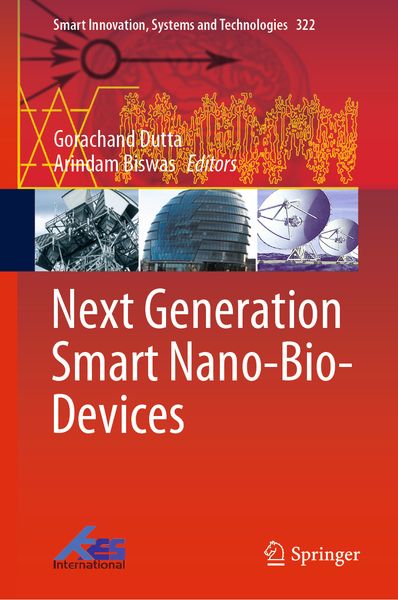
Produktbild: Next Generation Smart Nano-Bio-Devices
- 11%

Next Generation Smart Nano-Bio-Devices

11% sparen

96,99 € UVP 109,99 €

inkl. gesetzl. MwSt., Versandkostenfrei


Beschreibung

Produktdetails

Einband

Gebundene Ausgabe

Erscheinungsdatum

21.10.2022

Herausgeber

Gorachand Dutta + weitere

Verlag

Springer Singapore

Seitenzahl

209

Maße (L/B/H)

24,1/16/1,7 cm

Auflage

1. Auflage

Sprache

Englisch

ISBN

978-981-19-7106-8

Beschreibung

Portrait

Dr. Gorachand Dutta is Assistant Professor at School of Medical Science and Technology, IIT Kharagpur. He received M.Sc. degree in Chemistry from Indian Institute of Technology, Guwahati, India. His research interests include the design and characterization of portable biosensors, biodevices, and sensor interfaces for miniaturized systems and biomedical applications for point-of-care testing. He received his Ph.D. in Biosensor and Electrochemistry from Pusan National University, South Korea, where he developed different class of electrochemical sensors and studied the electrochemical properties of gold, platinum, and palladium-based metal electrodes. He completed his postdoctoral fellowships in the Department of Mechanical Engineering, Michigan State University, USA, Department of Chemistry, Pusan National University, South Korea, and Centre for Biosensors, Bioelectronics and Biodevices at University of Bath, UK. During his research tenure in USA and South Korea, Dr. Dutta inventedan enzyme-free, disposable miniaturized immunosensor chip using micropatterned electrode and wash-free method for the development of mobile phone-based platforms for fast and simple point-of-care testing of infectious and metabolic disease biomarkers. He has expertise on label-free multichannel electrochemical biosensors, electronically addressable biosensor arrays, aptamer- and DNA-based sensors, and surface bio-functionalization. 


Dr. Arindam Biswas received M. Tech. degree in Radio Physics and Electronics from University of Calcutta, India, in 2010 and Ph.D. from NIT Durgapur in 2013. He has worked as Postdoctoral Researcher at Pusan National University, South Korea, with prestigious BK21PLUS Fellowship, Republic of Korea 2015, DST-JSPS Invitation Research Grant Award in 2020, and DST-ASEAN S&T Development Grant Award 2021. He was Visiting Professor at Research Institute of Electronics, Shizouka University, Japan. He has been selected for IE(I) Young Engineer Award : 2019-20 from Institute of Engineers (I), India. Dr. Biswas has 12 years of experience in teaching research and administration. Presently, Dr. Biswas is working as Associate Professor in School of Mines and Metallurgy at Kazi Nazrul University, Asansol, WB, India. He has 53 technical papers in different journals, 35 conference proceedings, 7 books, 8 edited volumes, and 6 chapters with international repute. Dr. Biswas received research grant from Science and Engineering Research Board, Government of India, under Early Career Research Scheme for research in terahertz-based GaN source. He has also received research grant from Centre of Biomedical Engineering, Tokyo Medical & Dental University in association with RIE, Shizouka University, Japan, for study of biomedical THz imaging based on WBG semiconductor IMPATT source for two consecutive years 2019-20 and 2020-2021. Presently, Dr. Biswas has served as Associate Editor of Cluster Computing, Springer (SCI Indexed). Dr. Biswas has produced 05 Ph.D. students in different topics of applied optics and high-frequency semiconductor device. He has organized and chaired different international conferences in India and abroad. His research interest is in carrier transport in low-dimensional system and electronic device, nonlinear optical communication, and THz semiconductor source. Dr. Biswas acted as Reviewer for reputed journals, Member of the Institute of Engineers (India), and Regular Fellow of Optical Society of India (India).

Produktdetails

Einband

Gebundene Ausgabe

Erscheinungsdatum

21.10.2022

Herausgeber

Verlag

Springer Singapore

Seitenzahl

209

Maße (L/B/H)

24,1/16/1,7 cm

Auflage

1. Auflage

Sprache

Englisch

ISBN

978-981-19-7106-8

Herstelleradresse

Springer-Verlag KG
Sachsenplatz 4-6
1201 Wien
AT

Email: GPSR Kontakt

Noch keine Bewertungen vorhanden

Verfassen Sie die erste Bewertung zu diesem Artikel

Helfen Sie anderen Kundinnen und Kunden durch Ihre Meinung.

Kundinnen und Kunden meinen

Bewertungen (0)

  • Produktbild: Next Generation Smart Nano-Bio-Devices
  • Chapter 1. Aspects of Biosensors with refers to emerging implications of Artificial Intelligence, Big Data & Analytics: The Changing Healthcare-A General Review.- Chapter 2. On Few Electronic Properties of Nano Wires of Heavily Doped Biosensing Materials.- Chapter 3. Overview of Biosensors and its Application in Healthcare.- Chapter 4. Graphene and Carbon Nanotubes (CNTs) based biosensor for life sciences applications.- Chapter 5. An Overview of Integrated Miniaturized/Microfluidic Electrochemical Biosensor Platforms for Health Care Applications.- Chapter 6. Application of Nanomaterial based Biosensors for Healthcare Diagnostics.- Chapter 7. Nanomaterials and nanodevices for treating human infectious and inflammatory diseases: Bane or Boon for human health?.- Chapter 8. Design and Analysis of One Dimensional Photonic Crystal Biosensor Device for Identification of Cancerous Cells.- Chapter 9. Dielectric Modulated Biosensor Based on Vertical Tunnel Field Effect Transistor.- Chapter 10. Electrochemical Biosensor Designs Used for Detecting SARS-CoV-2 Virus: A Review.