Gutscheinbedingungen

**Gültig von 22.06.2026 ab 19 Uhr bis 23.06.2026 24 Uhr auf Spielzeug, Schreibwaren, Filme, Geschenke & Trends, Musik, tolino eReader & Zubehör, Hörbücher und Hörbuch-Downloads (außer Abo), nicht preisgebundene Bücher und Kalender online auf thalia.at und in der Thalia App. Einzelne Artikel können ausgeschlossen sein. Aufgrund der Buchpreisbindung sind deutschsprachige Bücher und eBooks ausgenommen. Zusätzlich ausgenommen sind preisgebundene Artikel, Abos & Flatrates, eBooks, Games, Geschenkkarten/-boxen, Shelfies, Software, Zeitschriften sowie einzelne Artikel von tonies®. Pro Einkauf einmal einlösbar. Click & Collect nur bei Onlinevorabzahlung möglich. Keine Barauszahlung. Nicht kombinierbar mit anderen Aktionen und Gutscheinen. Gutschein wird auf max. 500€ Bestellwert angerechnet. Nicht gültig für Versandkosten und Services.

Produktbild: Environmental Biotechnology Volume 4
- 12%

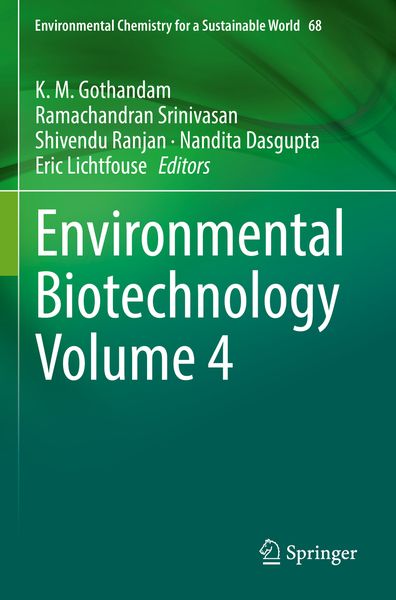
Environmental Biotechnology Volume 4

12% sparen

163,99 € UVP 186,99 €

inkl. gesetzl. MwSt., Versandkostenfrei


Beschreibung

Produktdetails

Einband

Taschenbuch

Erscheinungsdatum

26.09.2022

Herausgeber

K. M. Gothandam + weitere

Verlag

Springer

Seitenzahl

261

Maße (L/B/H)

23,5/15,5/1,5 cm

Gewicht

473 g

Auflage

1st ed. 2021

Sprache

Englisch

ISBN

978-3-030-77797-5

Beschreibung

Portrait

Dr. K. M. Gothandam is a Professor in the Department of Biotechnology, School of BioSciences and Technology, Vellore Institute of Technology, Vellore. His research interest includes Plant Molecular Biology, Plant and Microbial Metabolites, cancer biology, Environmental Biotechnology, etc. He has published many scientific research and review articles in international peer-reviewed journals and also refereed many journals of high impact.

Dr. Ramachandran Srinivasan is currently working as a National Post-Doctoral Fellow of Science and Education Research Board (SERB) in the Department of Genetic Engineering, SRM Institute of Science and Technology, Kattankulathur. He obtained his doctorate from Vellore Institute of Technology, Vellore. He did his postdoctoral research at International Centre for Genetic Engineering and Biotechnology (ICGEB), New Delhi. His field of interest includes metabolic engineering of algae as well as photosynthetic organisms towards stress tolerance, production of metabolites and other high value-added products. He is also an active team member of SERB and BIRAC funded projects.

Dr. Shivendu Ranjan is a senior research associate, at the University of Johannesburg, Johannesburg, South Africa. His research interests include biomaterials, nanotechnology, nanomedicine, and nanotoxicology. He has been elected as a Fellow of several reputed scientific societies e.g. The Linnean Society of London, Indian Chemical Society, Bose Science Society, and Indian Engineering Teachers Association. He is associate editor of Environmental Chemistry Letters.

Dr. Nandita Dasgupta has vast working experience in nanoscience and is working as Assistant Professor at the Department of Biotechnology, Institute of Engineering and Technology, Lucknow, India. She has worked on Mesenchymal stem cell-derived exosomes for the treatment of uveitis. She has successfully engineered micro-vehicles for model drug molecules. Her areas of interest include nanomaterial fabrication and its applications in medicine, food, environment, agriculture and biomedical. She is the associate editor of Environmental Chemistry Letters. She has received several awards and recognitions from different national and international organizations.

Dr. Eric Lichtfouse is an environmental chemist working at the University of Aix-Marseille, France. He has invented carbon-13 dating. He is teaching scientific writing and communication, and has published the book Scientific Writing for Impact Factors. He is the founder and Chief Editor of scientific journals and series in environmental chemistry and agriculture. He got the Analytical Chemistry Prize from the French Chemical Society, the Grand Prize of the Universities of Nancy and Metz, and a Journal Citation Award by the Essential Indicators.
Produktdetails

Einband

Taschenbuch

Erscheinungsdatum

26.09.2022

Herausgeber

Verlag

Springer

Seitenzahl

261

Maße (L/B/H)

23,5/15,5/1,5 cm

Gewicht

473 g

Auflage

1st ed. 2021

Sprache

Englisch

ISBN

978-3-030-77797-5

Herstelleradresse

Springer-Verlag KG
Sachsenplatz 4-6
1201 Wien
AT

Email: ProductSafety@springernature.com

Kundinnen und Kunden meinen

0 Bewertungen

Informationen zu Bewertungen

Zur Abgabe einer Bewertung ist eine Anmeldung im Konto notwendig. Die Authentizität der Bewertungen wird von uns nicht überprüft. Wir behalten uns vor, Bewertungstexte, die unseren Richtlinien widersprechen, entsprechend zu kürzen oder zu löschen.

Die Bewertungen sind nach Format, Anzahl Sterne und Datum sortiert.

Verfassen Sie die erste Bewertung zu diesem Artikel

Helfen Sie anderen Kund*innen durch Ihre Meinung

Kundinnen und Kunden meinen

0 Bewertungen filtern

  • Produktbild: Environmental Biotechnology Volume 4
  • Chapter 1 Switching to bioplastics for sustaining our environment.- Chapter 2 Bioenergy production from wastewater resources using Clostridium species.- Chapter 3 Management of Phosphate in Domestic Wastewater Treatment Plants.- Chapter 4 Agricultural Waste: A potential solution to combat heavy metal toxicity.- Chapter 5 Current Trends and Emerging Technologies for Pest Control Management of Rice (Oryza sativa) Plants.- Chapter 6 Comet assay: is it a sensitive tool in ecogenotoxicology?.- Chapter 7 Drosophila melanogaster as a model to study Acrylamide induced toxicity and the effects of phytochemicals.- Chapter 8 Mesoporous Silica Nanoparticles are Nanocarrier for Drug Loading and Induces Cell Death in Breast Cancer.- Chapter 9 Insights on the Biotechnological applications of Marine Fungal Exopolysaccharides.