KI-Beratung Beta

  • Produktbild: Emerging Model Organisms
  • Produktbild: Emerging Model Organisms
Band 194 - 12%

Emerging Model Organisms

Aus der Reihe Neuromethods
12% sparen

211,99 € UVP 241,99 €

inkl. gesetzl. MwSt., Versandkostenfrei


Beschreibung

This volume discusses different approaches towards understanding the brain plasticity, aging, and regeneration of the nervous system in model organisms. Chapters guide the reader through an overview of model organisms,  setup of an aquatic system, Tol2-mediated transgenesis, CRISPR/Cas9-mediated gene...

Beschreibung

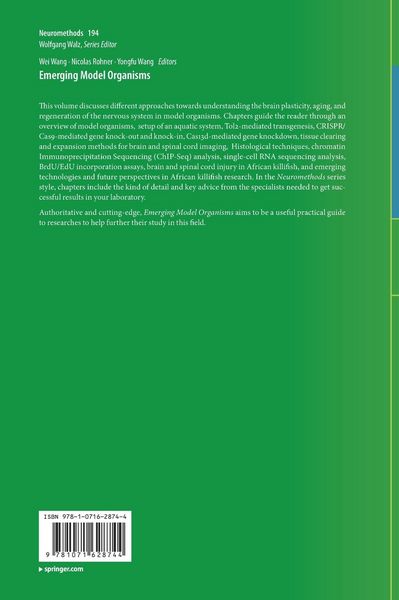
This volume discusses different approaches towards understanding the brain plasticity, aging, and regeneration of the nervous system in model organisms. Chapters guide the reader through an overview of model organisms,  setup of an aquatic system, Tol2-mediated transgenesis, CRISPR/Cas9-mediated gene knock-out and knock-in, Cas13d-mediated gene knockdown, tissue clearing and expansion methods for brain and spinal cord imaging,  Histological techniques, chromatin Immunoprecipitation Sequencing (ChIP-Seq) analysis, single-cell RNA sequencing analysis, BrdU/EdU incorporation assays, brain and spinal cord injury in African killifish, and emerging technologies and future perspectives in African killifish research. In the  Neuromethods  series style, chapters include the kind of detail and key advice from the specialists needed to get successful results in your laboratory. 

Authoritative and cutting-edge,  Emerging Model Organisms aims to be a useful practical guide to researches to help further their study in this field. 

Produktdetails

Einband

Gebundene Ausgabe

Erscheinungsdatum

02.01.2023

Abbildungen

XV, 359 p. 95 illus., 94 illus. in color.

Herausgeber Wei Wang + weitere

Produktdetails

Einband

Gebundene Ausgabe

Erscheinungsdatum

02.01.2023

Abbildungen

XV, 359 p. 95 illus., 94 illus. in color.

Herausgeber
Verlag Springer Us
Seitenzahl

359

Maße (L/B/H)

26/18,3/2,6 cm

Gewicht

839 g

Auflage

23001 Auflage 1st edition 2023

Sprache

Englisch

ISBN

978-1-07-162874-4

Herstelleradresse

Springer-Verlag GmbH
Europaplatz 3
69115 Heidelberg
DE

Email: ProductSafety@springernature.com

Noch keine Bewertungen vorhanden

Verfassen Sie die erste Bewertung zu diesem Artikel

Helfen Sie anderen Kundinnen und Kunden durch Ihre Meinung.

Kundinnen und Kunden meinen

Bewertungen (0)

  • Produktbild: Emerging Model Organisms
  • Produktbild: Emerging Model Organisms
  • Establish a fishroom for African turquoise killifish Nothobranchius furzeri.- Gene editing and transgenic reporter assays in African killifish.- Spinal cord injury in African killifish.- Whole brain clearing and immunolabelling in the African killifish N. furzeri.- Studying Mating Behaviors in Nothobranchius furzeri.- A chromatin immunoprecipitation (ChIP) protocol for African turquoise killifish.- EdU labeling of proliferating cells in the African killifish Nothobranchius furzeri.- Immunofluorescence staining on cryosections with high autofluorescence in African killifish.- Rapid visualization of gene expression using chromogenic RNA in situ hybridization in African killifish.- Profiling gene expression in African turquoise killifish Nothobranchius furzeri embryos with RNA fluorescence in situ hybridization chain reaction (HCR).- Cell dissociation of tissues for single-cell analysis in African killifish.- Cryopreservation of the Mexican Tetra: Astyanax mexicanus.- Whole-mount multicolor fluorescent labeling by in situ hybridization in Astyanax mexicanus embryos and larvae.- Application of CRISPR-Cas9 for functional analysis in A. mexicanus.- Immunohistochemistry and in vivo neural imaging in A. mexicanus.- Sleep behavior analysis in Astyanax mexicanus.- A new method to analyze non-visual based social-like interactions in asocial cavefish.- A generalist’s guide to quantifying swimming behavior within traditional and non-traditional teleost models.- Recording acoustic behaviour in Astyanax mexicanus fish:acquisition, decryption, interpretation.- Generation of mini-brains from hiPSCs.- Generating Human Pluripotent Stem Cell-Derived AssemBloids™ to Model Interneuron Migration and Immune Cell Interactions.- Multiplexed quantitative proteomics analysis of developing human brain organoids.