KI-Beratung Beta

Gutscheinbedingungen

**Gültig bis 18.11.2026 auf englischsprachige Klassiker (klassiker-32728) online auf thalia.at und in der Thalia App. Einzelne Artikel können ausgeschlossen sein. Ausgenommen sind preisgebundene Artikel & eBooks. Pro Einkauf einmal einlösbar. Click & Collect nur bei Onlinevorabzahlung möglich. Keine Barauszahlung. Nicht kombinierbar mit anderen Aktionen und Gutscheinen. Gutschein wird auf max. 500€ Bestellwert angerechnet. Nicht gültig für Geschenkkarten, Versandkosten und Services.

  • Produktbild: The Contemporary Russian Economy
  • Produktbild: The Contemporary Russian Economy
- 16%

The Contemporary Russian Economy A Comprehensive Analysis

16% sparen

63,99 € UVP 76,99 €

inkl. gesetzl. MwSt., Versandkostenfrei


Beschreibung

This textbook offers a wide-ranging, comprehensive analysis of the contemporary Russian economy (as it functions in the early 2020s) concentrated on the economy, economic policy, and economic governance. Chapters cover recent Russian economic history, the economic geography of Russia, natural resources,...

Beschreibung

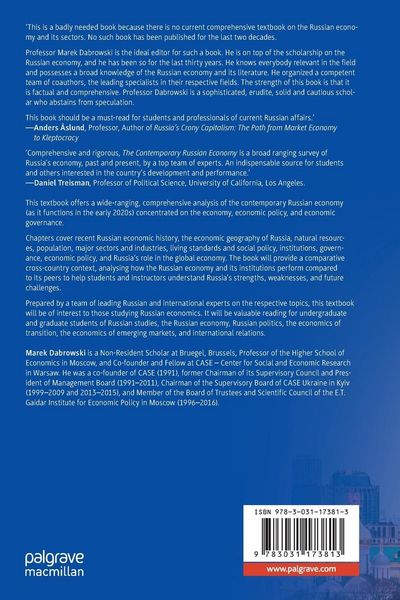
This textbook offers a wide-ranging, comprehensive analysis of the contemporary Russian economy (as it functions in the early 2020s) concentrated on the economy, economic policy, and economic governance. Chapters cover recent Russian economic history, the economic geography of Russia, natural resources, population, major sectors and industries, living standards and social policy, institutions, governance, economic policy, and Russia's role in the global economy. The book will provide a comparative cross-country context, analysing how the Russian economy and its institutions perform compared to its peers to help students and instructors understand Russia’s strengths, weaknesses, and future challenges. Prepared by a team of leading Russian and international experts on the respective topics, this textbook will be of interest to those studying Russian economics. It will be valuable reading for undergraduate and graduate students of Russian studies, the Russian economy, Russian politics,the economics of transition, the economics of emerging markets, and international relations.

Portrait

Marek Dabrowski  is a Non-Resident Scholar at Bruegel, Brussels, Professor of the Higher School of Economics in Moscow, and Co-founder and Fellow at CASE - Center for Social and Economic Research in Warsaw. He was a co-founder of CASE (1991), former Chairman of its Supervisory Council and President of Management Board (1991-2011), Chairman of the Supervisory Board of CASE Ukraine in Kyiv (1999-2009 and 2013-2015), and Member of the Board of Trustees and Scientific Council of the E.T. Gaidar Institute for Economic Policy in Moscow (1996-2016).


Produktdetails

Einband

Taschenbuch

Erscheinungsdatum

02.01.2023

Herausgeber Marek Dabrowski
Verlag Springer

Produktdetails

Einband

Taschenbuch

Erscheinungsdatum

02.01.2023

Herausgeber Marek Dabrowski
Verlag Springer
Seitenzahl

410

Maße (L/B/H)

23,5/15,5/2,5 cm

Gewicht

674 g

Auflage

1st ed. 2023

Sprache

Englisch

ISBN

978-3-031-17381-3

Herstelleradresse

Springer-Verlag GmbH
Tiergartenstr. 17
69121 Heidelberg
DE

Email: ProductSafety@springernature.com

Noch keine Bewertungen vorhanden

Verfassen Sie die erste Bewertung zu diesem Artikel

Helfen Sie anderen Kundinnen und Kunden durch Ihre Meinung.

Kundinnen und Kunden meinen

Bewertungen (0)

  • Produktbild: The Contemporary Russian Economy
  • Produktbild: The Contemporary Russian Economy
  • Part I: Natural and Human Resources.- Chapter 1: Natural resources, geography, and climate (by Leonid Limonov).- Chapter 2: Human resources (by Irina Denisova and Marina Kartseva).- Part II: Historical Roots.- Chapter 3: Capitalist industrialization and modernization: since Alexander's reforms until World War I (the 1860s - 1917) (by Carol Scott Leonard).- Chapter 4: The Soviet economy (1918-1991) (by Carol Scott Leonard).- Part III. Institutions and Their Transformation.- Chapter 5: Constitutional foundations of the economic system and the role of government in economic activity (by Christopher Hartwell).- Chapter 6: Regulatory environment and business climate (by Marek Dabrowski).- Chapter 7: Evolution of ownership structure and corporate governance (by Alexander Radygin).- Part IV: Major Sectors and Regional Diversity.- Chapter 8: Structural changes in the Russian economy since 1992 (by Boris Kuznetsov).- Chapter 9: Energy sector (oil, natural gas, coal, and electricity) and energy intensity (by Przemyslaw Kowalski).- Chapter 10: Agriculture (by Evgeniya Serova).- Chapter 11: Science, research and innovation (by Boris Kuznetsov).- Chapter 12: Regional diversity (by Leonid Limonov).- Part V: Russia in the Global Economy.- Chapter 13: Trade (by Arne Melchior).- Chapter 14: Foreign investment (by Kalman Kalotay).- Chapter 15: Sanctions and forces driving to autarky (by Marek Dabrowski).- Part VI: Economic and Social Policy Challenges.- Chapter 16: Economic growth (by Ilya Voskoboynikov).- Chapter 17: Macroeconomic vulnerability, monetary and fiscal policies (by Marek Dabrowski).- Chapter 18: Labour market, employment, and migration (by Vladimir Gimpelson).- Chapter 19: Living standard and social policy (by Irina Denisova and Marina Kartseva).- Chapter 20: Summary: changes in an economic system since the early 2000s (by Marek Dabrowski).