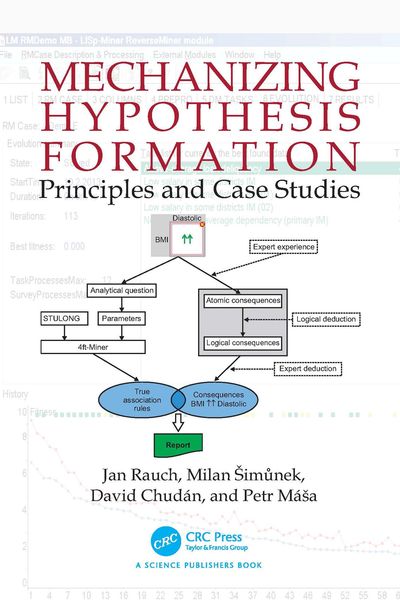
Mechanizing Hypothesis Formation Principles and Case Studies
-
- Hardcover
- Taschenbuch
- eBook ausgewählt
-
Form:Einzelkauf Download
-
Sprache:Englisch
-
eBook Format:ePUB 3
- ePUB 3 91,00 € ausgewählt
- PDF 91,00 €
91,00 €
inkl. gesetzl. MwSt.Beschreibung
Produktdetails
Format
ePUB 3
Kopierschutz
Ja
Family Sharing
Nein
Text-to-Speech
Ja
Erscheinungsdatum
20.10.2022
Verlag
Taylor & Francis eBooksSeitenzahl
362 (Printausgabe)
Auflage
1. Auflage
Sprache
Englisch
EAN
9781000778021
Mechanizing hypothesis formation is an approach to exploratory data analysis. Its development started in the 1960s inspired by the question "can computers formulate and verify scientific hypotheses?". The development resulted in a general theory of logic of discovery. It comprises theoretical calculi dealing with theoretical statements as well as observational calculi dealing with observational statements concerning finite results of observation. Both calculi are related through statistical hypotheses tests. A GUHA method is a tool of the logic of discovery. It uses a one-to-one relation between theoretical and observational statements to get all interesting theoretical statements. A GUHA procedure generates all interesting observational statements and verifies them in a given observational data. Output of the procedure consists of all observational statements true in the given data. Several GUHA procedures dealing with association rules, couples of association rules, action rules, histograms, couples of histograms, and patterns based on general contingency tables are involved in the LISp-Miner system developed at the Prague University of Economics and Business. Various results about observational calculi were achieved and applied together with the LISp-Miner system.
The book covers a brief overview of logic of discovery. Many examples of applications of the GUHA procedures to solve real problems relevant to data mining and business intelligence are presented. An overview of recent research results relevant to dealing with domain knowledge in data mining and its automation is provided. Firsthand experiences with implementation of the GUHA method in the Python language are presented.
Noch keine Bewertungen vorhanden
Verfassen Sie die erste Bewertung zu diesem Artikel
Helfen Sie anderen Kundinnen und Kunden durch Ihre Meinung.
Kurze Frage zu unserer Seite
Vielen Dank für Ihr Feedback
Wir nutzen Ihr Feedback, um unsere Produktseiten zu verbessern. Bitte haben Sie Verständnis, dass wir Ihnen keine Rückmeldung geben können. Falls Sie Kontakt mit uns aufnehmen möchten, können Sie sich aber gerne an unseren Kund*innenservice wenden.
zum Kundenservice