Gutscheinbedingungen

**Gültig bis 14.09.2026 auf Spielzeug, Schreibwaren, Filme, Geschenke & Trends, Musik, tolino eReader & Zubehör, Hörbücher, nicht preisgebundene Bücher und Kalender in der Thalia App. Einzelne Artikel können ausgeschlossen sein. Aufgrund der Buchpreisbindung sind deutschsprachige Bücher und eBooks ausgenommen. Zusätzlich ausgenommen sind Abos & Flatrates, Games, Geschenkkarten/-boxen, Shelfies, Software, Zeitschriften sowie einzelne Artikel von tonies®. Pro Einkauf einmal einlösbar. Nur gültig mit im Onlineshop hinterlegter Bonuscard. Click & Collect nur bei Onlinevorabzahlung möglich. Keine Barauszahlung. Nicht kombinierbar mit anderen Aktionen und Gutscheinen. Gutschein wird auf max. 500€ Bestellwert angerechnet. Nicht gültig für Versandkosten und Services.

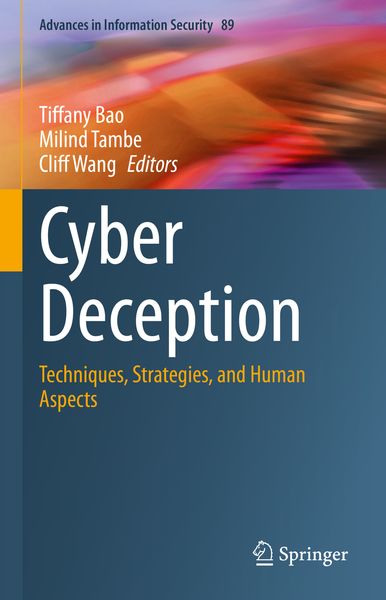
  • Produktbild: Cyber Deception
  • Produktbild: Cyber Deception
Band 89 - 12%

Cyber Deception Techniques, Strategies, and Human Aspects

12% sparen

144,99 € UVP 164,99 €

inkl. gesetzl. MwSt., Versandkostenfrei


Beschreibung

Produktdetails

Einband

Gebundene Ausgabe

Erscheinungsdatum

09.03.2023

Abbildungen

X, 249 p. 62 illus., 51 illus. in color.

Herausgeber

Tiffany Bao + weitere

Verlag

Springer

Seitenzahl

249

Maße (L/B/H)

24,1/16/2 cm

Gewicht

559 g

Auflage

2023

Sprache

Englisch

ISBN

978-3-031-16612-9

Beschreibung

Portrait


Tiffany Bao
: Dr. Tiffany Bao is an Assistant Professor at Arizona State University. Her research interest is aspects of software security, which spans binary analysis techniques, game-theoretical vulnerability mitigation strategies, qualitative study on cybersecurity operations, and vulnerability risk assessment. Dr. Bao was the winner of the NSA’s Annual Best Scientific Cybersecurity Paper Award and IEEE Security and Privacy’s Best Student Paper Award. She has served as a program committee member in toptier cybersecurity conferences, including IEEE Security and Privacy, USENIX Security, Computer and Communication Security, and Network & Distributed System Security Symposium. Her team has discovered and responsibly reported tens of zero-day vulnerabilities to the community. She received her Ph.D. from Carnegie Mellon University.


Milind Tambe
: Dr. Milind Tambe is Gordon McKay Professor of Computer Scienceand Director of Center for Research in Computation and Society at Harvard University; concurrently, he is also Principal Scientist and Director "AI for Social Good" at Google Research. He is recipient ofMilind Tambe photo 2 the IJCAI (International Joint Conference on AI) John McCarthy Award, AAMAS ACM (Association for Computing Machinery) Autonomous Agents Research Award, AAAI (Association for Advancement of Artificial Intelligence)  Robert S. Engelmore Memorial Lecture Award, and he is a fellow of AAAI and ACM. He is also a recipient of the INFORMS Wagner prize for excellence in Operations Research practice and Rist Prize from MORS (Military Operations Research Society). For his work on AI and public safety, he has received Columbus Fellowship Foundation Homeland security award and commendations and certificates of appreciation from the US Coast Guard, the Federal Air Marshals Service and airport police at the city of Los Angeles.


Cliff Wang
: Dr. Cliff Wang graduated from North Carolina State University with a PhD in computer engineering in 1996. He has been carrying out research in the area of computer vision, medical imaging, high speed networks, and most recently information security. He has authored 60 technical papers and 3 Internet standards RFCs. Dr. Wang also authored/edited for 20 books in the area of information security and hold 4 US patents on information security system development. 


Since 2003, Dr. Wang has been managing extramural research portfolio on information assurance at US Army Research Office. In 2007 he was selected as the director of the computing sciences division at ARO while in the same time managing his program in cyber security. For the past ten years, Dr. Wang managed over $250M research funding which led to significant technology breakthroughs. Dr. Wang also holds adjunct professor appointment at both Department of Computer Science and Department of Electrical and Computer Engineering at North Carolina State University. Dr. Wang is a Fellow of IEEE and AAAS.


Produktdetails

Einband

Gebundene Ausgabe

Erscheinungsdatum

09.03.2023

Abbildungen

X, 249 p. 62 illus., 51 illus. in color.

Herausgeber

Verlag

Springer

Seitenzahl

249

Maße (L/B/H)

24,1/16/2 cm

Gewicht

559 g

Auflage

2023

Sprache

Englisch

ISBN

978-3-031-16612-9

Herstelleradresse

Springer-Verlag KG
Sachsenplatz 4-6
1201 Wien
AT

Email: ProductSafety@springernature.com

Noch keine Bewertungen vorhanden

Verfassen Sie die erste Bewertung zu diesem Artikel

Helfen Sie anderen Kundinnen und Kunden durch Ihre Meinung.

Kundinnen und Kunden meinen

Bewertungen (0)

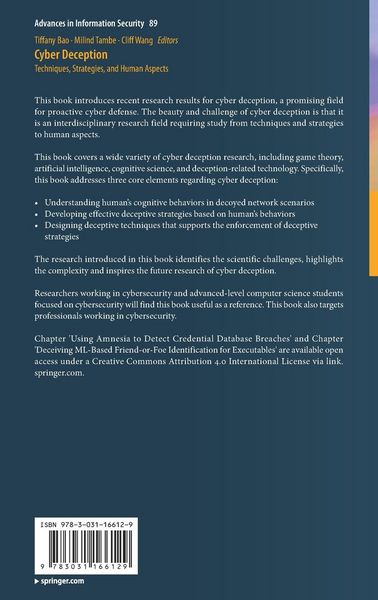
  • Produktbild: Cyber Deception
  • Produktbild: Cyber Deception
  • 1. Diversifying Deception: Game Theoretic Models for Two-Sided and Layered Deception.- 2. Human-Subject Experiments on Risk-based Cyber Camouflage Games.- 3. Adaptive Cyberdefense with Deception: A Human-AI Cognitive Approach.- 4. Cognitive Modeling for Personalized, Adaptive Signaling for Cyber Deception.- 5. Deceptive Signaling: Understanding Human Behavior against Signaling algorithms.- 6. Optimizing Honey Traffic Using Game Theory and Adversarial Learning.- 7. Mee: Adaptive Honeyfile System for Insider Attacker Detection.- 8. HoneyPLC: A Next-Generation Honeypot for Industrial Control Systems.- 9. Using Amnesia to Detect Credential Database Breaches.- 10. Deceiving ML-Based Friend-or-Foe Identification for Executables.