Gutscheinbedingungen

**Gültig bis 25.06.2026 auf fremdsprachige Bücher online auf thalia.at und in der Thalia App. Einzelne Artikel können ausgeschlossen sein. Ausgenommen sind preisgebundene Artikel & eBooks. Pro Einkauf einmal einlösbar. Click & Collect nur bei Onlinevorabzahlung möglich. Keine Barauszahlung. Nicht kombinierbar mit anderen Aktionen und Gutscheinen. Gutschein wird auf max. 500€ Bestellwert angerechnet. Nicht gültig für Geschenkkarten, Versandkosten und Services.

  • Produktbild: Cardiopulmonary Monitoring
  • Produktbild: Cardiopulmonary Monitoring

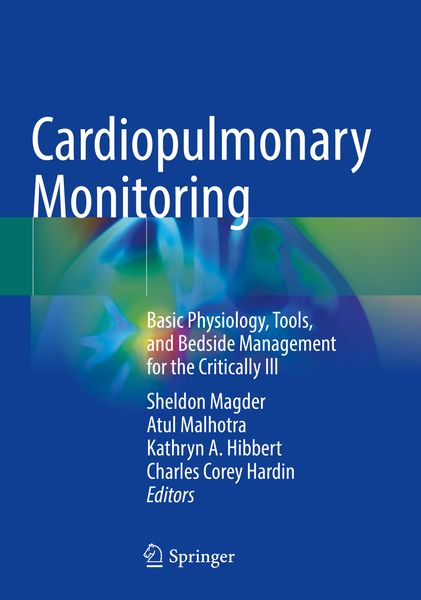
Cardiopulmonary Monitoring Basic Physiology, Tools, and Bedside Management for the Critically Ill

175,99 €

inkl. gesetzl. MwSt., Versandkostenfrei


Beschreibung

Produktdetails

Einband

Taschenbuch

Erscheinungsdatum

03.09.2022

Herausgeber

Sheldon Magder + weitere

Verlag

Springer

Seitenzahl

971

Maße (L/B/H)

25,4/17,8/5,3 cm

Gewicht

1830 g

Auflage

1st ed. 2021

Sprache

Englisch

ISBN

978-3-030-73389-6

Beschreibung

Portrait

Sheldon Magder, MD Professor of Medicine and PhysiologyRoyal Victoria Hospital (McGill University Health Centre)Department of Critical CareMontreal, Quebec, Canada 

Atul Malhotra, MD Peter C Farrell Presidential Chair and Tenured Professor of Respiratory MedicineUniversity of California San DiegoDepartment of MedicineLa Jolla, CA, USA 

Charles Corey Hardin, MD, PhD Assistant ProfessorMassachusetts General HospitalDivision of Pulmonary and Critical Care MedicineBoston, MA, USA

Kathryn A. Hibbert, MD Director, Medical ICUMassachusetts General HospitalDivision of Pulmonary and Critical CareBoston, MA, USA

Produktdetails

Einband

Taschenbuch

Erscheinungsdatum

03.09.2022

Herausgeber

Verlag

Springer

Seitenzahl

971

Maße (L/B/H)

25,4/17,8/5,3 cm

Gewicht

1830 g

Auflage

1st ed. 2021

Sprache

Englisch

ISBN

978-3-030-73389-6

Herstelleradresse

Springer-Verlag KG
Sachsenplatz 4-6
1201 Wien
AT

Email: ProductSafety@springernature.com

Kundinnen und Kunden meinen

0 Bewertungen

Informationen zu Bewertungen

Zur Abgabe einer Bewertung ist eine Anmeldung im Konto notwendig. Die Authentizität der Bewertungen wird von uns nicht überprüft. Wir behalten uns vor, Bewertungstexte, die unseren Richtlinien widersprechen, entsprechend zu kürzen oder zu löschen.

Die Bewertungen sind nach Format, Anzahl Sterne und Datum sortiert.

Verfassen Sie die erste Bewertung zu diesem Artikel

Helfen Sie anderen Kund*innen durch Ihre Meinung

Kundinnen und Kunden meinen

0 Bewertungen filtern

  • Produktbild: Cardiopulmonary Monitoring
  • Produktbild: Cardiopulmonary Monitoring
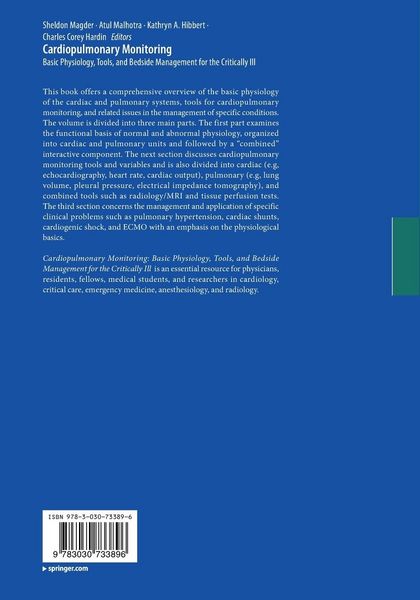
  • Chapter 1. Introduction.- Part 1: Physiological Basics .- Section 1.1: Cardiovascular Basics .- Chapter 2. Volume and the Regulation of Cardiac Output.- Chapter 3. Function of the Right Heart.- Chapter 4. Function of the Left Heart.- Chapter 5. Pulmonary Vascular Resistance.- Chapter 6. Fluid Filtration in the Microcirculation.- Chapter 7. Physiology of Heart Rate.- Chapter 8. Physiological Aspects of Arterial Blood Pressure.- Chapter 9. Pulsatile Hemodynamics and Arterial Impedance.- Chapter 10. Basics of Fluid Physiology.- Chapter 11. Cerebral Hemodynamics.- Section 1.2: Pulmonary Basics .- Chapter 12. Stress, Strain and the Inflation of the Lung.- Chapter 13. Physiology of PEEP and Auto-PEEP.- Chapter 14. Basics of Ventilation/Perfusion Abnormalities in Critically Ill Ventilated Patients.- Chapter 15. Control of Breathing.- Chapter 16. Respiratory Muscle Blood Flow and Heart-Lung Interactions.- Chapter 17. Surfactant Activity and the Pressure Volume Curve of the Respiratory System.- Section 1.3: Interactions .- Chapter 18. Heart Lung Interactions.- Part 2: The Tools .- Section 2.1: Cardiovascular .- Chapter 19. Blood Pressure Measurements.- Chapter 20. Measurement of Cardiac Output.- Chapter 21. Evaluations of Devices for Measurement of Cardiac Output.- Chapter 22. Basics of Hemodynamic Measurements.- Chapter 23. Cerebral Hemodynamic Monitoring Techniques.- Chapter 24. Transthoracic Echocardiography for Monitoring Cardiopulmonary Interactions.- Chapter 25. Transesophageal Echocardiography for Monitoring Cardiopulmonary Interactions.- Chapter 26. Extra-Cardiac Doppler Hemodynamic Assessment Using Point-of-Care Ultrasound.- Chapter 27. Measurements of Fluid Requirements with Cardiovascular Challenges.- Chapter 28. CO2-Derived Indices to Guide Resuscitation in Critically Ill Patients.- Chapter 29. Microcirculatory Monitoring to Assess Cardio-Pulmonary Status.- Chapter 30. Clinical Assessment and Monitoring of Peripheral Circulation During Shock and Resuscitation.- Chapter 31. Optimizing Oxygen Delivery in Clinical Practice.- Section 2.2: Respiratory .- Chapter 32. Measuring Volume, Flow and Pressure in the Clinical Setting.- Chapter 33. Management of Pleural Pressure.- Chapter 34. Ultrasound Assessment of the Lung.- Chapter 35. Diaphragm Ultrasound: Physiology and Applications.- Chapter 36. Monitoring Respiratory Muscle Function.- Chapter 37. Basics of Electrical Impedance Tomography and its Application.- Chapter 38. Clinical Monitoring by Volumetric Capnography.- Chapter 39. MRI in the Assessment of Cardiopulmonary Interaction.- Section 2.3: Interaction .- Chapter 40. Respiratory Function of Hemoglobin: From Origin to Human Physiology and Pathophysiology.- Chapter 41. Acid Base and Hydrogen Ion.- Part 3: Applications .- Chapter 42. Use of Maintenance and Resuscitation Fluids.- Chapter 43. Identifying and Applying Best PEEP in Ventilated Critically Ill Patients.- Chapter 44. Cardiopulmonary Monitoring in the Prone Patient.- Chapter 45. Cardiopulmonary Interactions in the Management of Acute Obstructive Disease.- Chapter 46. Evaluation and Management of Ventilator-Patient Dyssynchrony.- Chapter 47. Cardiopulmonary Monitoring in the Patient with an Inflamed Lung.- Chapter 48. Ventilation during Veno-Venous Extracorporeal Membrane Oxygenation.- Chapter 49. Vasopressor Support of Patients with Cardio-Pulmonary Failure.- Chapter 50. Cardiogenic Shock Part 1: Epidemiology, Classification, Clinical Presentation, Physiological Process and Non-Mechanical Treatments.- Chapter 51. Cardiogenic Shock Part 2: Mechanical Devices for Cardiogenic Shock.- Chapter 52. Pathophysiology of Sepsis and Heart Lung Interactions: Part 1: Presentation and Mechanisms.- Chapter 53. Pathophysiology of Sepsis and Heart-Lung Interactions: Part 2,Treatment.- Chapter 54. Cardiopulmonary Monitoring of Pulmonary Hypertension and Right Ventricular Failure.- Chapter 55. Monitoring and Management of Acute Pulmonary Embolism.- Chapter 56. Clinical Neurologic Issues in Cerebrovascular Monitoring.- Chapter 57. Delirium in the Critically Ill Patient.- Chapter 58. Obesity in Critically Ill Patients.- Section 4: Epilogue .- Chapter 59. The Future.