
KI-Beratung Beta

Gutscheinbedingungen

**Gültig bis 11.11.2026 auf Spielzeug, Schreibwaren, Filme, Geschenke & Trends, Musik, tolino eReader & Zubehör, Hörbücher und Hörbuch-Downloads, nicht preisgebundene Bücher und Kalender online auf thalia.at und in der Thalia App. Einzelne Artikel können ausgeschlossen sein. Aufgrund der Buchpreisbindung sind deutschsprachige Bücher und eBooks ausgenommen. Zusätzlich ausgenommen sind Abos & Flatrates, Games, Geschenkkarten/-boxen, Shelfies, Software, Zeitschriften sowie einzelne Artikel von tonies®. Pro Einkauf einmal einlösbar. Click & Collect nur bei Onlinevorabzahlung möglich. Keine Barauszahlung. Nicht kombinierbar mit anderen Aktionen und Gutscheinen. Gutschein wird auf max. 500€ Bestellwert angerechnet. Nicht gültig für Versandkosten und Services.

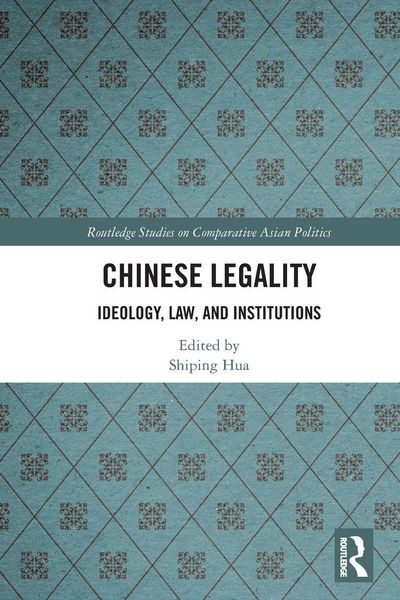
  • Produktbild: Chinese Legality
  • Produktbild: Chinese Legality

Chinese Legality Ideology, Law, and Institutions

56,99 €

inkl. gesetzl. MwSt., Versandkostenfrei


Beschreibung

Produktdetails

Einband

Taschenbuch

Erscheinungsdatum

30.12.2022

Abbildungen

13 SW-Abb., 13 SW-Zeichn., 6 Tabellen

Herausgeber

Shiping Hua

Verlag

Taylor & Francis

Seitenzahl

278

Maße (L/B/H)

23,4/15,6/1,5 cm

Gewicht

427 g

Sprache

Englisch

ISBN

978-1-03-227994-7

Beschreibung

Rezension

'Shiping Hua offers one of the best collective studies on Chinese legal reforms by organizing world-leading scholars to explain how Xi Jinping used law to control Chinese government and society. Insightful and provocative, a milestone in Chinese legal research. A must-read for those who are interested in Chinese politics and law.'

Xiaobing Li, University of Central Oklahoma, USA

'This timely new volume, edited by Professor Shiping Hua of the University of Louisville - Chinese Legality: Ideology, Law and Institutions - is both comprehensive and of considerable interest to students and academics studying current Chinese law and state legal institutions. Given the many recent challenges presented by the COVID-19 pandemic, realignment of global power and the evolution of Chinese Communist Party rule after the 20th Party Congress, this collection of analyses by a multinational cohort of China scholars is a most welcome contribution.'

James V. Feinerman, James M. Morita Professor of Asian Legal Studies, Georgetown University Law Center, USA

Produktdetails

Einband

Taschenbuch

Erscheinungsdatum

30.12.2022

Abbildungen

13 SW-Abb., 13 SW-Zeichn., 6 Tabellen

Herausgeber

Shiping Hua

Verlag

Taylor & Francis

Seitenzahl

278

Maße (L/B/H)

23,4/15,6/1,5 cm

Gewicht

427 g

Sprache

Englisch

ISBN

978-1-03-227994-7

Herstelleradresse

Libri GmbH
Europaallee 1
36244 Bad Hersfeld
DE

Email: gpsr@libri.de

Noch keine Bewertungen vorhanden

Verfassen Sie die erste Bewertung zu diesem Artikel

Helfen Sie anderen Kundinnen und Kunden durch Ihre Meinung.

Kundinnen und Kunden meinen

Bewertungen (0)

Die Leseprobe wird geladen.
  • Produktbild: Chinese Legality
  • Produktbild: Chinese Legality
  • 1. Introduction to Chinese Legality: Ideology, Law, and Institutions Part 1: How is Legality Defined? Theories and Ideologies 2. Rule of Law with Chinese Characteristics 3. A Hundred Schools of Thought Contending on Constitutionalism - The Short Life of the Great Debate of Constitutionalism Remembered 4. Legalism and the Xi Jinping Thought: Han Fei's Influence on Contemporary Chinese Politics and Law Part 2: How is Legality Reflected and Embodied in Laws? 5. Dashed Hopes? The Limits of International Economic Rules in Promoting the Rule of Law in China 6. Legality of Chinese Extraterritorial Jurisdiction 7. Civil Rights Chinese Style: The Politics and Ideology of the New Civil Code Part 3: How is Legality Realized? Institutions in Action 8. Can Xi Jinping Stop the Bureaucrats from Seeking Rents via Legislation? 9. Politics, Law, and Policing in Reform Era China 10. Legality and the Hong Kong Protests 11. Policing the Police, Party, and State: Corruption and Anti-corruption in China 12. Legality of Reprimand and Contest of Public Trust Amid the Pandemic: The Case of the Inadvertent Whistleblower Li Wenliang Part 4: Conclusion 13. Chinese Law in a Comparative Context