Gutscheinbedingungen

**Gültig bis 15.06.2026 auf Spiele & Spielzeug online auf thalia.at, in der Thalia App ab einem Mindestbestellwert von 30€ und in allen Thalia Buchhandlungen in Österreich. In den Buchhandlungen nur gültig auf lagernde Ware. Einzelne Artikel können ausgeschlossen sein. Ausgenommen sind preisgebundene Artikel sowie online auf thalia.at und in der Thalia App einzelne Artikel von tonies®. Pro Einkauf einmal einlösbar. Nur gültig gegen Vorlage oder im Onlineshop hinterlegter Bonuscard. Infos zur Einlösung in der Buchhandlung sind auf der Bonuscard-Vorteilspreisseite zu finden. Click & Collect nur bei Onlinevorabzahlung möglich. Keine Einlösung bei Scan & Go-Bezahlung. Keine Barauszahlung. Nicht kombinierbar mit anderen Aktionen und Gutscheinen. Gutschein wird auf max. 500€ Bestellwert angerechnet. Nicht gültig für Geschenkkarten, Versandkosten und Services.

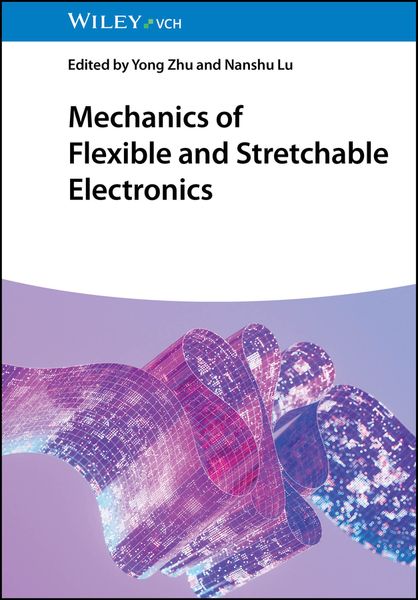
Produktbild: Mechanics of Flexible and Stretchable Electronics
- 13%

Mechanics of Flexible and Stretchable Electronics

13% sparen

155,99 € UVP 180,00 €

inkl. gesetzl. MwSt., Versandkostenfrei


Beschreibung

Produktdetails

Einband

Gebundene Ausgabe

Erscheinungsdatum

09.10.2024

Abbildungen

farbige Illustrationen, Tabellen, schwarz-weiss, schwarz-weiss Illustrationen

Herausgeber

Yong Zhu + weitere

Verlag

Wiley-VCH

Seitenzahl

496

Maße (L/B/H)

25/17,3/3 cm

Gewicht

666 g

Auflage

1. Auflage

Sprache

Englisch

ISBN

978-3-527-35219-7

Beschreibung

Portrait

Yong Zhu is the Andrew A. Adams Distinguished Professor in the Department of Mechanical and Aerospace Engineering at North Carolina State University (NCSU). He received his Ph.D. degrees from Northwestern University. His group conducts research at the intersection of solid mechanics and micro/nano-technology, including nanomechanics, microelectromechanical systems, and flexible and stretchable electronics. His work has been recognized with a number of awards including James R. Rice Medal from the Society of Engineering Science, Bessel Research Award from the Alexander von Humboldt Foundation, and Gustus L. Larson Memorial Award from ASME.


Nanshu Lu is Full Professor at the University of Texas at Austin. She received her B.Eng. from Tsinghua University, Beijing, Ph.D. from Harvard University, and then Beckman Postdoctoral Fellowship at UIUC. Her research concerns the mechanics, materials, manufacture, and human/robot integration of soft electronics. She is a Clarivate highly cited researcher. She has been named 35 innovators under 35 by MIT Technology Review (TR 35) and iCANX/ACS Nano Inaugural Rising Star. She has received US NSF CAREER Award, US ONR and AFOSR Young Investigator Awards, 3M non-tenured faculty award, and the ASME Applied Mechanics Division Thomas J.R. Hughes Young Investigator Award. She has been selected as one of the five great innovators on campus and five world-changing women of the University of Texas at Austin.

Produktdetails

Einband

Gebundene Ausgabe

Erscheinungsdatum

09.10.2024

Abbildungen

farbige Illustrationen, Tabellen, schwarz-weiss, schwarz-weiss Illustrationen

Herausgeber

Verlag

Wiley-VCH

Seitenzahl

496

Maße (L/B/H)

25/17,3/3 cm

Gewicht

666 g

Auflage

1. Auflage

Sprache

Englisch

ISBN

978-3-527-35219-7

Herstelleradresse

Wiley-VCH GmbH
Boschstraße 12
69469 Weinheim
DE

Email: wiley-vch@kolibri360.de

Kundinnen und Kunden meinen

0 Bewertungen

Informationen zu Bewertungen

Zur Abgabe einer Bewertung ist eine Anmeldung im Konto notwendig. Die Authentizität der Bewertungen wird von uns nicht überprüft. Wir behalten uns vor, Bewertungstexte, die unseren Richtlinien widersprechen, entsprechend zu kürzen oder zu löschen.

Die Bewertungen sind nach Format, Anzahl Sterne und Datum sortiert.

Verfassen Sie die erste Bewertung zu diesem Artikel

Helfen Sie anderen Kund*innen durch Ihre Meinung

Kundinnen und Kunden meinen

0 Bewertungen filtern

Die Leseprobe wird geladen.
  • Produktbild: Mechanics of Flexible and Stretchable Electronics
  • Preface xiii

    Part I Materials 1

    1 Extreme Mechanics of Hydrogels Toward In Situ Hydrogel Bioelectronics 3
    Tsz H. Wong, Xuanhe Zhao, and Shaoting Lin

    1.1 Introduction 3

    1.2 Extreme Properties of Hydrogels by Polymer Network Design 5

    1.3 Stretchable Hydrogel Conductors 14

    1.4 Electrochemical Hydrogel Biosensors 18

    1.5 Flexible Hydrogel Biobattery 20

    1.6 Concluding Remarks 23

    2 Multiscale Mechanics of Metal Nanowire-Based Stretchable Electronics 37
    Shuang Wu and Yong Zhu

    2.1 Introduction 37

    2.2 Metal NW-Based Flexible and Stretchable Electronics 38

    2.3 Mechanics of Individual NWs 39

    2.4 Interfacial Mechanics of the NW-Polymer Interface 45

    2.5 Mechanical Design of Stretchable Structures 54

    2.6 Concluding Remarks 58

    3 Liquid Metal-Based Electronics 69
    Carmel Majidi

    3.1 Introduction 69

    3.2 LM Architectures 71

    3.3 Mechanics and Modeling 76

    3.4 Open Challenges and Future Directions 81

    4 Mechanics of Two-Dimensional Materials 87
    Olugbenga Ogunbiyi and Yingchao Yang

    4.1 Introduction 87

    4.2 Nanoindentation Method 90

    4.3 AFM-Enabled Nanoindentation 93

    4.4 In Situ Indentation in SEM 108

    4.5 Micro-/Nano-mechanical Devices 111

    4.6 Piezoelectric Tube-Driven Testing in TEM 120

    4.7 Bulge Testing 121

    4.8 Electrostatic Force Triggered Drum Structure 124

    4.9 Phonon Dispersion Measurement 125

    4.10 Summary 126

    5 Mechanics of Flexible and Stretchable Organic Electronics 139
    Abdullah Al Shafe and Brendan T. O'Connor

    5.1 Introduction 139

    5.2 Mechanical Characterization Methods 140

    5.3 Material Design 145

    5.4 Device Design 153

    5.5 Applications 156

    5.6 Conclusion 159

    Part II Design and Manufacturing 171

    6 Structural Design of Flexible and Stretchable Electronics 173
    Zhaoqian Xie, Zichen Zhao, and Raudel Avila

    6.1 Introduction 173

    6.2 Design of Planar Stretchable and Flexible Structures 174

    6.3 Design of Three-Dimensional Flexible Electronic Structures 189

    6.4 Design of Protective Structures for Flexible Electronic Devices 193

    7 Laser-Based Fabrication Process Development for Flexible and Stretchable Electronics 207
    Jung Jae Park, Minwoo Kim, and Seung Hwan Ko

    7.1 Introduction 207

    7.2 Representative Laser-Based Fabrication Process 208

    7.3 Applications Based on Laser Fabrication 211

    7.4 Perspectives and Conclusion 225

    8 Electrospinning Manufacturing of Stretchable Electronics 235
    Yinhui Li, Kan Li, Yunlei Zhou, and YongAn Huang

    8.1 Background 235

    8.2 High-Precision Manufacturing 236

    8.3 Electrospinning Stretchable Structure 243

    8.4 Application in Stretchable Electronics 247

    8.5 Conclusions 254

    9 Mechanics-Guided 3D Assembly of Flexible Electronics 265
    Guoquan Luo, Jianzhong Zhao, Xu Cheng, and Yihui Zhang

    9.1 Introduction 265

    9.2 Design Strategies of Mechanics-Guided Assembly 266

    9.3 Mechanics Modeling and Analyses of the 3D Assembly 275

    9.4 Applications of 3D Flexible Electronics 284

    9.5 Concluding Remarks 287

    10 Harnessing Wrinkling and Buckling Instabilities for Stretchable Devices and Healthcare 293
    Yao Zhao, Fangjie Qi, Haoze Sun, Yanbin Li, Haitao Qing, and Jie Yin

    10.1 Introduction 293

    10.2 Structural Designs and Mechanics 294

    10.3 Applications in Stretchable Devices 300

    10.4 Applications in Healthcare 306

    10.5 Conclusion and Outlook 311

    Part III Applications 319

    11 Spherical Indentation Behavior of Soft Electronics 321
    Changxian Wang, Zequn Cui, and Xiaodong Chen

    11.1 Spherical Indentation of the Semi-infinite Solid 321

    11.2 Applications in a Force-Softness Bimodal Sensor Array for Human Body Feature Identification 328

    11.3 Applications in a Self-Locked Young's Modulus Sensor for Quantifying the Softness of Swollen Tissues in the Clinic 336

    11.4 Conclusions 343

    12 Mechanics of Wet Adhesion 345
    Jiawei Yang and Ruobing Bai

    12.1 Introduction 345

    12.2 Characterization of Adhesion 346

    12.3 General Principles for StrongWet Adhesion 347

    12.4 Methods for StrongWet Adhesion 354

    12.5 Mechanics ofWet Interfaces 357

    12.6 Summary and Outlook 362

    13 Electromechanics of Soft Resistive and Capacitive Tactile Sensors 373
    Zhengjie Li, Sangjun Kim, Zheliang Wang, Zhengtao Zhu, and Nanshu Lu

    13.1 Introduction 373

    13.2 Resistive Tactile Sensors 378

    13.3 Capacitive Tactile Sensors 399

    13.4 Resistive-Capacitive Hybrid Response Tactile Sensors 415

    13.5 Conclusion and Outlook 418

    14 Active Mechanical Haptics Constructed with Curved Origami 431
    Zhuang Zhang and Hanqing Jiang

    14.1 Introduction 431

    14.2 Stiffness Tuning via Curved Origami 432

    14.3 Theoretical Modeling and Analysis of Curved Origami 434

    14.4 Closed-Loop Design and System Integration of Origami 438

    14.5 In-hand Haptic Device 440

    14.6 Stiffness Perception via Active Pressing 443

    14.7 Body-Centered Stepping Device 444

    14.8 Whole-Body Stiffness Perceptions 447

    14.9 Discussion 448

    15 Mechanics of Transient Electronics 453
    Ankan Dutta and Huanyu Cheng

    15.1 Introduction 453

    15.2 Hydrolysis of Semiconducting Materials 455

    15.3 Model of Reactive Diffusion for Transient Materials 457

    15.4 Dissolution of the Device with Bi-layered Structures 461

    15.5 Conclusion 467

    Acknowledgments 468

    References 468

    Index 473