Gutscheinbedingungen

**Gültig bis 06.07.2026 auf fremdsprachige Bücher online auf thalia.at, in der Thalia App ab einem Mindestbestellwert von 30€ und in allen Thalia Buchhandlungen in Österreich. In den Buchhandlungen nur gültig auf lagernde Ware. Einzelne Artikel können ausgeschlossen sein. Ausgenommen sind preisgebundene Artikel & eBooks. Pro Einkauf einmal einlösbar. Nur gültig gegen Vorlage oder im Onlineshop hinterlegter Bonuscard. Infos zur Einlösung in der Buchhandlung sind auf der Bonuscard-Vorteilspreisseite zu finden. Click & Collect nur bei Onlinevorabzahlung möglich. Keine Einlösung bei Scan & Go-Bezahlung. Keine Barauszahlung. Nicht kombinierbar mit anderen Aktionen und Gutscheinen. Gutschein wird auf max. 500€ Bestellwert angerechnet. Nicht gültig für Versandkosten und Services.

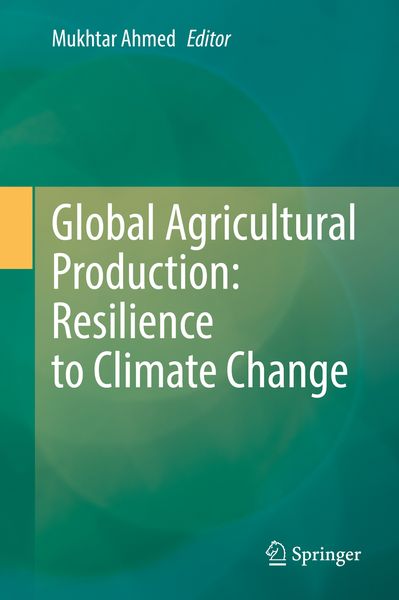
Produktbild: Global Agricultural Production: Resilience to Climate Change
- 12%

Global Agricultural Production: Resilience to Climate Change

12% sparen

173,99 € UVP 197,99 €

inkl. gesetzl. MwSt., Versandkostenfrei


Beschreibung

Produktdetails

Einband

Gebundene Ausgabe

Erscheinungsdatum

03.01.2023

Herausgeber

Mukhtar Ahmed

Verlag

Springer

Seitenzahl

634

Maße (L/B/H)

24,1/16/3,8 cm

Gewicht

1238 g

Auflage

1st ed. 2022

Sprache

Englisch

ISBN

978-3-031-14972-6

Beschreibung

Portrait

Mukhtar Ahmed’s research focuses on the impact of climate change on crop ecology, crop physiology, cropping system and rain-fed ecosystem management. He has been involved in teaching and research since 2005. During his PhD and visit to Sydney University, Australia, he worked on the application of APSIM as a decision support tool and rainfall forecasting using generalised additive models. He was awarded a young scientist fellowship by APCC South Korea. He also won a research productivity award from Pakistan Council of Science and Technology (PCST) and a Publons reviewer award in 2018 and 2019.  He was part of the Regional Approaches for Climate Change (REACCH) project in the USA, which developed multi-model ensemble approaches to minimize the uncertainties. He is involved in the use of statistical and dynamic models as risk management tools to mitigate the challenges of climate change. Dr. Ahmed also has experience in applying his expertise in Nordic climate atSwedish University of Agricultural Sciences (2019-2021) where he was involved in the adaptability of perennial grasses e.g., red clover and yellow lucerne under changing climate as well as in whole farm modeling, precision agriculture and APSIM next generation modeling. His current research includes agroecosystems modelling, precision agriculture, modelling the nutrient use efficiency of legume-based cropping systems, forage agronomy and physiological responses to climate variability and its modelling. He is a project co-leader in the Model Calibration Group of the Agricultural Model Intercomparison and Improvement Project (AGMIP) Wheat and Maize Evapotranspiration. Dr. Ahmed has published more than 100 articles in well-known high quality solid journals and he is the author of 50 book chapters. He has an H-Index of 33 with citations of more than 3500. He is an editor and reviewer of several peer-reviewed, international journals. He is also an active lifetime member of professional societies like the Pakistan Society of Agronomy and Pakistan Society of Botany. He has attended and presented papers and posters at national and international conferences in various countries.

Produktdetails

Einband

Gebundene Ausgabe

Erscheinungsdatum

03.01.2023

Herausgeber

Mukhtar Ahmed

Verlag

Springer

Seitenzahl

634

Maße (L/B/H)

24,1/16/3,8 cm

Gewicht

1238 g

Auflage

1st ed. 2022

Sprache

Englisch

ISBN

978-3-031-14972-6

Herstelleradresse

Springer-Verlag KG
Sachsenplatz 4-6
1201 Wien
AT

Email: GPSR Kontakt

Noch keine Bewertungen vorhanden

Verfassen Sie die erste Bewertung zu diesem Artikel

Helfen Sie anderen Kundinnen und Kunden durch Ihre Meinung.

Kundinnen und Kunden meinen

Bewertungen (0)

  • Produktbild: Global Agricultural Production: Resilience to Climate Change
  • Chapter 1. Climate change: An Overview.- Chapter 2. Climate change, agricultural productivity, and food security.- Chapter 3. Climate change and Process Based Soil Modeling.- Chapter 4. Soil microbes and climate smart agriculture.- Chapter 5. Climate Change Impacts on Legumes Crop Production and Adaptation Strategies.- Chapter 6. Cereal crop modeling for food and nutrition security.- Chapter 7. Changing climate scenario: Perspectives of Camelina sativa as low input biofuel and oilseed crop.- Chapter 8. Greenhouse Gas Emissions and Mitigation Strategies in Rice Production Systems.- Chapter 9. Fiber Crops in Changing Climate.- Chapter 10. Estimation of Crop Genetic Coefficients to Simulate Growth and Yield under Changing Climate.- Chapter 11. Climate Change Impacts on Animal Production.- Chapter 12. Climate change and global insect dynamics.- Chapter 13. Sustainable Solutions to Food Insecurity in Nigeria: Perspectives on Irrigation, Crop-Water Productivity, and antecedents.- Chapter 14. Functions of Soil Microbes Under Stress Environment.- Chapter 15. Modeling impacts of climate change and adaptation strategies for cereal crops in Ethiopia.- Chapter 16. Strategies for Mitigating Greenhouse Gas Emissions from Agricultural Ecosystems.- Chapter 17. Environmental and Economic Benefits of Sustainable Sugarcane Initiative and Production Constraints in Pakistan: A Review.- Chapter 18. Modeling Photoperiod Response of Canola under Changing Climate.- Chapter 19. Modeling and Field Based Evaluation of Vernalisation Requirement of Canola for Higher Yield Potential.- Chapter 20. Integrated crop-livestock system: Prospectus for climate change adaptation in Jordan, a case study.- Chapter 21. Impact of Salinity Intrusion Problem in the sediments of paddy field and farmers adaptation initiative: Case Study.