Gutscheinbedingungen

**Gültig bis 24.09.2026 ab einem Mindestbestellwert von 30€ auf Spielzeug, Schreibwaren, Filme, Geschenke & Trends, Musik, tolino eReader & Zubehör, Hörbücher und Hörbuch-Downloads, nicht preisgebundene Bücher und Kalender online auf thalia.at und in der Thalia App. Einzelne Artikel können ausgeschlossen sein. Aufgrund der Buchpreisbindung sind deutschsprachige Bücher und eBooks ausgenommen. Zusätzlich ausgenommen sind Abos & Flatrates, Games, Geschenkkarten/-boxen, Shelfies, Software, Zeitschriften sowie einzelne Artikel von tonies®. Pro Einkauf einmal einlösbar. Click & Collect nur bei Onlinevorabzahlung möglich. Keine Barauszahlung. Nicht kombinierbar mit anderen Aktionen und Gutscheinen. Gutschein wird auf max. 500€ Bestellwert angerechnet. Nicht gültig für Versandkosten und Services. Preisgebundene Artikel sind vom Mindestbestellwert ausgeschlossen.

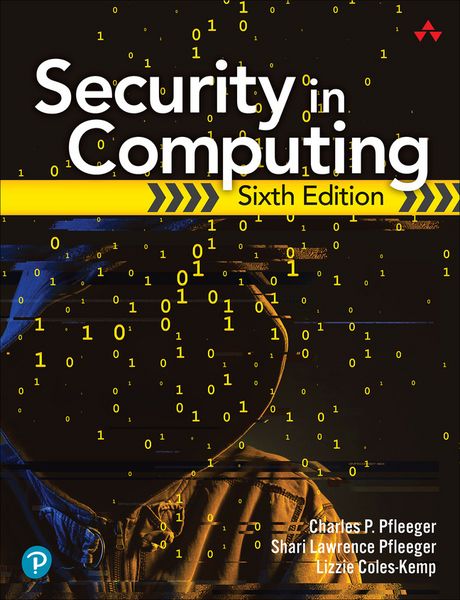
Produktbild: Security in Computing
- 15%

Security in Computing

15% sparen

98,99 € UVP 116,49 €

inkl. gesetzl. MwSt., Versandkostenfrei


Beschreibung

Produktdetails

Einband

Taschenbuch

Erscheinungsdatum

26.07.2023

Verlag

Pearson Education Limited

Seitenzahl

1040

Maße (L/B/H)

23,2/17,8/5,6 cm

Gewicht

1744 g

Auflage

6

Sprache

Englisch

ISBN

978-0-13-789121-4

Beschreibung

Produktdetails

Einband

Taschenbuch

Erscheinungsdatum

26.07.2023

Verlag

Pearson Education Limited

Seitenzahl

1040

Maße (L/B/H)

23,2/17,8/5,6 cm

Gewicht

1744 g

Auflage

6

Sprache

Englisch

ISBN

978-0-13-789121-4

Herstelleradresse


Email: info@bod.de

Noch keine Bewertungen vorhanden

Verfassen Sie die erste Bewertung zu diesem Artikel

Helfen Sie anderen Kundinnen und Kunden durch Ihre Meinung.

Kundinnen und Kunden meinen

Bewertungen (0)

Die Leseprobe wird geladen.
  • Produktbild: Security in Computing
  • Foreword xix

    Preface xxv

    Acknowledgments xxxi

    About the Authors xxxiii

    Chapter 1: Introduction 1

    1.1 What Is Computer Security? 3

    1.2 Threats 6

    1.3 Harm 24

    1.4 Vulnerabilities 30

    1.5 Controls 30

    1.6 Conclusion 33

    1.7 What's Next? 34

    1.8 Exercises 36

    Chapter 2: Toolbox: Authentication, Access Control, and Cryptography 38

    2.1 Authentication 40

    2.2 Access Control 78

    2.3 Cryptography 93

    2.4 Conclusion 137

    2.5 Exercises 138

    Chapter 3: Programs and Programming 141

    3.1 Unintentional (Nonmalicious) Programming Oversights 143

    3.2 Malicious Code--Malware 178

    3.3 Countermeasures 211

    3.4 Conclusion 245

    3.5 Exercises 245

    Chapter 4: The Internet--User Side 248

    4.1 Browser Attacks 251

    4.2 Attacks Targeting Users 265

    4.3 Obtaining User or Website Data 280

    4.4 Mobile Apps 289

    4.5 Email and Message Attacks 310

    4.6 Conclusion 320

    4.7 Exercises 321

    Chapter 5: Operating Systems 323

    5.1 Security in Operating Systems 323

    5.2 Security in the Design of Operating Systems 351

    5.3 Rootkits 371

    5.4 Conclusion 382

    5.5 Exercises 382

    Chapter 6: Networks 385

    6.1 Network Concepts 386

    Part I--War on Networks: Network Security Attacks 399

    6.2 Threats to Network Communications 400

    6.3 Wireless Network Security 421

    6.4 Denial of Service 443

    6.5 Distributed Denial of Service 468

    Part II--Strategic Defenses: Security Countermeasures 479

    6.6 Cryptography in Network Security 479

    6.7 Firewalls 497

    6.8 Intrusion Detection and Prevention Systems 522

    6.9 Network Management 536

    6.10 Conclusion 545

    6.11 Exercises 545

    Chapter 7: Data and Databases 549

    7.1 Introduction to Databases 550

    7.2 Security Requirements of Databases 555

    7.3 Reliability and Integrity 561

    7.4 Database Disclosure 566

    7.5 Data Mining and Big Data 585

    7.6 Conclusion 599

    7.7 Exercises 599

    Chapter 8: New Territory 601

    8.1 Introduction 601

    8.2 Cloud Architectures and Their Security 605

    8.3 IoT and Embedded Devices 627

    8.4 Cloud, IoT, and Embedded Devices--The Smart Home 638

    8.5 Smart Cities, IoT, Embedded Devices, and Cloud 643

    8.6 Cloud, IoT, and Critical Services 648

    8.7 Conclusion 657

    8.8 Exercises 658

    Chapter 9: Privacy 659

    9.1 Privacy Concepts 660

    9.2 Privacy Principles and Policies 671

    9.3 Authentication and Privacy 688

    9.4 Data Mining 694

    9.5 Privacy on the Internet 698

    9.6 Email and Message Security 713

    9.7 Privacy Impacts of Newer Technologies 717

    9.8 Conclusion 724

    9.9 Exercises 725

    Chapter 10: Management and Incidents 727

    10.1 Security Planning 727

    10.2 Business Continuity Planning 738

    10.3 Handling Incidents 742

    10.4 Risk Analysis 749

    10.5 Physical Threats to Systems 767

    10.6 New Frontiers in Security Management 776

    10.7 Conclusion 778

    10.8 Exercises 779

    Chapter 11: Legal Issues and Ethics 781

    11.1 Protecting Programs and Data 783

    11.2 Information and the Law 800

    11.3 Rights of Employees and Employers 805

    11.4 Redress for Software Failures 808

    11.5 Computer Crime 814

    11.6 Ethical Issues in Computer Security 822

    11.7 An Ethical Dive into Artificial Intelligence 828

    11.8 Incident Analyses with Ethics 830

    11.9 Conclusion 846

    11.10 Exercises 847

    Chapter 12: Details of Cryptography 850

    12.1 Cryptology 851

    12.2 Symmetric Encryption Algorithms 863

    12.3 Asymmetric Encryption 877

    12.4 Message Digests 883

    12.5 Digital Signatures 888

    12.6 Quantum Key Distribution 889

    12.7 Conclusion 894

    Chapter 13: Emerging Topics 895

    13.1 AI and Cybersecurity 896

    13.2 Blockchains and Cryptocurrencies 908

    13.3 Offensive Cyber and Cyberwarfare 924

    13.4 Quantum Computing and Computer Security 936

    13.5 Conclusion 937

    Bibliography 939

    Index 963