Beschreibung
Produktdetails
Einband
Taschenbuch
Erscheinungsdatum
17.11.2022
Verlag
Human Kinetics PublishersSeitenzahl
520
Maße (L/B/H)
28,1/21,6/3,1 cm
Gewicht
1444 g
Sprache
Englisch
ISBN
978-1-4925-9958-6
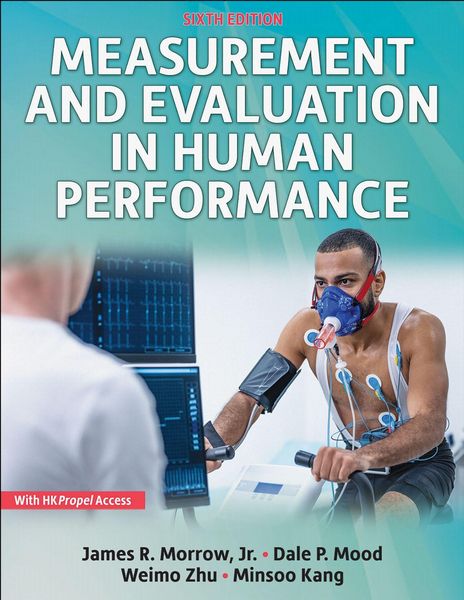
This is the loose-leaf version of Measurement and Evaluation in Human Performance, Sixth Edition With HKPropel Access, which offers students a less expensive, printed version of the text.
Measurement and Evaluation in Human Performance, Sixth Edition With HKPropel Access, guides students through the essentials of collecting and analyzing data of human performance and using that data in practical application. Introductory algebraic concepts are combined with the technological capabilities of Microsoft Excel and IBM’s SPSS software to aid students in calculations and data analysis. Focusing on the core concepts of reliability and validity of data, the text provides all the necessary tools for evidence-based decision making to apply in kinesiology, sport and exercise science, physical therapy, allied health, physical education, health, and fitness.
The sixth edition of Measurement and Evaluation in Human Performance has been reorganized to offer a logical progression of information that makes it easy for instructors and students to apply the content to their specific courses and career goals. It is enhanced with added expertise from new coauthor Weimo Zhu, who served as the chair of the Measurement and Evaluation Council of SHAPE America. The amount of information on physical activity assessment has been increased across all chapters, and the text includes new content about sport video analysis apps, employment-related testing, and more.
The text is divided into four parts. Part I introduces the concepts of measurement and evaluation and their importance for decision making in human performance. Part II explores statistics as core tools and resources for these evaluations and explains the various forms of statistical procedures often used in measurement. Part III presents reliability and validity from theoretical, comprehensive, and criterion-referenced perspectives. Skills gained through previous sections are applied to human performance issues such as evaluating a person’s aerobic capacity or muscular strength. Part IV applies all of the content from the previous sections to practical settings where students will use the knowledge gained in the text, covering topics like fitness assessment, performance assessment, motor behavior, and sport and exercise psychology.
To enhance student comprehension and retention, related online learning aids are delivered through HKPropel. Sample data sets allow students to practice data analysis, as do a wide range of study and practice activities. Chapter quizzes may be assigned to students by instructors and are automatically graded within HKPropel. In addition, Mastery Item sidebars throughout the text include problems and activities that test student knowledge, while Measurement and Evaluation Challenge sidebars provide scenarios that can be tackled with the information from the chapter.
Measurement and Evaluation in Human Performance, Sixth Edition, continues to provide students with the tools and confidence they will need to gather reliable data, analyze it, and apply it in their work with clients.
Note: A code for accessing HKPropel is included with all new print books.
Noch keine Bewertungen vorhanden
Verfassen Sie die erste Bewertung zu diesem Artikel
Helfen Sie anderen Kundinnen und Kunden durch Ihre Meinung.
Kurze Frage zu unserer Seite
Vielen Dank für Ihr Feedback
Wir nutzen Ihr Feedback, um unsere Produktseiten zu verbessern. Bitte haben Sie Verständnis, dass wir Ihnen keine Rückmeldung geben können. Falls Sie Kontakt mit uns aufnehmen möchten, können Sie sich aber gerne an unseren Kund*innenservice wenden.
zum Kundenservice