Gutscheinbedingungen

**Gültig nur für Bestellungen an die Wunsch-Poststation bis 10.06.2026 auf Spielzeug, Schreibwaren, Filme, Geschenke & Trends, Musik, tolino eReader & Zubehör, Hörbücher und Hörbuch-Downloads (außer Abo), nicht preisgebundene Bücher und Kalender online auf thalia.at und in der Thalia App. Einzelne Artikel können ausgeschlossen sein. Aufgrund der Buchpreisbindung sind deutschsprachige Bücher und eBooks ausgenommen. Zusätzlich ausgenommen sind preisgebundene Artikel, Abos & Flatrates, eBooks, Games, Geschenkkarten/-boxen, Shelfies, Software, Zeitschriften sowie einzelne Artikel von tonies®. Pro Einkauf einmal einlösbar. Kein Click & Collect möglich. Keine Barauszahlung. Nicht kombinierbar mit anderen Aktionen und Gutscheinen. Gutschein wird auf max. 500€ Bestellwert angerechnet. Nicht gültig für Versandkosten und Services.

  • Produktbild: Handbook of Resilience in Children
  • Produktbild: Handbook of Resilience in Children
- 13%

Handbook of Resilience in Children

13% sparen

361,99 € UVP 417,99 €

inkl. gesetzl. MwSt., Versandkostenfrei


Beschreibung

Produktdetails

Einband

Gebundene Ausgabe

Erscheinungsdatum

10.03.2023

Herausgeber

Sam Goldstein + weitere

Verlag

Springer

Seitenzahl

601

Maße (L/B/H)

26/18,3/3,9 cm

Gewicht

1354 g

Auflage

Third Edition 2023

Sprache

Englisch

ISBN

978-3-031-14727-2

Beschreibung

Portrait

Sam Goldstein obtained his Ph.D. in School Psychology from the University of Utah and is licensed as a Psychologist and Certified School Psychologist in the state of Utah. He is also board certified as a Pediatric Neuropsychologist and listed in the Council for the National Register of Health Service Providers in Psychology. He is a Fellow of the American Psychological Association and the National Academy of Neuropsychology. He is an Adjunct Assistant Professor in the Department of Psychiatry, the University of Utah School of Medicine. He has authored, co-edited, or co-authored over fifty clinical and trade publications, three dozen chapters, nearly three dozen peer-reviewed scientific articles, and eight psychological and europsychological tests. Since 1980, he has served as Clinical Director of The Neurology, Learning, and Behavior Center in Salt Lake City, Utah.

Robert B. Brooks obtained his Ph.D. in Clinical Psychology from Clark University in Worcester, MA, and completed a postdoctoral fellowship at the University of Colorado Medical School in Denver. He is board certified in Clinical Psychology and listed in the Council for the National Register of Health Service Providers in Psychology. He is currently on the faculty of Harvard Medical School (part-time) and is Former Director of the Department of Psychology at McLean Hospital, a private psychiatric hospital. He has authored, co-edited, or co-authored 19 books and, in addition, authored or co-authored almost three dozen chapters and more than three dozen peer-reviewed scientific articles. He has received numerous awards for his work, including most recently the Mental Health Humanitarian Award from William James College in Massachusetts for his contributions as a Clinician, Educator, and Author.

Produktdetails

Einband

Gebundene Ausgabe

Erscheinungsdatum

10.03.2023

Herausgeber

Verlag

Springer

Seitenzahl

601

Maße (L/B/H)

26/18,3/3,9 cm

Gewicht

1354 g

Auflage

Third Edition 2023

Sprache

Englisch

ISBN

978-3-031-14727-2

Herstelleradresse

Springer-Verlag GmbH
Tiergartenstr. 17
69121 Heidelberg
DE

Email: ProductSafety@springernature.com

Kundinnen und Kunden meinen

0 Bewertungen

Informationen zu Bewertungen

Zur Abgabe einer Bewertung ist eine Anmeldung im Konto notwendig. Die Authentizität der Bewertungen wird von uns nicht überprüft. Wir behalten uns vor, Bewertungstexte, die unseren Richtlinien widersprechen, entsprechend zu kürzen oder zu löschen.

Die Bewertungen sind nach Format, Anzahl Sterne und Datum sortiert.

Verfassen Sie die erste Bewertung zu diesem Artikel

Helfen Sie anderen Kund*innen durch Ihre Meinung

Kundinnen und Kunden meinen

0 Bewertungen filtern

  • Produktbild: Handbook of Resilience in Children
  • Produktbild: Handbook of Resilience in Children
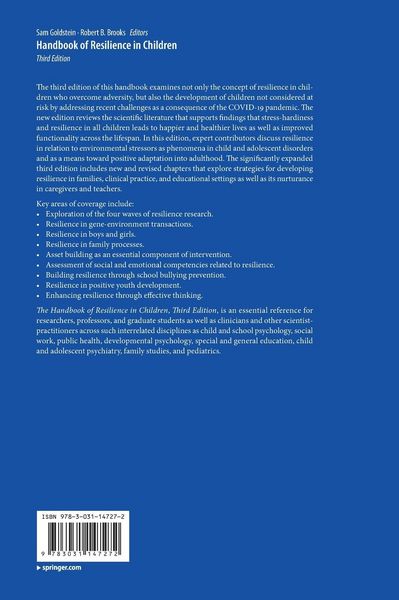
  • Part I: Overview.- Chapter 1 The Continuing Study of Resilience in Times of a Pandemic:  This is Why We Study Childhood Resilience.- Chapter 2 Resilience Processes in Development: Multisystem Integration Emerging from Four Waves of Research.- Chapter 3 Resilience in Gene-Environment Transactions.- Chapter 4 Relational Resilience in Girls.- Chapter 5 What Can We Learn About Resilience from Large-Scale Longitudinal Studies?.- Part II: Resilience as a Phenomenon in Childhood Challenges.- Chapter 6 Resilience in Situational and Cultural Context.- Chapter 7 Appreciating and Promoting Resilience in Families.- Chapter 8 Resilience and the Disruptive, Impulse Control and Conduct Disorders of Childhood.- Chapter 9 From Helplessness to Optimism: The Role of Resilience in Treating and Preventing Depression in Youth.- Chapter 10 Resilience and Self-Control Impairment.- Part III: Assessment of Resilience.- Chapter 11 Measuring Resilience in Children: From Theory to Practice.- Chapter 12 Assessment of Social Emotional Competencies in Educational Settings.- Chapter 13 Assessing Resiliency in Children, Adolescents and Young Adults.- Chapter 14 Assessment of Resilience with the Risk Inventory and Strengths Evaluation (RISE).- Part IV: Resilience in Family and Community Settings.- Chapter 15 Comprehensive Interventions to Foster Resilience in Children With Complex Trauma.- Chapter 16 Building Resilience in Juvenile Offenders.- Chapter 17 Cultivating Resilience in LGBTQ+ Youth.- Chapter 18 Resilience and Positive Youth Development:  A Dynamic, Relational Developmental Systems-Based Perspective.- Chapter 19 A Resilience Framework for Treating Child Trauma.- Chapter 20 Promoting Resilience in Families.- Chapter 21 The Power of Parenting.- Chapter 22 Building Resilience in Children: A Public Health Equity Approach.- Chapter 23 Enhancing the Process of Resilience Through Effective Thinking.- Part V Resilience in School Settings.- Chapter 24 Re-thinking Approaches to Fostering Academic Resilience.- Chapter 25 Resilience and the Child with Learning Disabilities.- Chapter 26 Resilience through Violence and Bullying Prevention in Schools.- Chapter 27 Caring for the Caregiver: Promoting the Resilience of Educators.- Chapter 28 Enhancing Resilience in Classrooms.- Chapter 29 School Climate Improvement:  A Data-Driven Strategy That Supports.- Chapter 30 Nurturing Positive Emotions in the Classroom:  A Foundation for Purpose.- Chapter 31 The BARR Model:  Fostering Resilient School Systems, Staff and Students.- Part VI  Conclusions.- Chapter 32 After Resilience, What?