KI-Beratung Beta

Gutscheinbedingungen

**Gültig bis 18.11.2026 auf englischsprachige Klassiker (klassiker-32728) online auf thalia.at und in der Thalia App. Einzelne Artikel können ausgeschlossen sein. Ausgenommen sind preisgebundene Artikel & eBooks. Pro Einkauf einmal einlösbar. Click & Collect nur bei Onlinevorabzahlung möglich. Keine Barauszahlung. Nicht kombinierbar mit anderen Aktionen und Gutscheinen. Gutschein wird auf max. 500€ Bestellwert angerechnet. Nicht gültig für Geschenkkarten, Versandkosten und Services.

  • Produktbild: How People Learn in Informal Science Environments
  • Produktbild: How People Learn in Informal Science Environments
- 13%

How People Learn in Informal Science Environments

13% sparen

142,99 € UVP 164,99 €

inkl. gesetzl. MwSt., Versandkostenfrei


Beschreibung

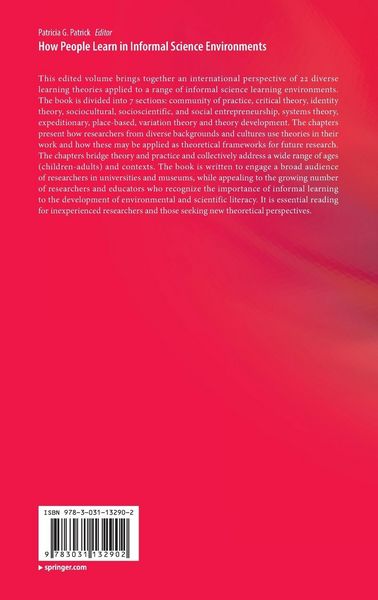
This edited volume brings together an international perspective of 22 diverse learning theories applied to a range of informal science learning environments. The book is divided into 7 sections: community of practice, critical theory, identity theory, sociocultural, socioscientific, and social entrepreneurship,...

Beschreibung

This edited volume brings together an international perspective of 22 diverse learning theories applied to a range of informal science learning environments. The book is divided into 7 sections: community of practice, critical theory, identity theory, sociocultural, socioscientific, and social entrepreneurship, systems theory, and theory development. The chapters present how researchers from diverse backgrounds and cultures use theories in their work and how these may be applied as theoretical frameworks for future research. The chapters bridge theory and practice and collectively address a wide range of ages (children-adults) and contexts. The book is written to engage a broad audience of researchers in universities and museums, while appealing to the growing number of researchers and educators who recognize the importance of informal learning to the development of environmental and scientific literacy. It is essential reading for inexperienced researchers and those seeking new theoretical perspectives.

Portrait


Dr. Patrick is an associate professor at Columbus State University and a Fulbright Scholar (2019 & 2022). Her Fulbright project focused on the ways Sumatran (Indonesia) Battra, native healers, passed native medicine, environmental, and ecological knowledge to the next generation. She is the coauthor of 
Zoo Talk
 (Springer) and Editor of 
Preparing Informal Science Educators
(Springer). Her research focuses on the importance of communicating science to the public and the relationship between communication and science literacy. Her interest is identifying how families learn and share science knowledge.

Produktdetails

Einband

Gebundene Ausgabe

Erscheinungsdatum

04.04.2023

Abbildungen

XIII, 568 p. 92 illus., 46 illus. in color.

Herausgeber Patricia G. Patrick

Produktdetails

Einband

Gebundene Ausgabe

Erscheinungsdatum

04.04.2023

Abbildungen

XIII, 568 p. 92 illus., 46 illus. in color.

Herausgeber Patricia G. Patrick
Verlag Springer
Seitenzahl

568

Maße (L/B/H)

24,1/16/3,7 cm

Gewicht

982 g

Auflage

2023

Sprache

Englisch

ISBN

978-3-031-13290-2

Herstelleradresse

Springer-Verlag GmbH
Europaplatz 3
69115 Heidelberg
DE

Email: ProductSafety@springernature.com

Noch keine Bewertungen vorhanden

Verfassen Sie die erste Bewertung zu diesem Artikel

Helfen Sie anderen Kundinnen und Kunden durch Ihre Meinung.

Kundinnen und Kunden meinen

Bewertungen (0)

  • Produktbild: How People Learn in Informal Science Environments
  • Produktbild: How People Learn in Informal Science Environments

  • Part 1: Adult Learning.- Chapter 1. Teaching About the Holocaust Through Expeditionary Learning.- Chapter 2. Conceptualising and working With a Theory of Learning for Adults Who Need to Know.- Part 2: Aquariums, Arboretums, and Zoos.-  Chapter 3. The ARCS Model: Motivate Audiences and Facilitating Learning.- Chapter 4. Application of the Contextual Model of Learning and the Situated Identity Model in Informal STEM Learning Research.- Chapter 5. Socioscientific Issues and the Potential for Fostering Engagement in Informal Science Institutions.- Chapter 6. Sociocultural Theory: Defining Interactions at an Arboretum, Aquarium, and State Park.- Chapter 7. Merging Three Learning Theories to Understand How Learning Outside the Classroom Institutions Learn Themselves.- Part 3: Community Spaces.- Chapter 8. A Mobile Theory of Learning and Becoming in and Through Relations of Dignity: A Research Framing for Research Outside the Classroom.- Chapter 9. Complementing Informal STEM Education with Social Entrepreneurship.- Chapter 10. Playing to Become a Science Person: The Application of Play and Identity Theories in Two Out-of-School Settings.