Gutscheinbedingungen

**Gültig bis 06.07.2026 auf fremdsprachige Bücher online auf thalia.at, in der Thalia App ab einem Mindestbestellwert von 30€ und in allen Thalia Buchhandlungen in Österreich. In den Buchhandlungen nur gültig auf lagernde Ware. Einzelne Artikel können ausgeschlossen sein. Ausgenommen sind preisgebundene Artikel & eBooks. Pro Einkauf einmal einlösbar. Nur gültig gegen Vorlage oder im Onlineshop hinterlegter Bonuscard. Infos zur Einlösung in der Buchhandlung sind auf der Bonuscard-Vorteilspreisseite zu finden. Click & Collect nur bei Onlinevorabzahlung möglich. Keine Einlösung bei Scan & Go-Bezahlung. Keine Barauszahlung. Nicht kombinierbar mit anderen Aktionen und Gutscheinen. Gutschein wird auf max. 500€ Bestellwert angerechnet. Nicht gültig für Versandkosten und Services.

  • Produktbild: Shifting Categories of Work
  • Produktbild: Shifting Categories of Work

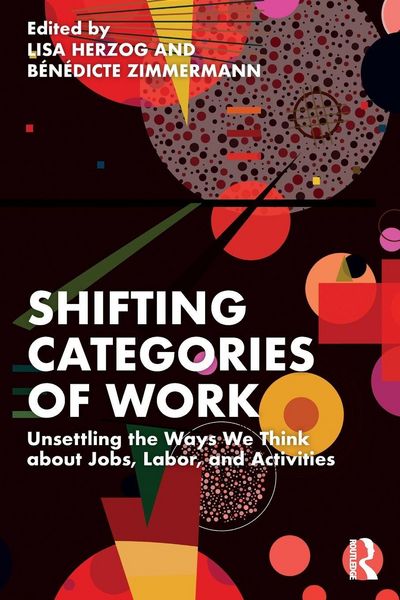
Shifting Categories of Work Unsettling the Ways We Think about Jobs, Labor, and Activities

54,99 €

inkl. gesetzl. MwSt., Versandkostenfrei


Beschreibung

Produktdetails

Einband

Taschenbuch

Erscheinungsdatum

30.12.2022

Abbildungen

schwarz-weiss Illustrationen, Zeichnungen, schwarz-weiss, Tabellen, schwarz-weiss

Herausgeber

Lisa Herzog + weitere

Verlag

Taylor & Francis

Seitenzahl

300

Maße (L/B/H)

22,9/15,2/1,6 cm

Gewicht

426 g

Sprache

Englisch

ISBN

978-1-03-237662-2

Beschreibung

Rezension

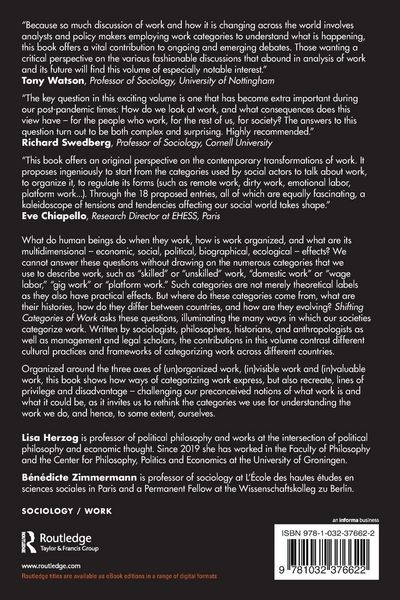
"Because so much discussion of work and how it is changing across the world involves analysts and policy makers employing work categories to understand what is happening, this book offers a vital contribution to ongoing and emerging debates. Those wanting a critical perspective on the various fashionable discussions that abound in analysis of work and its future will find this volume of especially notable interest."

Tony Watson, Professor of Sociology, University of Nottingham

"The key question in this exciting volume is one that has become extra important during our post-pandemic times: How do we look at work, and what consequences does this view have - for the people who work, for the rest of us, for society? The answers to this question turn out to be both complex and surprising. Highly recommended."

Richard Swedberg, Professor of Sociology, Cornell University

"This book offers an original perspective on the contemporary transformations of work. It proposes ingeniously to start from the categories used by social actors to talk about work, to organize it, to regulate its forms (such as remote work, dirty work, emotional labor, platform work...). Through the 18 proposed entries, all of which are equally fascinating, a kaleidoscope of tensions and tendencies affecting our social world takes shape."

Eve Chiapello, Research Director at EHESS, Paris

Produktdetails

Einband

Taschenbuch

Erscheinungsdatum

30.12.2022

Abbildungen

schwarz-weiss Illustrationen, Zeichnungen, schwarz-weiss, Tabellen, schwarz-weiss

Herausgeber

Verlag

Taylor & Francis

Seitenzahl

300

Maße (L/B/H)

22,9/15,2/1,6 cm

Gewicht

426 g

Sprache

Englisch

ISBN

978-1-03-237662-2

Herstelleradresse

Libri GmbH
Europaallee 1
36244 Bad Hersfeld
DE

Email: gpsr@libri.de

Noch keine Bewertungen vorhanden

Verfassen Sie die erste Bewertung zu diesem Artikel

Helfen Sie anderen Kundinnen und Kunden durch Ihre Meinung.

Kundinnen und Kunden meinen

Bewertungen (0)

Die Leseprobe wird geladen.
  • Produktbild: Shifting Categories of Work
  • Produktbild: Shifting Categories of Work
  • Introduction

    Lisa Herzog and Bénédicte Zimmermann

    Part 1: (Un)organized Work

    1. Subordinate Work: How Does the Law Categorize Modern Labor Relationships?
    Linxin He

    2. Corporate Work: A Category That Has Lost Its Managerial Foundations?
    Blanche Segrestin

    3. Remote Work: From Employee Telework to Self-Employed Home-Based Work?
    Frédérique Letourneux and Gabrielle Schütz

    4. Platform Work: New Workers, New Rights?

    Sophie Bernard and Josepha Dirringer

    5. Teamwork: From Self-Managed to Lean and Agile Teams

    Martin Krzywdzinski and Maximilian Greb

    6. Democratized Work: Concepts and Practices
    Roberto Frega and Martin Kuhlmann

    Part 2: (In)visible Work

    7. Free vs. Unfree Labor: Challenging their Boundaries
    Léa Renard and Theresa Wobbe

    8. Informal Work: A Relational Category

    Nicola Schalkowski and Marianne Braig

    9. Migrants' Work: An Anthropological Perspective from West Africa
    Isaie Dougnon

    10. Domestic Work: The Invention of a Gendered Relationship

    Michel Lallement

    11. Unpaid Work: Expansion and Mobilization of a Feminist Category
    Maud Simonet

    12. Emotional Labor: Concept and Practical Categorizations in Light of Covid Critical Care Nursing
    Robert McMurray, Nicki Credland, Martyn Griffin, Peter Hamilton, Kimberly Jamie and Oonagh Harness

    Part 3: (In)valuable Work

    13. Dirty Work: Physical, Social and Moral Taint
    Natalia Slutskaya and Annilee Game

    14. Efficient Work: Exploring Algorithmic Approaches to Categorization

    Sasha Disko, Bruce Kogut, Hanyu Li and Jennifer Zhang

    15. Skilled and Unskilled Work: From Theoretical Concepts to Social Practices
    Philipp Grollmann and Michael Tiemann

    16. Entrepreneurship: Moral Categorizations Across Three Countries

    Constance Perrin-Joly and Laure de Verdalle

    17. Essential Work: A Category in the Making?

    Lisa Herzog, Katrin Sold and Bénédicte Zimmermann

    18. Sustainable Work: Foundations and Challenges of a Contested Category

    Maja Hoffmann