KI-Beratung Beta

Gutscheinbedingungen

**Gültig am 25.11.2026 auf fremdsprachige Bücher online auf thalia.at und in der Thalia App. Einzelne Artikel können ausgeschlossen sein. Ausgenommen sind preisgebundene Artikel & eBooks. Pro Einkauf einmal einlösbar. Click & Collect nur bei Onlinevorabzahlung möglich. Keine Barauszahlung. Nicht kombinierbar mit anderen Aktionen und Gutscheinen. Gutschein wird auf max. 500€ Bestellwert angerechnet. Nicht gültig für Geschenkkarten, Versandkosten und Services.

  • Produktbild: Economics of the SDGs
  • Produktbild: Economics of the SDGs
- 13%

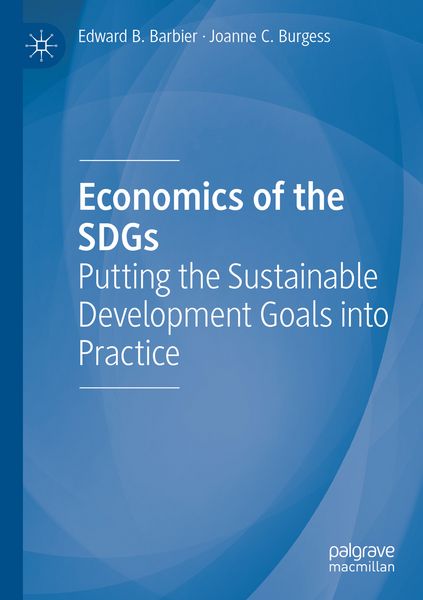
Economics of the SDGs Putting the Sustainable Development Goals into Practice

13% sparen

104,99 € UVP 120,99 €

inkl. gesetzl. MwSt., Versandkostenfrei


Beschreibung

This is the first book that employs economics to develop and apply an analytical framework for assessing progress towards the Sustainable Development Goals (SDGs). The authors explore the historical context for the underlying sustainability concept, develop an economics-based analytical framework for...

Beschreibung

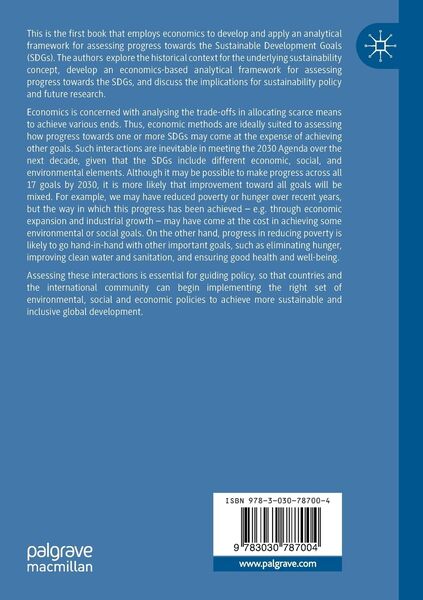
This is the first book that employs economics to develop and apply an analytical framework for assessing progress towards the Sustainable Development Goals (SDGs). The authors explore the historical context for the underlying sustainability concept, develop an economics-based analytical framework for assessing progress towards the SDGs, and discuss the implications for sustainability policy and future research. 
Economics is concerned with analysing the trade-offs in allocating scarce means to achieve various ends. Thus, economic methods are ideally suited to assessing how progress towards one or more SDGs may come at the expense of achieving other goals. Such interactions are inevitable in meeting the 2030 Agenda over the next decade, given that the SDGs include different economic, social, and environmental elements. Although it may be possible to make progress across all 17 goals by 2030, it is more likely that improvement toward all goals will be mixed.For example, we may have reduced poverty or hunger over recent years, but the way in which this progress has been achieved – e.g. through economic expansion and industrial growth – may have come at the cost in achieving some environmental or social goals. On the other hand, progress in reducing poverty is likely to go hand-in-hand with other important goals, such as eliminating hunger, improving clean water and sanitation, and ensuring good health and well-being.
Assessing these interactions is essential for guiding policy, so that countries and the international community can begin implementing the right set of environmental, social and economic policies to achieve more sustainable and inclusive global development.
  

Produktdetails

Einband

Taschenbuch

Erscheinungsdatum

30.07.2022

Abbildungen

XXI, 209 p. 24 illus.

Verlag Springer

Produktdetails

Einband

Taschenbuch

Erscheinungsdatum

30.07.2022

Abbildungen

XXI, 209 p. 24 illus.

Verlag Springer
Seitenzahl

209

Maße (L/B/H)

21/14,8/1,3 cm

Gewicht

306 g

Auflage

22001 Auflage 1st ed. 2021

Sprache

Englisch

ISBN

978-3-030-78700-4

Herstelleradresse

Springer-Verlag GmbH
Tiergartenstr. 17
69121 Heidelberg
DE

Email: ProductSafety@springernature.com

Noch keine Bewertungen vorhanden

Verfassen Sie die erste Bewertung zu diesem Artikel

Helfen Sie anderen Kundinnen und Kunden durch Ihre Meinung.

Kundinnen und Kunden meinen

Bewertungen (0)

  • Produktbild: Economics of the SDGs
  • Produktbild: Economics of the SDGs

  • Historical Context of the SDGs: Introduction to the SDGs.- The SDGs and the Systems Approach to Sustainability.- Analytical Framework and Economic Assessment: Key Indicators for the SDGs.- Trends in Key SDG Indicators.- An Analytical Framework for Assessing Progress.- Applying the Analytical Framework.- Enhancing the SDGs.- Policy Implications: Policy Implications.- Are the SDGs Sufficient?.- Conclusion.