• Produktbild: Literature and its Language
  • Produktbild: Literature and its Language
- 11%

Literature and its Language Philosophical Aspects

11% sparen

125,99 € UVP 142,99 €

inkl. gesetzl. MwSt., Versandkostenfrei


Beschreibung

Produktdetails

Einband

Gebundene Ausgabe

Erscheinungsdatum

30.10.2022

Abbildungen

XIX, 335 p.

Herausgeber

Garry L. Hagberg

Verlag

Springer

Seitenzahl

335

Maße (L/B/H)

21,6/15,3/2,4 cm

Gewicht

573 g

Auflage

1st edition 2022

Sprache

Englisch

ISBN

978-3-031-12329-0

Beschreibung

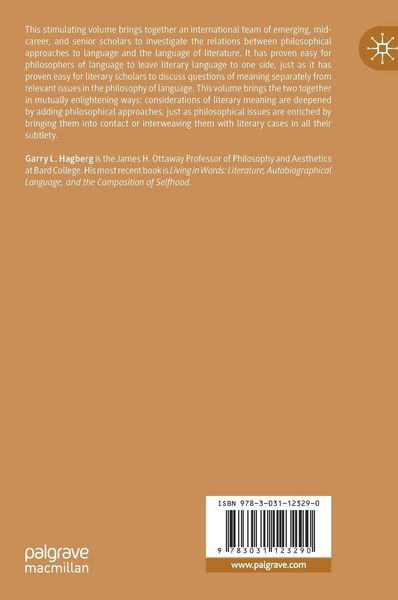
Portrait


Garry L. Hagberg
 is the James H. Ottaway Professor of Philosophy and Aesthetics at Bard College. His most recent book is
Living in Words: Literature, Autobiographical Language, and the Composition of Selfhood
.

Produktdetails

Einband

Gebundene Ausgabe

Erscheinungsdatum

30.10.2022

Abbildungen

XIX, 335 p.

Herausgeber

Garry L. Hagberg

Verlag

Springer

Seitenzahl

335

Maße (L/B/H)

21,6/15,3/2,4 cm

Gewicht

573 g

Auflage

1st edition 2022

Sprache

Englisch

ISBN

978-3-031-12329-0

Herstelleradresse

Springer-Verlag GmbH
Tiergartenstr. 17
69121 Heidelberg
DE

Email: ProductSafety@springernature.com

Noch keine Bewertungen vorhanden

Verfassen Sie die erste Bewertung zu diesem Artikel

Helfen Sie anderen Kundinnen und Kunden durch Ihre Meinung.

Kundinnen und Kunden meinen

Bewertungen (0)

  • Produktbild: Literature and its Language
  • Produktbild: Literature and its Language

  • Introduction: Words at Work,
     
    Garry L. Hagberg.-
    Part I. Wittgenstein, Austin: Meaning and Literary Performatives.-1. ‘I am, forsooth, a
    layman
    !’ Flann O’Brien, Wittgenstein, and the Challenge of Ordinary Language, 
    Andrew Gaedtke.- 
    2. The Poetics of the Unpoetic: Literature, Ordinariness, and Raymond Carver’s Minimalist Realism, Daniel Just.- 3. Bunbury Could Not Live, That Is What I Mean: Austin’s Performative Speech and Truth in the Case of Oscar Wilde, 
    Luke Mueller.- 
    4. Contending with the Storm: Lear’s Performatives, 
    Julian Lamb.- 
    Part II. The Case of Samuel Beckett.- 5. “Now I can go on!”: The Collapse of Linguistic Authority in Beckett’s
    Endgame

    Greg Chase.- 
    6. Post-Apocalyptic Leftover: The Void of Language in Beckett's
    Murphy
    and
    Endgam
    e, 
    Masoud Farahmandfar.- 
    7. Selves Lost and Regained: Retrospective vs. Prospective Quests forIdentity in Samuel Beckett’s
    Krapp’s Last Tape

    Ivan Nyusztay.- 
    Part III. The Meanings of Words: Defining by Showing.- 8. “What is this world?”: Chaucer, Realism, and Metaphysics, 
    Darragh Greene.- 
    9. Consenting as an Ethical Act: On the Meaning of a Word, 
    Robert B. Pierce.- 
    10. Fooling: Material Meaning-Making under Conditions of Epistemic Injustice, 
    Hannah Walser.- 
    11. A State of Mind as the Meaning of a Word: J. M. Coetzee’s
    Disgrace

    Garry L. Hagberg.- 
    Part IV: Evocative and Uncanny Phrases.- 12. Rehearsing the Unexpected: Poetry and Rhythm in the (New) Age of the Poets, 
    Ruth Parkin-Gounelas.- 
    13.  A Window. A Word. An Inkling, 
    Gordon C.F. Bearn.- 
    14. On Wittgenstein, Lydia Davis, and Other Uncanny Grammarians, 
    Ben Roth