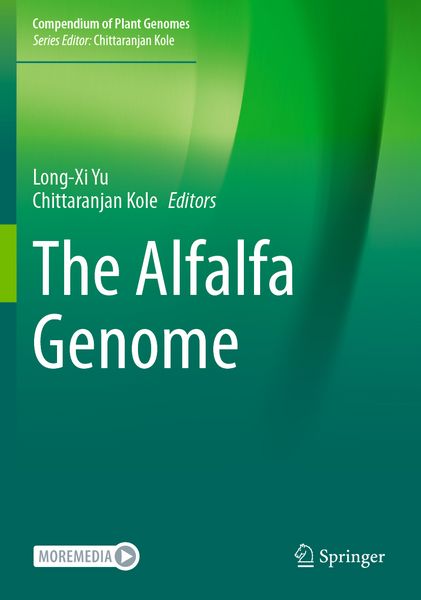
Produktbild: The Alfalfa Genome
- 12%

The Alfalfa Genome

12% sparen

144,99 € UVP 164,99 €

inkl. gesetzl. MwSt., Versandkostenfrei


Beschreibung

Produktdetails

Einband

Taschenbuch

Erscheinungsdatum

19.07.2022

Abbildungen

XXV, 283 p. 64 illus., 52 illus. in color.

Herausgeber

Long-Xi Yu + weitere

Verlag

Springer

Seitenzahl

283

Maße (L/B/H)

25,4/17,8/1,7 cm

Gewicht

590 g

Auflage

1st ed. 2021

Sprache

Englisch

ISBN

978-3-030-74468-7

Beschreibung

Portrait


Dr. Long-Xi Yu is Research Plant Geneticist in USDA-ARS and Adjunct Professor at Washington State University. Dr. Yu received his Ph.D. degree from University of Orleans, France, and completed postdoctoral training at Cornell University. Dr. Yu has conducted research in plant genetics and genomics for 35 years in academia, industrial and government agency. He is currently leading several research projects for improving alfalfa production and forage quality. He has authored or co-authored more than 100 publications and received 50 special invitations to present seminars or review papers. He served on panels of The National Alfalfa & MISC Legumes Variety Review Board and The Washington Alfalfa Seeds Commission. He has supervised more than 30 visiting scientists, postdocs and PhD students. He has also served on editorial boards of 8 peer-reviewed journals and several scientific committees. 


Prof. Chittaranjan Kole is an internationally reputed scientist with an illustrious professional career of spanning over thirty-six years and original contributions in the fields of plant genomics, biotechnology, and molecular breeding leading to the publication of more than 160 quality research articles and reviews. He has edited over 130 books for the leading publishers of the world including Springer Nature, Wiley-Blackwell, and Taylor and Francis Group. His scientific contributions and editing acumen have been appreciated by seven Nobel Laureates including Profs. Norman Borlaug, Arthur Kornberg, Werner Arber, Phillip Sharp, Günter Blobel, Lee Hartwell, and Roger Kornberg. He has been honored with a number of Fellowships, Honorary Fellowships, and national and international awards including the Outstanding Crop Scientist Award conferred by the International Crop Science Society. He has served at all prestigious positions in academia including as Vice-Chancellor of BC Agricultural university, Project Coordinator of Indo-Russian Center of Biotechnology in India,and Director of Research of Institute of Nutraceutical Research of Clemson University, in USA. He worked also in the Pennsylvania State University and Clemson University as Visiting Professor in USA. He is also heading the International Climate-Resilient Crop Genomics Consortium and International Consortium for Phytomedomics and Nutriomics as their founding Principal Coordinator and President.

Produktdetails

Einband

Taschenbuch

Erscheinungsdatum

19.07.2022

Abbildungen

XXV, 283 p. 64 illus., 52 illus. in color.

Herausgeber

Verlag

Springer

Seitenzahl

283

Maße (L/B/H)

25,4/17,8/1,7 cm

Gewicht

590 g

Auflage

1st ed. 2021

Sprache

Englisch

ISBN

978-3-030-74468-7

Herstelleradresse

Springer-Verlag KG
Sachsenplatz 4-6
1201 Wien
AT

Email: ProductSafety@springernature.com

Noch keine Bewertungen vorhanden

Verfassen Sie die erste Bewertung zu diesem Artikel

Helfen Sie anderen Kundinnen und Kunden durch Ihre Meinung.

Kundinnen und Kunden meinen

Bewertungen (0)

  • Produktbild: The Alfalfa Genome

  • Chapter 1. Economic Importance, Practical Limitations to Production, Management and Breeding Targets of Alfalfa.- Chapter 2. Factors Influencing Yield and Quality.- Chapter 3. The Origin, Evolution and Genetic Diversity of Alfalfa.- Chapter 4. Germplasm Collection, Genetic Resources and Gene Pools in Alfalfa.- Chapter 5. Biotechnology Advances in Alfalfa.- Chapter 6. Sequencing, Assembly and Annotation of the Alfalfa Genome.- Chapter 7. Transcription Factors in Alfalfa (
    Medicago

    sativa
    L.): Genome-Wide Identification and a Web Resource Center AlfalfaTFDB.- Chapter 8. Genomics of Forage Quality in Alfalfa.- Chapter 9. Physiological, Morphological, Biochemical, and Genetic Responses of Alfalfa to Salinity.- Chapter 10. Developing SNPs and Strategies for Genomic Analysis in Alfalfa.- Chapter 11. Genomics Resources for Breeding in Alfalfa: Availability, Utility, and Adoption.- Chapter 12. Genomic Selection for Higher Yield and Quality in Alfalfa.- Chapter 13. Identification and Characterization of Disease Resistance Genes in Alfalfa and
    Medicago

    truncatula
    for Breeding Improved Cultivars.- Chapter 14. Genetic and Genomic Assessments for Improving Drought Resilience in Alfalfa.- Chapter 15. Self-Incompatibility, Inbreeding Depression, and Potential to Develop Inbred Lines in Alfalfa.- Chapter 16. Targeted Mutagenesis of Alfalfa.