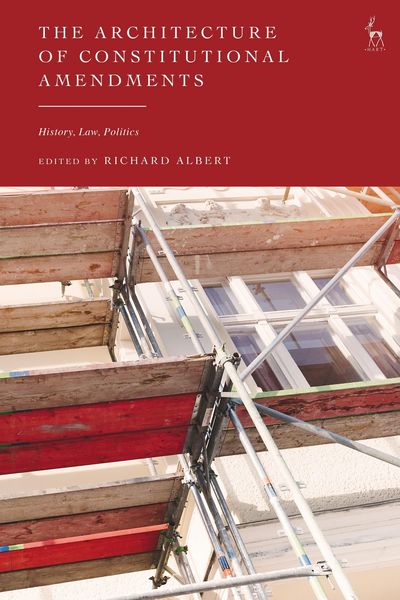
The Architecture of Constitutional Amendments History, Law, Politics
-
- Hardcover ausgewählt
- Taschenbuch
- eBook
-
Sprache:Englisch
134,99 €
inkl. gesetzl. MwSt.,
Beschreibung
Produktdetails
Einband
Gebundene Ausgabe
Erscheinungsdatum
18.05.2023
Herausgeber
Richard AlbertVerlag
Hart PublishingSeitenzahl
278
Maße (L/B/H)
23,4/15,6/1,8 cm
Gewicht
568 g
Sprache
Englisch
ISBN
978-1-5099-5908-2
This innovative book blends constitutional theory with real-life political practice to explore the impact of codifying constitutional amendments on the operation of the constitution in relation to democracy, the rule of law, and the separation of powers.
It draws from comparative, historical, political and theoretical perspectives to answer questions all constitutional designers should ask themselves:
- Should the constitution append amendments sequentially to the end of the text?
- Should it embed amendments directly into the existing text, with notations about what has been modified and how?
- Should it instead insert amendments into the text without indicating at all that any alteration has occurred?
The book examines the 3 major models of amendment codification - the appendative, the integrative, and the invisible models - and also shows how some jurisdictions have innovated alternative forms of amendment codification that combine elements of more than 1 model in a unique hybridisation driven by history, law, and politics.
Constitutional designers rarely consider where in the constitution to codify amendments once they are ratified. Yet this choice is pivotal to the operation of any constitution. This groundbreaking book shows why the placement of constitutional amendments goes well beyond mere aesthetics. It influences how and whether a people remembers its past, how the constitutional text will be interpreted and by whom, and whether the constitution will be easily accessible to the governed.
A global tour of the high stakes of constitution-making, this book features 18 diverse and outstanding scholars from around the world - across Africa, America, Asia and Oceania, and Europe - raising new questions, opening our eyes to new streams of research, and uncovering new possibilities for constitutional design.
Noch keine Bewertungen vorhanden
Verfassen Sie die erste Bewertung zu diesem Artikel
Helfen Sie anderen Kundinnen und Kunden durch Ihre Meinung.
Kurze Frage zu unserer Seite
Vielen Dank für Ihr Feedback
Wir nutzen Ihr Feedback, um unsere Produktseiten zu verbessern. Bitte haben Sie Verständnis, dass wir Ihnen keine Rückmeldung geben können. Falls Sie Kontakt mit uns aufnehmen möchten, können Sie sich aber gerne an unseren Kund*innenservice wenden.
zum Kundenservice