KI-Beratung Beta

Gutscheinbedingungen

**Gültig bis 30.11.2026 auf Spielzeug, Schreibwaren, Filme, Geschenke & Trends, Musik, tolino eReader & Zubehör, Hörbücher und Hörbuch-Downloads, nicht preisgebundene Bücher und Kalender online auf thalia.at und in der Thalia App. Einzelne Artikel können ausgeschlossen sein. Aufgrund der Buchpreisbindung sind deutschsprachige Bücher und eBooks ausgenommen. Zusätzlich ausgenommen sind Abos & Flatrates, Games, Geschenkkarten/-boxen, Shelfies, Software, Zeitschriften sowie einzelne Artikel von tonies®. Pro Einkauf einmal einlösbar. Nur gültig mit im Onlineshop hinterlegter Bonuscard. Click & Collect nur bei Onlinevorabzahlung möglich. Keine Barauszahlung. Nicht kombinierbar mit anderen Aktionen und Gutscheinen. Gutschein wird auf max. 500€ Bestellwert angerechnet. Nicht gültig für Versandkosten und Services.

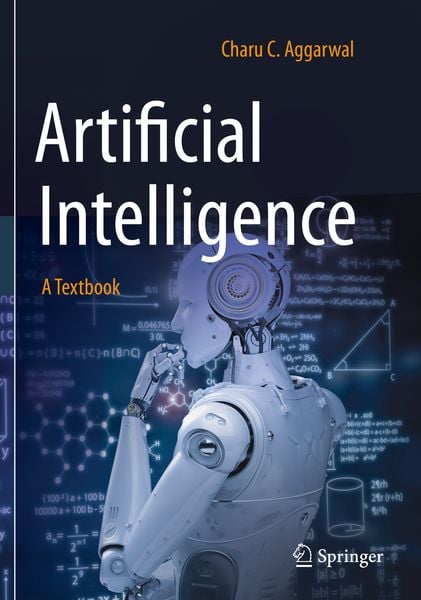
  • Produktbild: Artificial Intelligence
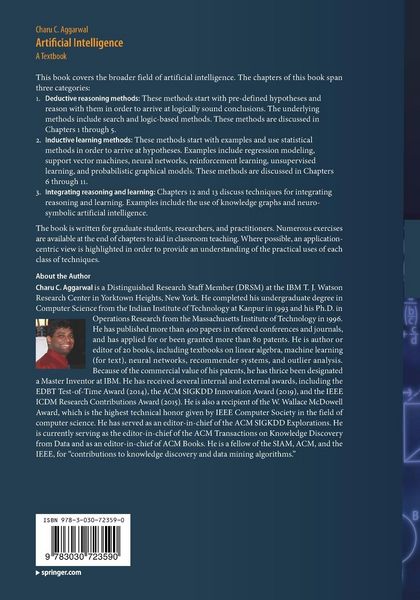
  • Produktbild: Artificial Intelligence

Artificial Intelligence A Textbook

59,99 €

inkl. gesetzl. MwSt., Versandkostenfrei


Beschreibung

This textbook covers the broader field of artificial intelligence.   The chapters for this textbook span within three categories:

  • Deductive reasoning methods:  These methods start with pre-defined hypotheses and reason with them in order to arrive at logically sound conclusions. The underlying methods...

Beschreibung

This textbook covers the broader field of artificial intelligence.   The chapters for this textbook span within three categories:


  • Deductive reasoning methods:
     These methods start with pre-defined hypotheses and reason with them in order to arrive at logically sound conclusions. The underlying methods include search and logic-based methods. These methods are discussed in Chapters 1through 5.


  • Inductive Learning Methods:
      These methods start with examples and use statistical methods in order to arrive at hypotheses. Examples include regression modeling, support vector machines, neural networks, reinforcement learning, unsupervised learning, and probabilistic graphical models. These methods are discussed in Chapters~6 through 11. 


  • Integrating Reasoning and Learning:
      Chapters~11 and 12 discuss techniques for integrating reasoning and learning. Examples include the use of knowledge graphs and neuro-symbolic artificial intelligence.


The primary audience for this textbook are professors and advanced-level students in computer science. It is also possible to use this textbook for the mathematics requirements for an undergraduate data science course. Professionals working in this related field many also find this textbook useful as a reference.

Rezension

“The author has thoroughly researched all areas of AI in order to write this high-quality book. … This highly valuable book provides a vast overview of AI in a well-structured manner. It could be used as a textbook in graduate-level courses.” (J. Arul, Computing Reviews, December 12, 2022)

“This is very useful book for graduate students and researchers.” (T. C. Mohan, zbMATH 1477.68001, 2022)

Produktdetails

Einband

Taschenbuch

Erscheinungsdatum

18.07.2022

Abbildungen

XX, 483 p. 173 illus., 15 illus. in color.

Verlag Springer

Produktdetails

Einband

Taschenbuch

Erscheinungsdatum

18.07.2022

Abbildungen

XX, 483 p. 173 illus., 15 illus. in color.

Verlag Springer
Seitenzahl

483

Maße (L/B/H)

25,4/17,8/2,8 cm

Gewicht

945 g

Auflage

22001 Auflage 1st ed. 2021

Sprache

Englisch

ISBN

978-3-030-72359-0

Herstelleradresse

Springer-Verlag KG
Sachsenplatz 4-6
1201 Wien
AT

Email: ProductSafety@springernature.com

Noch keine Bewertungen vorhanden

Verfassen Sie die erste Bewertung zu diesem Artikel

Helfen Sie anderen Kundinnen und Kunden durch Ihre Meinung.

Kundinnen und Kunden meinen

Bewertungen (0)

  • Produktbild: Artificial Intelligence
  • Produktbild: Artificial Intelligence
  • 1 An Introduction to Artificial Intelligence.- 2 Searching State Spaces.- 3 Multiagent Search.- 4 Propositional Logic.- 5 First-Order Logic.- 6 Machine Learning: The Inductive View.- 7 Neural Networks.- 8 Domain-Specific Neural Architectures.- 9 Unsupervised Learning.- 10 Reinforcement Learning.- 11 Probabilistic Graphical Models.- 12 Knowledge Graphs.- 13 Integrating Reasoning and Learning.