Gutscheinbedingungen

**Gültig bis 06.07.2026 auf fremdsprachige Bücher online auf thalia.at, in der Thalia App ab einem Mindestbestellwert von 30€ und in allen Thalia Buchhandlungen in Österreich. In den Buchhandlungen nur gültig auf lagernde Ware. Einzelne Artikel können ausgeschlossen sein. Ausgenommen sind preisgebundene Artikel & eBooks. Pro Einkauf einmal einlösbar. Nur gültig gegen Vorlage oder im Onlineshop hinterlegter Bonuscard. Infos zur Einlösung in der Buchhandlung sind auf der Bonuscard-Vorteilspreisseite zu finden. Click & Collect nur bei Onlinevorabzahlung möglich. Keine Einlösung bei Scan & Go-Bezahlung. Keine Barauszahlung. Nicht kombinierbar mit anderen Aktionen und Gutscheinen. Gutschein wird auf max. 500€ Bestellwert angerechnet. Nicht gültig für Versandkosten und Services.

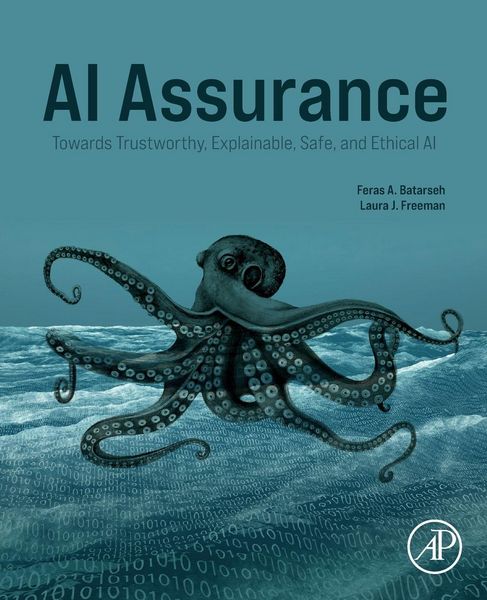
  • Produktbild: AI Assurance
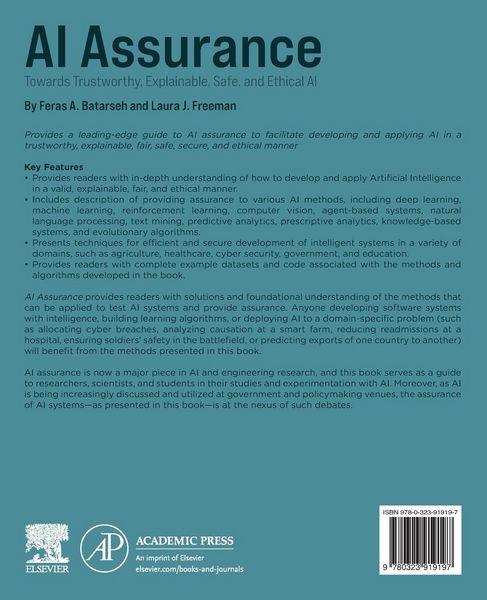
  • Produktbild: AI Assurance

AI Assurance Towards Trustworthy, Explainable, Safe, and Ethical AI

197,99 €

inkl. gesetzl. MwSt., Versandkostenfrei


Beschreibung

Produktdetails

Einband

Taschenbuch

Erscheinungsdatum

28.10.2022

Herausgeber

Feras A. Batarseh + weitere

Verlag

Elsevier Science & Technology

Seitenzahl

602

Maße (L/B/H)

23,5/19,1/3,1 cm

Gewicht

1220 g

Sprache

Englisch

ISBN

978-0-323-91919-7

Beschreibung

Rezension

"The book s structure allows readers to appreciate the interconnectedness of the various aspects of AI assurance. The editors have thoughtfully curated content that demonstrates the intricate relationship between technical, ethical, and practical considerations. The chapters build upon one another, providing a comprehensive understanding of AI assurance while simultaneously allowing readers to explore specific topics in greater depth. One of the book s most striking features is its commitment to providing practical, real-world examples to illustrate the concepts discussed in each chapter.... a captivating scholarly book that offers a thought-provoking and comprehensive examination of AI assurance. We highly recommend this book to scholars, policymakers, industry practitioners, and anyone seeking to navigate the complex labyrinth of AI assurance. [It] has the potential to shape the future of AI development and implementation, ultimately ensuring a more ethical, safe, and beneficial integration of AI into our society." - Jialei Wang (Shining3D Tech Co.) and Li Fu (Hangzhou Dianzi University), AI & Society , November 2023

Produktdetails

Einband

Taschenbuch

Erscheinungsdatum

28.10.2022

Herausgeber

Verlag

Elsevier Science & Technology

Seitenzahl

602

Maße (L/B/H)

23,5/19,1/3,1 cm

Gewicht

1220 g

Sprache

Englisch

ISBN

978-0-323-91919-7

Herstelleradresse

Libri GmbH
Europaallee 1
36244 Bad Hersfeld
DE

Email: gpsr@libri.de

Noch keine Bewertungen vorhanden

Verfassen Sie die erste Bewertung zu diesem Artikel

Helfen Sie anderen Kundinnen und Kunden durch Ihre Meinung.

Kundinnen und Kunden meinen

Bewertungen (0)

Die Leseprobe wird geladen.
  • Produktbild: AI Assurance
  • Produktbild: AI Assurance
  • 1. An introduction to AI assurance
    2. Setting the goals for ethical, unbiased and fair AI
    3. An overview of explainable and interpretable AI
    4. Bias, Fairness, and assurance in AI: Overview and Synthesis
    5. An evaluation of the potential global impacts of AI assurance
    6. The role of inference in AI: start S.M.A.L.L. with mindful models
    7. Outlier detection using AI: a survey
    8. AI assurance using casual inference: application to public policy
    9. Data collection, wrangling and preprocessing for AI assurance
    10. Coordination-aware assurance for end-to-end machine learning systems: the R3E approach
    11. Assuring AI methods for economic policymaking
    12. Panopticon implications of ethical AI: equity, disparity, and inequality in healthcare
    13. Recent advances in uncertainty quantification methods for engineering problems
    14. Socially responsible AI assurance in precision agriculture for farmers and policymakers
    15. The application of AI assurance in precision farming and agricultural economics
    16. Bringing dark data to light with AI for evidence-based policy making