Gutscheinbedingungen

**Gültig bis 25.06.2026 auf fremdsprachige Bücher online auf thalia.at und in der Thalia App. Einzelne Artikel können ausgeschlossen sein. Ausgenommen sind preisgebundene Artikel & eBooks. Pro Einkauf einmal einlösbar. Click & Collect nur bei Onlinevorabzahlung möglich. Keine Barauszahlung. Nicht kombinierbar mit anderen Aktionen und Gutscheinen. Gutschein wird auf max. 500€ Bestellwert angerechnet. Nicht gültig für Geschenkkarten, Versandkosten und Services.

Produktbild: The People's Tongue

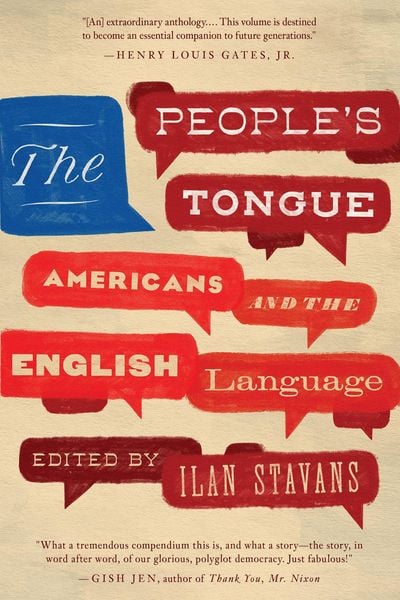
The People's Tongue Americans and the English Language

31,99 €

inkl. gesetzl. MwSt., Versandkostenfrei


Beschreibung

Produktdetails

Einband

Gebundene Ausgabe

Erscheinungsdatum

14.02.2023

Herausgeber

Ilan Stavans

Verlag

Ingram Publishers Services

Seitenzahl

512

Maße (L/B/H)

23,4/16,1/3,9 cm

Gewicht

840 g

Sprache

Englisch

ISBN

978-1-63206-265-9

Beschreibung

Portrait

Ilan Stavans is the publisher of Restless Books and a passionate lover of dictionaries, with a collection of over three hundred now housed in his personal collection at the University of Pennsylvania. He has published an assortment of books about language, including Spanglish: The Making of a New American Language (2003), Dictionary Days: A Defining Passion (2005), Resurrecting Hebrew (2008), and How Yiddish Changed America and How America Changed Yiddish (2020). He serves as a consultant to the Oxford English Dictionary and lives in Amherst, Mass.

Produktdetails

Einband

Gebundene Ausgabe

Erscheinungsdatum

14.02.2023

Herausgeber

Ilan Stavans

Verlag

Ingram Publishers Services

Seitenzahl

512

Maße (L/B/H)

23,4/16,1/3,9 cm

Gewicht

840 g

Sprache

Englisch

ISBN

978-1-63206-265-9

Herstelleradresse

Libri GmbH
Europaallee 1
36244 Bad Hersfeld
DE

Email: gpsr@libri.de

Kundinnen und Kunden meinen

0 Bewertungen

Informationen zu Bewertungen

Zur Abgabe einer Bewertung ist eine Anmeldung im Konto notwendig. Die Authentizität der Bewertungen wird von uns nicht überprüft. Wir behalten uns vor, Bewertungstexte, die unseren Richtlinien widersprechen, entsprechend zu kürzen oder zu löschen.

Die Bewertungen sind nach Format, Anzahl Sterne und Datum sortiert.

Verfassen Sie die erste Bewertung zu diesem Artikel

Helfen Sie anderen Kund*innen durch Ihre Meinung

Kundinnen und Kunden meinen

0 Bewertungen filtern

Weitere Artikel finden Sie in

Die Leseprobe wird geladen.
  • Produktbild: The People's Tongue
  • Introduction: Language as Character, by Ilan Stavans

    Chronology


    Part I: Landing Mode

    Anne Winthrop: “Letter to Adam Winthrop” (1581)

    Robert Smith: from New England Primer (1687)

    John Adams: “Proposal for an American Language Academy” (1780)

    Thomas Jefferson: “Letter to John Waldo Monticello” (1813)

    Noah Webster: preface to An American Dictionary of the English Language (1828)

    Alexis de Tocqueville: from Democracy in America (1835)

    Lydia Huntley Sigourney: “Indian Names” (1841)

    Thomas Hopkins Gallaudet: from “On the Natural Languages of Signs II” (1848)

    Sojourner Truth: “Ain’t I a Woman?” (1851)

    Abraham Lincoln: “Gettysburg Address” (1863)

    Bret Harte: “The Spelling Bee at Angels” (1878)

    Mark Twain: from Adventures of Huckleberry Finn (1884)

    José da Fonseca and Pedro Carolino: from English as She Is Spoke (1884)

    Walt Whitman: “Slang in America” (1885)

    Emily Dickinson: Poem #236 (1886)

    Richard Henry Pratt: from “Kill the Indian, Save the Man” (1892)

    Simon Pokagon: “On Naming the Indians” (1897)

    Paul Laurence Dunbar: “When Malindy Sings” (1903)

    Ambrose Bierce: “Two Definitions” (1906)

    Henry James: from The American Scene (1907)

    Mary Antin: from The Promised Land (1912)

    William L. Harding: “Babel Proclamation” (1918)

    Theodore Roosevelt Jr.: “The Last Message” (1919)


    Part II: Fly Me to the Moon

    H. L. Mencken: “The Characters of American” (1919)

    e e cummings: “next to of course god america i” (1926)

    Thomas Wolfe: “Only the Dead Know Brooklyn” (1935)

    Henry Roth: from Call It Sleep (1936)

    Zora Neale Hurston: from Their Eyes Were Watching God (1937)

    Abel Meeropol and Billie Holiday: “Strange Fruit” (1939)

    Abbott and Costello: “Who’s on First?” (1944)

    Martin Minoru Iida: “Go for Broke” (1944)

    Lucille Ball and Desi Arnaz: “Ough” (1953)

    William Faulkner: from “What’s the Good Word” (1958)

    Dr. Seuss: from Green Eggs and Ham (1960)

    Amiri Baraka: “Expressive Language” (1963)

    Bob Dylan: “A Hard Rain’s A-Gonna Fall” (1963)

    Dwight McDonald: from “The String Untuned” (1963)

    Leo Rosten: from The Joys of Yiddish (1968)

    George Carlin: “The Seven Words You Can Never Say on Television” (1972)

    Adrienne Rich “Transcendental Etude” (1978)

    James Baldwin: “If Black English Isn’t a Language, Tell Me What Is? (1979)

    Isaac Bashevis Singer: “On Translating My Books” (1979)

    Sugarhill Gang: from “Rapper’s Delight” (1979)

    E. B. White: Introduction to Oliver Strunk’s The Elements of Style (1979)

    John Ashbery: “Paradoxes and Oxymorons” (1980)

    Russell Hoban: from Riddley Walker (1980)

    Samuel Ichiye Hayakawa: “Speech on Language Amendment” (1982)

    Richard Rodríguez: “English, Sí” (1982)


    Part III: The Ruckus of Polyphony

    Gloria Anzaldúa: from “How to Tame a Wild Tongue” (1987)

    Judith Ortiz Cofer: “Homework: Define Caliente” (1987)

    Julia Álvarez: “Bilingual Sestina” (1990)

    Amy Tan: “Mother Tongue” (1990)

    Tony Kushner: from Angels in America (1991)

    Toni Morrison: “Nobel Lecture” (1993)

    Chang-Rae Lee: “Mute in an English-Only World” (1996)

    Jamaica Kincaid: “In History” (1997)

    Robert F. Panara: “On His Deafness” (1997)

    Bill Clinton: “Memorandum on Plain Language in Government Writing” (1998)

    Louise Erdrich: “Two Languages in Mind, but Just One in the Heart” (2000)

    Joy Harjo: “A Map to the Next World” (2000)

    David Foster Wallace: “Tense Present: Democracy, English, and the Wars Over Usage” (2001)

    Susan Sontag: “The World as India” (2002)

    Ha Jin: from The Writer as Migrant (2008)

    Ammon Shea: “The Keypad Solution” (2010)

    Yusef Komunyakaa: “English” (2011)

    Peter Sokolowski: “New Words and the Dictionary” (2012)

    Jesse Sheidlower: “The Case for Profanity in Print” (2014)

    Ilan Stavans: “In Defense of Spanglish” (2014)

    Kendrick Lamar: “DNA” (2017)

    Natalie Diaz “Manhattan is a Lenape Word” (2020)

    Donald Trump: “CNN” (2021) 

    Jhumpa Lahiri: “Lingua / Language” (2022)

    John McWorther: “English as a Living Language—Period” (2022)


    Permissions

    Index