Gutscheinbedingungen

**Gültig bis 22.07.2026 ab einem Mindestbestellwert von 40€ auf Spielzeug, Schreibwaren, Filme, Geschenke & Trends, Musik, tolino eReader & Zubehör, Hörbücher und Hörbuch-Downloads (außer Abo), nicht preisgebundene Bücher und Kalender online auf thalia.at und in der Thalia App. Einzelne Artikel können ausgeschlossen sein. Aufgrund der Buchpreisbindung sind deutschsprachige Bücher und eBooks ausgenommen. Zusätzlich ausgenommen sind preisgebundene Artikel, Abos & Flatrates, eBooks, Games, Geschenkkarten/-boxen, Shelfies, Software, Zeitschriften sowie einzelne Artikel von tonies®. Pro Einkauf einmal einlösbar. Click & Collect nur bei Onlinevorabzahlung möglich. Keine Barauszahlung. Nicht kombinierbar mit anderen Aktionen und Gutscheinen. Gutschein wird auf max. 500€ Bestellwert angerechnet. Nicht gültig für Versandkosten und Services. Preisgebundene Artikel sind vom Mindestbestellwert ausgeschlossen.

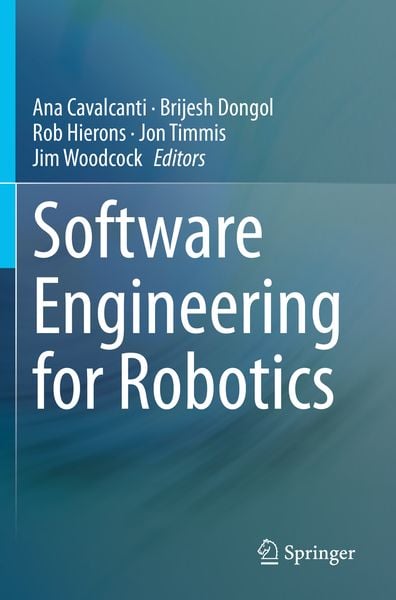
  • Produktbild: Software Engineering for Robotics
  • Produktbild: Software Engineering for Robotics
- 12%

Software Engineering for Robotics

12% sparen

115,99 € UVP 131,99 €

inkl. gesetzl. MwSt., Versandkostenfrei


Beschreibung

Produktdetails

Einband

Taschenbuch

Erscheinungsdatum

06.07.2022

Herausgeber

Ana Cavalcanti + weitere

Verlag

Springer

Seitenzahl

483

Maße (L/B/H)

23,5/15,5/2,8 cm

Gewicht

756 g

Auflage

1st ed. 2021

Sprache

Englisch

ISBN

978-3-030-66496-1

Beschreibung

Portrait

Ana Cavalcanti is Professor of Software Verification at the University of York and Royal Academy of Engineering Chair in Emerging Technologies, and is working on software engineering issues for robotics like modelling, validation, simulation, and testing. She currently leads the RoboStar research group at the University of York. Her research is on theory and practice of verification and testing for robotics.

Brijesh Dongol  is a Senior Lecturer at the University of Surrey. His research is on formal techniques and verification methods for concurrent and real-time systems. This includes concurrent objects, transactional memory and associated correctness conditions; weak memory models; algebraic techniques; and hybrid systems. He leads several projects funded by the EPSRC, research institutions and industrial partners and is a member of the Formal Methods Teaching Committee.

Rob Hierons  joined The University of Sheffield in 2018 as a full Professor. His research concerns the automated generation of efficient, systematic test suites on the basis of program code, models or specifications. He is joint Editor-in-Chief of the Journal of Software Testing, Verification, and Reliability (STVR) and is a member of the editorial boards of The Computer Journal and Formal Aspects of Computing.

Jon Timmis is Professor of Intelligent and Adaptive Systems at the University of Sunderland, where he is Deputy Vice-Chancellor, and is Visiting Professor at the University of York.  His research focuses on biologically-inspired systems and modelling, with applications in robotic and swarm robotic systems as well as computational biology.  He has commercialized his research into modelling and simulation in the biosciences. He is a former Royal Society-Wolfs on Research Merit Award holder and a Royal Academy of Engineering Enterprise Fellow.

Jim Woodcock is Professor of Software Engineering at the University of York, known for his research, teaching, and consultancy in the application of industrial-scale software engineering and formal methods. He is a Chartered Engineer, a fellow of the UK Royal Academy of Engineering, and a member of the London Mathematical Society. His current research is in modelling and reasoning about uncertainty in robotic applications.

Produktdetails

Einband

Taschenbuch

Erscheinungsdatum

06.07.2022

Herausgeber

Verlag

Springer

Seitenzahl

483

Maße (L/B/H)

23,5/15,5/2,8 cm

Gewicht

756 g

Auflage

1st ed. 2021

Sprache

Englisch

ISBN

978-3-030-66496-1

Herstelleradresse

Springer-Verlag KG
Sachsenplatz 4-6
1201 Wien
AT

Email: GPSR Kontakt

Noch keine Bewertungen vorhanden

Verfassen Sie die erste Bewertung zu diesem Artikel

Helfen Sie anderen Kundinnen und Kunden durch Ihre Meinung.

Kundinnen und Kunden meinen

Bewertungen (0)

  • Produktbild: Software Engineering for Robotics
  • Produktbild: Software Engineering for Robotics
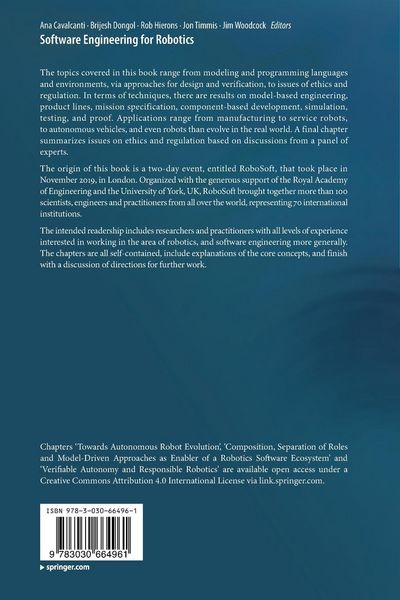
  • Software Product Line Engineering for Robotics.- Towards Autonomous Robot Evolution.- Composition, Separation of Roles and Model-Driven Approaches as Enabler of a Robotics Software Ecosystem.- Testing Industrial Robotic Systems: A New Battlefield!.- Gaining Confidence in the Trustworthiness of Robotic and Autonomous Systems.- Robot Accident Investigation: A Case Study in Responsible Robotics.- Verifiable Autonomy and Responsible Robotics.- Verification of Autonomous Robots: A Roboticist's Bottom-Up Approach?.- RoboStar Technology: A Roboticist’s Toolbox for Combined Proof, Simulation, and Testing.- CorteX: A software Framework for Interoperable, Plug-and-Play, Distributed, Robotic Systems-of-Systems.- Mutation Testing for RoboChart.- Languages for Specifying Missions of Robotic Applications.- RoboStar Technology: Modelling Uncertainty in RoboChart using Probability.- Panel Discussion: Regulation and Ethics of Robotics and Autonomous Systems.