KI-Beratung Beta

Gutscheinbedingungen

**Gültig am 20.11.2026 ab einem Mindestbestellwert von 30€ auf Spielzeug, Schreibwaren, Filme, Geschenke & Trends, Musik, tolino eReader & Zubehör, Hörbücher und Hörbuch-Downloads, nicht preisgebundene Bücher und Kalender online auf thalia.at und in der Thalia App. Einzelne Artikel können ausgeschlossen sein. Aufgrund der Buchpreisbindung sind deutschsprachige Bücher und eBooks ausgenommen. Zusätzlich ausgenommen sind Abos & Flatrates, Games, Geschenkkarten/-boxen, Shelfies, Software, Zeitschriften sowie einzelne Artikel von tonies®. Pro Einkauf einmal einlösbar. Click & Collect nur bei Onlinevorabzahlung möglich. Keine Barauszahlung. Nicht kombinierbar mit anderen Aktionen und Gutscheinen. Gutschein wird auf max. 500€ Bestellwert angerechnet. Nicht gültig für Versandkosten und Services. Preisgebundene Artikel sind vom Mindestbestellwert ausgeschlossen.

  • Produktbild: Japanese Politeness
  • Produktbild: Japanese Politeness

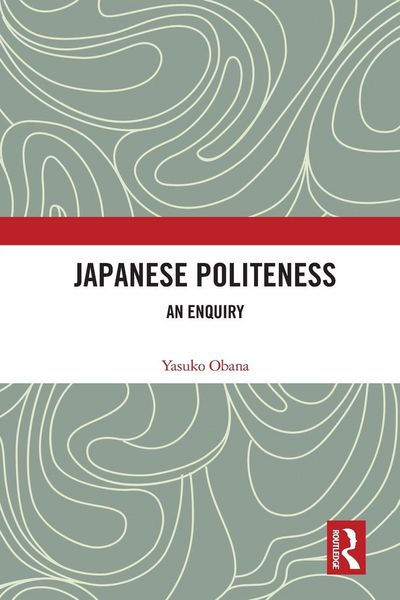
Japanese Politeness An Enquiry

74,99 €

inkl. gesetzl. MwSt., Versandkostenfrei


Beschreibung

Although the Japanese language is one of the most quoted examples in politeness research, extant publications focus on particular areas of politeness, and very few of them enquire into the varied aspects of Japanese politeness. In this book, Yasuko Obana provides an integrated account of what signifies...

Beschreibung

Although the Japanese language is one of the most quoted examples in politeness research, extant publications focus on particular areas of politeness, and very few of them enquire into the varied aspects of Japanese politeness. In this book, Yasuko Obana provides an integrated account of what signifies Japanese politeness.

By examining how far previous assumptions can apply to Japanese, Obana exposes a variety of characteristics of Japanese politeness. By taking a diachronic approach, she probes into what constitutes politeness, extracts key elements of the term 'polite' in Japanese, and demonstrates how modern honorifics' apparent diverse, divergent uses and effects can be integrated into a systematic matrix. Furthermore, by quoting traditional Japanese language scholars' (kokugo gakusha) studies, Obana brings different views into the open. She also carves out politeness strategies in Japanese that have not been adequately explored to date, and which often conform to the way in which honorifi cs behave because they refl ect social indexicality.

This book is a good reference for scholars in pragmatics, particularly for those who are working on politeness. It is useful for Japanese language teachers who want to know how to teach Japanese politeness to non-native learners. Postgraduate students of Japanese or pragmatics may also find this book useful for self-study.

Produktdetails

Einband

Taschenbuch

Erscheinungsdatum

01.08.2022

Abbildungen

14 SW-Abb., 14 SW-Zeichn., 4 Tabellen

Verlag Taylor & Francis

Produktdetails

Einband

Taschenbuch

Erscheinungsdatum

01.08.2022

Abbildungen

14 SW-Abb., 14 SW-Zeichn., 4 Tabellen

Verlag Taylor & Francis
Seitenzahl

220

Maße (L/B/H)

23,4/15,6/1,2 cm

Gewicht

342 g

Sprache

Englisch

ISBN

978-0-367-61225-2

Herstelleradresse

Libri GmbH
Europaallee 1
36244 Bad Hersfeld
DE

Email: gpsr@libri.de

Noch keine Bewertungen vorhanden

Verfassen Sie die erste Bewertung zu diesem Artikel

Helfen Sie anderen Kundinnen und Kunden durch Ihre Meinung.

Kundinnen und Kunden meinen

Bewertungen (0)

Die Leseprobe wird geladen.
  • Produktbild: Japanese Politeness
  • Produktbild: Japanese Politeness
  • Contents

    Preface: Some characteristics of this book

    On a theory of politeness

    Acknowledgements

    Note on transcriptions

    I. POLITENESS BEGINS

    1. The Definition of Politeness: Review

    1.0. Introduction

    1.1. The etymology of 'politeness'

    1.2. Politeness as part of speech acts: A set of rules

    1.3. Face-saving view: Brown and Levinson's politeness theory

    1.4. Discursive politeness

    Endnote 1: Brown and Levinson's positive and negative strategies

    Endnote 2: Collectivism and individualism - Are they real?

    2. The Underlying Meaning of Politeness: How it begins and evolves

    2.1. The recent development of politeness studies: What 'politeness'

    constitutes

    2.2. The underlying meaning of politeness: A diachronic approach

    2.2.1. Involvement and independence as basic human needs/wants

    2.2.2. Evaluations as the basis of politeness

    2.3. Identity and role in Symbolic Interactionism

    2.3.1. Symbolic Interactionism

    2.3.2. Subcategories of Role-Identity and politeness

    Endnote: 'face' ¿ 'involvement & independence'

    3. Politeness as a Social norm, and its Contingency and Discursiveness

    3.1. The term 'social norm' in sociology

    3.2. Politeness as a social norm and its contingencies

    The summary of Part I

    II. HONORIFICS

    1. The Term 'Polite' in English and Japanese: Their conceptual differences
    2. 4.1. The etymology of term 'polite' in Japanese: Reigi tadashii and teineina

      4.2. The sociological significance of 'polite' in English and Japanese

      4.3. Keigo, keii hyoogen and politeness

    3. The Origin of Honorifics: Distance begins
    4. 5.1. The origin of honorifics as taboo?

      5.2. Norito as the origin of honorifics

      5.2.1. The nature of norito

      5.2.2. Honorifics in norito: A language for gods and goddesses

      5.3. Characteristics of honorific use in norito

    5. Understanding Honorifics

      1. The classification of honorific styles
      2. The status of honorifics in pragmatic principles
        1. Honorifics as wakimae?
        2. Honorifics as a positive or negative strategy?
        3. Honorifics as ritual?
        4. Honorifics as a social index and the linguistic evidence of a

        social relationship

      3. Socio-pragmatic functions of honorifics: Ideology, image and reality
      4. 6.3.1. From hierarchical to democratic 'honorifics'?

        6.3.2. How Japanese people in general perceive honorifics today

        Endnote 1: Uchi as the extension of the speaker's viewpoint to

        differentiate honorific styles

        Endnote 2: The uchi/soto distinction as Japanese mentality?

        Endnote 3: The functions of the formula yoroshiku onegaishimasu

        7. Variations and Derivations of Honorific Use

        7.0. Introduction

        7.1. Norms and contingencies: Bicchieri's (2006) "grammar of society"

        7.2. Speech level shifts: The case of plus-level shifts

        7.2.1. Distance as a psychological barrier: Irony, sarcasm and conflict

        7.2.2. The origin of honorifics: Gratitude, attentiveness, carefulness

        7.2.3. Mock stage performance

        7.2.4. Norms of honorifics, honorifics used in plus-level shifts and

        the origin of honorifics: A pragmatic parallel

        7.3. Other derivations of honorific use

        7.3.1. Task-based role shifts

        7.3.2. Women's language

        7.3.3. Personal styles

        7.3.4. Absolute honorifics and self-exalting

        Endnote: Examples of minus-level shifts

        The summary of Part II

        III. POLITENESS STRATEGIES

        1. Strategies as the Implementation of One's Role-Identity

          1. The concept of Role-Identity
          2. Role shifts and changes in politeness strategies
            1. Direct and indirect requests: Role shifts
            2. Repetition as assimilating with the other's role: It takes two to complete it
            3. Pretending to be a different person: Dissociative roles

          3. Summary
            1. Honorific Strategies
              1. Pragmatic transfer as a source for distinguishing Japanese from English
              2. Fundamental differences in strategic planning in English and Japanese: FTA based vs. Role-Identity based
              3. Praising, recognition and checking: Evaluative statements are
              4. condescending

              5. Direct enquiries of the senior's wants are intruding: The case of offer
              6. Direct request: One's entitlement prior to FTA consideration

              The summary of Part III

              IV. CONCLUDING REMARKS

              1. What this book has offered
                1. What constitutes politeness
                2. Contingencies and discursiveness of politeness
                3. Role-Identity as a process to determine polite behaviour

              2. What this book has left out
              3. References

                Index