KI-Beratung Beta

Gutscheinbedingungen

**Gültig am 20.11.2026 ab einem Mindestbestellwert von 30€ auf Spielzeug, Schreibwaren, Filme, Geschenke & Trends, Musik, tolino eReader & Zubehör, Hörbücher und Hörbuch-Downloads, nicht preisgebundene Bücher und Kalender online auf thalia.at und in der Thalia App. Einzelne Artikel können ausgeschlossen sein. Aufgrund der Buchpreisbindung sind deutschsprachige Bücher und eBooks ausgenommen. Zusätzlich ausgenommen sind Abos & Flatrates, Games, Geschenkkarten/-boxen, Shelfies, Software, Zeitschriften sowie einzelne Artikel von tonies®. Pro Einkauf einmal einlösbar. Click & Collect nur bei Onlinevorabzahlung möglich. Keine Barauszahlung. Nicht kombinierbar mit anderen Aktionen und Gutscheinen. Gutschein wird auf max. 500€ Bestellwert angerechnet. Nicht gültig für Versandkosten und Services. Preisgebundene Artikel sind vom Mindestbestellwert ausgeschlossen.

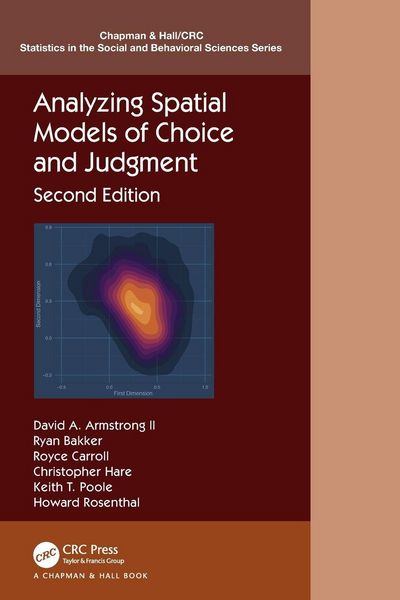
  • Produktbild: Analyzing Spatial Models of Choice and Judgment
  • Produktbild: Analyzing Spatial Models of Choice and Judgment

Analyzing Spatial Models of Choice and Judgment

74,99 €

inkl. gesetzl. MwSt., Versandkostenfrei


Beschreibung

With recent advances in computing power and the widespread availability of preference, perception and choice data, such as public opinion surveys and legislative voting, the empirical estimation of spatial models using scaling and ideal point estimation methods has never been more accessible.The second...

Beschreibung

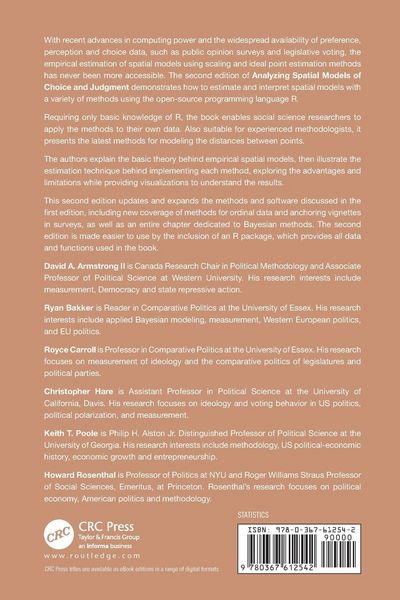
With recent advances in computing power and the widespread availability of preference, perception and choice data, such as public opinion surveys and legislative voting, the empirical estimation of spatial models using scaling and ideal point estimation methods has never been more accessible.The second edition of Analyzing Spatial Models of Choice and Judgment demonstrates how to estimate and interpret spatial models with a variety of methods using the open-source programming language R.

Requiring only basic knowledge of R, the book enables social science researchers to apply the methods to their own data. Also suitable for experienced methodologists, it presents the latest methods for modeling the distances between points.

The authors explain the basic theory behind empirical spatial models, then illustrate the estimation technique behind implementing each method, exploring the advantages and limitations while providing visualizations to understand the results.

This second edition updates and expands the methods and software discussed in the first edition, including new coverage of methods for ordinal data and anchoring vignettes in surveys, as well as an entire chapter dedicated to Bayesian methods. The second edition is made easier to use by the inclusion of an R package, which provides all data and functions used in the book.

David A. Armstrong II is Canada Research Chair in Political Methodology and Associate Professor of Political Science at Western University. His research interests include measurement, Democracy and state repressive action.

Ryan Bakker is Reader in Comparative Politics at the University of Essex. His research interests include applied Bayesian modeling, measurement, Western European politics, and EU politics.

Royce Carroll is Professor in Comparative Politics at the University of Essex. His research focuses on measurement of ideology and the comparative politics of legislatures and political parties.

Christopher Hare is Assistant Professor in Political Science at the University of California, Davis. His research focuses on ideology and voting behavior in US politics, political polarization, and measurement.

Keith T. Poole is Philip H. Alston Jr. Distinguished Professor of Political Science at the University of Georgia. His research interests include methodology, US political-economic history, economic growth and entrepreneurship.

Howard Rosenthal is Professor of Politics at NYU and Roger Williams Straus Professor of Social Sciences, Emeritus, at Princeton. Rosenthal's research focuses on political economy, American politics and methodology.

Rezension

"This book will have broad appeal across the social sciences, but especially in political science and psychology. An obvious audience is scholars doing work in attitudinal scaling, or psychometrics. However, the application of spatial models of the sort addressed in this text is certainly not limited to survey data or other types of data for which people are the units of analysis. These methods can be used to assess and describe the structure of relationships between variables or units wherever such relationships can be conceptualized as distances in some abstract space. I expect that this book will be used mostly as a reference guide, but only because courses in spatial models of this sort are (unfortunately) fairly limited. However, more advanced courses in multivariate analysis, latent variable modeling, dimensional analysis, and measurement across the social sciences would likely find this text extremely useful. (Adam Enders, University of Louisville)

"This book provides excellent coverage of spatial models of choice and judgment...Overall the manuscript is technically correct and clearly written. The biggest strength of the book is the deliberately informal and applied nature of the approach of the book, where both code and output are shown. This makes it very easy for researchers to quickly get these models running on their own data quickly." (James Lo, USC)

"I find the manuscript technically sound, clearly written, and at an appropriate level of difficulty for quantitative social scientists. It has several strengths. First, it is a comprehensive and up-to-date survey of spatial models for scaling preferential and perceptual data (including dyadic data measuring similarities/distances). Second, it is replete with interesting examples from political science, which greatly increases the readability of the material. Third, by including many chunks of R code for data analysis and visualization, it greatly reduces barriers to implementing these methods for practitioners." (Xiang Zhou, Harvard University)

Produktdetails

Einband

Taschenbuch

Erscheinungsdatum

01.08.2022

Verlag Taylor & Francis
Seitenzahl

320

Produktdetails

Einband

Taschenbuch

Erscheinungsdatum

01.08.2022

Verlag Taylor & Francis
Seitenzahl

320

Maße (L/B/H)

23,4/15,6/1,7 cm

Gewicht

488 g

Auflage

2. Auflage

Sprache

Englisch

ISBN

978-0-367-61254-2

Herstelleradresse

Libri GmbH
Europaallee 1
36244 Bad Hersfeld
DE

Email: gpsr@libri.de

Noch keine Bewertungen vorhanden

Verfassen Sie die erste Bewertung zu diesem Artikel

Helfen Sie anderen Kundinnen und Kunden durch Ihre Meinung.

Kundinnen und Kunden meinen

Bewertungen (0)

Die Leseprobe wird geladen.
  • Produktbild: Analyzing Spatial Models of Choice and Judgment
  • Produktbild: Analyzing Spatial Models of Choice and Judgment
  • 1. Introduction. 2. Analyzing Issue Scales. 3. Analyzing Similarities and Dissimilarities Data. 4. Unfolding Analysis of Rating Scale Data. 5. Unfolding Analysis of Binary Choice Data. 6. Bayesian Scaling Models.