KI-Beratung Beta

Gutscheinbedingungen

**Gültig bis 30.11.2026 auf Spielzeug, Schreibwaren, Filme, Geschenke & Trends, Musik, tolino eReader & Zubehör, Hörbücher und Hörbuch-Downloads, nicht preisgebundene Bücher und Kalender online auf thalia.at und in der Thalia App. Einzelne Artikel können ausgeschlossen sein. Aufgrund der Buchpreisbindung sind deutschsprachige Bücher und eBooks ausgenommen. Zusätzlich ausgenommen sind Abos & Flatrates, Games, Geschenkkarten/-boxen, Shelfies, Software, Zeitschriften sowie einzelne Artikel von tonies®. Pro Einkauf einmal einlösbar. Nur gültig mit im Onlineshop hinterlegter Bonuscard. Click & Collect nur bei Onlinevorabzahlung möglich. Keine Barauszahlung. Nicht kombinierbar mit anderen Aktionen und Gutscheinen. Gutschein wird auf max. 500€ Bestellwert angerechnet. Nicht gültig für Versandkosten und Services.

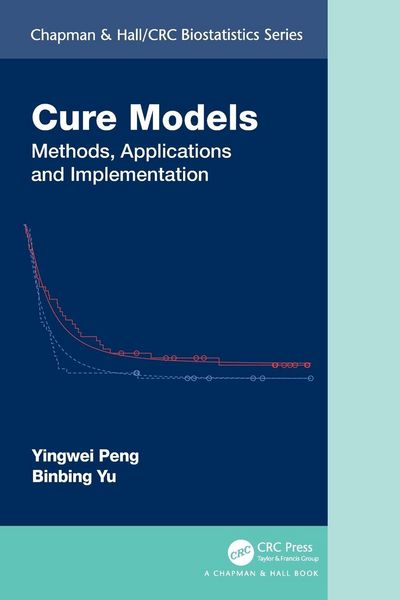
  • Produktbild: Cure Models
  • Produktbild: Cure Models

Cure Models Methods, Applications, and Implementation

57,99 €

inkl. gesetzl. MwSt., Versandkostenfrei


Beschreibung

Cure Models: Methods, Applications and Implementation is the first book in the last 25 years that provides a comprehensive and systematic introduction to the basics of modern cure models, including estimation, inference, and software. This book is useful for statistical researchers and graduate students,...

Beschreibung

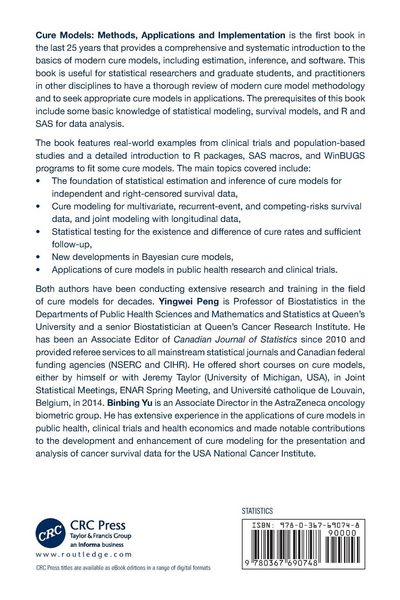
Cure Models: Methods, Applications and Implementation is the first book in the last 25 years that provides a comprehensive and systematic introduction to the basics of modern cure models, including estimation, inference, and software. This book is useful for statistical researchers and graduate students, and practitioners in other disciplines to have a thorough review of modern cure model methodology and to seek appropriate cure models in applications. The prerequisites of this book include some basic knowledge of statistical modeling, survival models, and R and SAS for data analysis.

The book features real-world examples from clinical trials and population-based studies and a detailed introduction to R packages, SAS macros, and WinBUGS programs to fit some cure models. The main topics covered include

  • the foundation of statistical estimation and inference of cure models for independent and right-censored survival data,
  • cure modeling for multivariate, recurrent-event, and competing-risks survival data, and joint modeling with longitudinal data,
  • statistical testing for the existence and difference of cure rates and sufficient follow-up,
  • new developments in Bayesian cure models,
  • applications of cure models in public health research and clinical trials.

Rezension

"Overall summary for those looking for a recommendation: outstanding applied statistics book for someone with intermediate knowledge and some data analysis experience, not appropriate for beginners, with just the right balance between theory and practice."

- David Manteigas, International Society for Clinical Biostatistics, 72, 2021

"The book, written by two well-known experts in the field, deals with cure models, wherein a portion of patients are deemed cured after a long period of follow up. This is a very important topic, both statistically and clinically. Though there are several books covering similar topics, the book clearly distinguishes itself from them in the following aspects:

1. It gives a much more comprehensive and updated treatment to cure models, ranging from parametric models to semi-parametric and nonparametric models, from a single endpoint to multivariate outcomes. Undoubtedly, this gives a solid and informative exposure to statisticians who would want to conduct research in the field.

2. It has been extremely helpful that the authors illustrate all the methods in the book by using the software developed by them. Thus, the book contains actionable knowledge that will benefit practitioners.

3. With a number of interesting datasets included in the book, the authors have nicely embedded the models and techniques with them, another practically appealing point.

As such, I strongly recommend the book and believe it will be useful for both theoreticians as well as practitioners."
(Yi Li, University of Michigan, Ann Arbor)

"I'm very glad that a new book on cure models is in preparation. There is an urgent need for a book on this topic...The book is written from a rather applied perspective, focusing on practical estimation, model validation, applications and software, without going more deeply into more theoretical issues like underlying model assumptions to make cure models identifiable, rigorous mathematical statements and properties, etc... The book is clearly written...Moreover, it is self-comprehensive and pleasant to read. It will definitely become an important reference in the field." (Ingrid Van Keilegom, KU Leuven)

"To the best of my knowledge a book on cure models on its own is not available yet. In view of the state of the art of cure models, a comprehensive book on this topic is very pertinent. It could be used as a textbook for a doctoral course in cure models as well as a reference book for researchers in the field." (Ricardo Cao, A Coruña, CITIC, ITMATI)

Produktdetails

Einband

Taschenbuch

Erscheinungsdatum

26.09.2022

Verlag Taylor & Francis
Seitenzahl

268

Produktdetails

Einband

Taschenbuch

Erscheinungsdatum

26.09.2022

Verlag Taylor & Francis
Seitenzahl

268

Maße (L/B/H)

23,4/15,6/1,5 cm

Gewicht

412 g

Sprache

Englisch

ISBN

978-0-367-69074-8

Herstelleradresse

Produktsicherheitsverantwortliche/r
Europaallee 1
36244 Bad Hersfeld
DE

Email: gpsr@libri.de

Noch keine Bewertungen vorhanden

Verfassen Sie die erste Bewertung zu diesem Artikel

Helfen Sie anderen Kundinnen und Kunden durch Ihre Meinung.

Kundinnen und Kunden meinen

Bewertungen (0)

Die Leseprobe wird geladen.
  • Produktbild: Cure Models
  • Produktbild: Cure Models
  • 1. Introduction. 2. The Parametric Cure Model. 3. The Semiparametric and Nonparametric Cure Models. 4. Cure Models for Multivariate Survival Data and Competing Risks. 5. Joint Modeling of Longitudinal and Survival Data with a Cure Fraction. 6. Testing the Existence of Cured Subjects and Sufficient Follow-up. 7. Bayesian Cure Model. 8. Analysis of Population-Based Cancer Survival Data. 9. Design and Analysis of Cancer Clinical Trials.