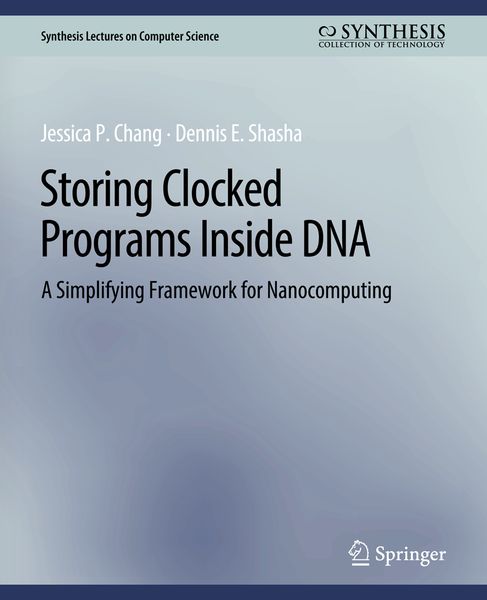
Storing Clocked Programs Inside DNA A Simplifying Framework for Nanocomputing
-
- Taschenbuch ausgewählt
- eBook
-
Sprache:Englisch
25,99 €
inkl. gesetzl. MwSt.,
- Kostenlose Lieferung ab 30 € Einkaufswert
- Versandkostenfrei für Bonuscard-Kund*innen
Beschreibung
Produktdetails
Einband
Taschenbuch
Erscheinungsdatum
21.04.2011
Abbildungen
VIII, 68 p.
Verlag
SpringerSeitenzahl
68
Maße (L/B/H)
23,5/19,1/0,5 cm
Gewicht
161 g
Sprache
Englisch
ISBN
978-3-031-00669-2
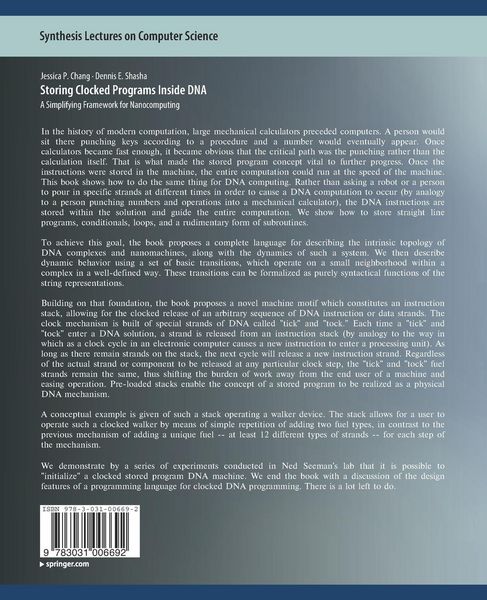
To achieve this goal, the book proposes a complete language for describing the intrinsic topology of DNA complexes and nanomachines, along with the dynamics of such a system. We then describe dynamic behavior using a set of basic transitions, which operate on a small neighborhood within a complex in a well-defined way. These transitions can be formalized as purely syntactical functions of the string representations.
Building on that foundation, the book proposes a novel machine motif which constitutes an instruction stack, allowing for the clocked release of an arbitrary sequence of DNA instruction or data strands. The clock mechanism is built of special strands of DNA called ""tick"" and ""tock."" Each time a ""tick"" and ""tock"" enter a DNA solution, a strand is released from an instruction stack (by analogy to the way in which as a clock cycle in an electronic computer causes a new instruction to enter a processing unit). As long as there remain strands on the stack, the next cycle will release a new instruction strand. Regardless of the actual strand or component to be released at any particular clock step, the ""tick"" and ""tock"" fuel strands remain the same, thus shifting the burden of work away from the end user of a machine and easing operation. Pre-loaded stacks enable the concept of a stored program to be realized as a physical DNA mechanism.
A conceptual example is given of such a stack operating a walker device. The stack allows for a user to operate such a clocked walker by means of simple repetition of adding two fuel types, in contrast to the previous mechanism of adding a unique fuel -- at least 12 different types of strands -- for each step of the mechanism.
We demonstrate by a series of experiments conducted in Ned Seeman's lab that it is possible to ""initialize"" a clocked stored program DNA machine. We end the book with a discussion of the design features of a programming language for clocked DNA programming. There is a lot left to do.
Table of Contents:Introduction / Notation / A Topological Description of DNA Computing / Machines and Motifs / Experiment: Storing Clocked Programs in DNA / A Clocked DNA Programming Language
Noch keine Bewertungen vorhanden
Verfassen Sie die erste Bewertung zu diesem Artikel
Helfen Sie anderen Kundinnen und Kunden durch Ihre Meinung.
Kurze Frage zu unserer Seite
Vielen Dank für Ihr Feedback
Wir nutzen Ihr Feedback, um unsere Produktseiten zu verbessern. Bitte haben Sie Verständnis, dass wir Ihnen keine Rückmeldung geben können. Falls Sie Kontakt mit uns aufnehmen möchten, können Sie sich aber gerne an unseren Kund*innenservice wenden.
zum Kundenservice