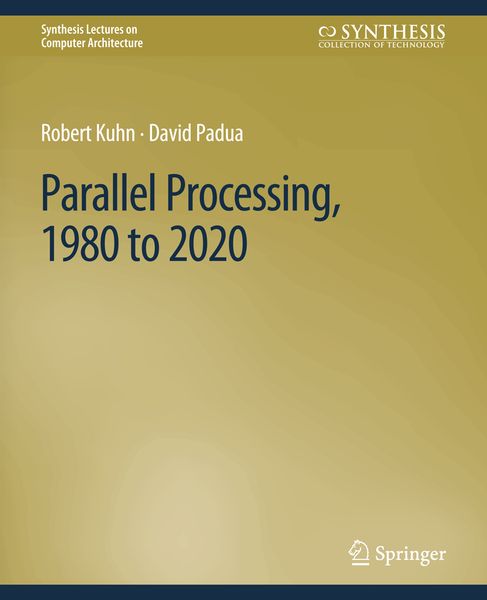
Parallel Processing, 1980 to 2020
-
- Taschenbuch ausgewählt
- eBook
-
Sprache:Englisch
55,99 €
inkl. gesetzl. MwSt.,
Beschreibung
Produktdetails
Einband
Taschenbuch
Erscheinungsdatum
14.10.2020
Abbildungen
XXIII, 166 p.
Verlag
SpringerSeitenzahl
166
Maße (L/B/H)
23,5/19,1/1,1 cm
Gewicht
370 g
Sprache
Englisch
ISBN
978-3-031-00640-1
This historical survey of parallel processing from 1980 to 2020 is a follow-up to the authors’ 1981 Tutorial on Parallel Processing, which covered the state of the art in hardware, programming languages, and applications.
Here, we cover the evolution of the field since 1980 in: parallel computers, ranging from the Cyber 205 to clusters now approaching an exaflop, to multicore microprocessors, and Graphic Processing Units (GPUs) in commodity personal devices; parallel programming notations such as OpenMP, MPI message passing, and CUDA streaming notation; and seven parallel applications, such as finite element analysis and computer vision. Some things that looked like they would be major trends in 1981, such as big Single Instruction Multiple Data arrays disappeared for some time but have been revived recently in deep neural network processors. There are now major trends that did not exist in 1980, such as GPUs, distributed memory machines, and parallel processing in nearly every commodity device.
This book is intended for those that already have some knowledge of parallel processing today and want to learn about the history of the three areas. In parallel hardware, every major parallel architecture type from 1980 has scaled-up in performance and scaled-out into commodity microprocessors and GPUs, so that every personal and embedded device is a parallel processor. There has been a confluence of parallel architecture types into hybrid parallel systems. Much of the impetus for change has been Moore’s Law, but as clock speed increases have stopped and feature size decreases have slowed down, there has been increased demand on parallel processing to continue performance gains. In programming notations and compilers, we observe that the roots of today’s programming notations existed before 1980. And that, through a great deal of research, the most widely used programming notations today, although the result of much broadening of these roots, remain close to target system architectures allowing the programmer to almost explicitly use the target’s parallelism to the best of their ability. The parallel versions of applications directly or indirectly impact nearly everyone, computer expert or not, and parallelism has brought about major breakthroughs in numerous application areas. Seven parallel applications are studied in this book.
Noch keine Bewertungen vorhanden
Verfassen Sie die erste Bewertung zu diesem Artikel
Helfen Sie anderen Kundinnen und Kunden durch Ihre Meinung.
Kurze Frage zu unserer Seite
Vielen Dank für Ihr Feedback
Wir nutzen Ihr Feedback, um unsere Produktseiten zu verbessern. Bitte haben Sie Verständnis, dass wir Ihnen keine Rückmeldung geben können. Falls Sie Kontakt mit uns aufnehmen möchten, können Sie sich aber gerne an unseren Kund*innenservice wenden.
zum Kundenservice