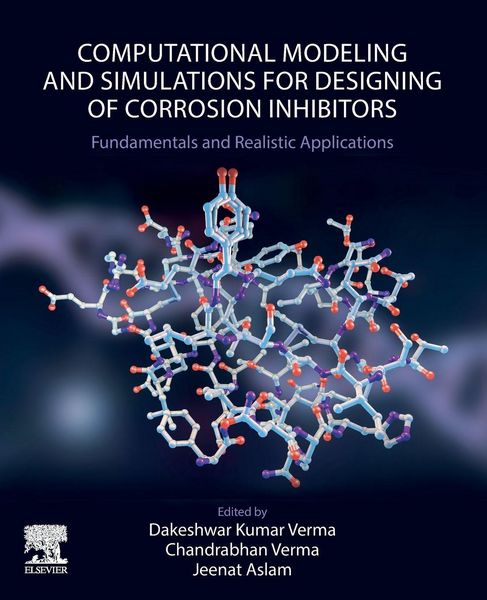
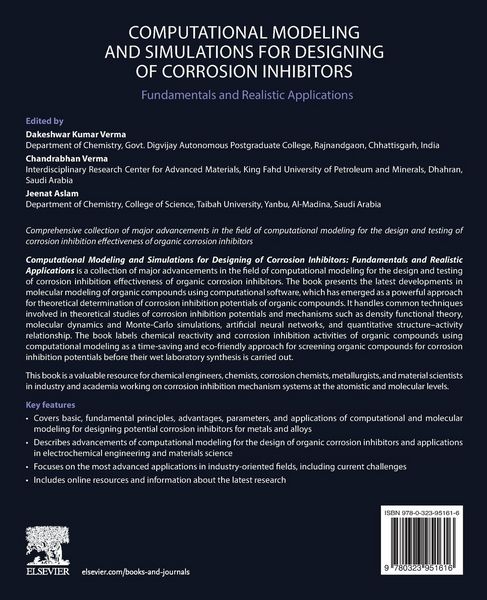
• Produktbild: Computational Modelling and Simulations for Designing of Corrosion Inhibitors
  • Produktbild: Computational Modelling and Simulations for Designing of Corrosion Inhibitors

Computational Modelling and Simulations for Designing of Corrosion Inhibitors Fundamentals and Realistic Applications

205,99 €

inkl. gesetzl. MwSt., Versandkostenfrei


Beschreibung

Produktdetails

Einband

Taschenbuch

Erscheinungsdatum

24.04.2023

Herausgeber

Dakeshwar Kumar Verma + weitere

Verlag

Elsevier Science & Technology

Seitenzahl

566

Maße (L/B/H)

23,5/19,1/2,9 cm

Gewicht

962 g

Sprache

Englisch

ISBN

978-0-323-95161-6

Beschreibung

Portrait

Dakeshwar Kumar Verma is Assistant Professor of Chemistry at Government Digvijay Autonomous Postgraduate College, Rajnandgaon, India. His research is mainly focused on the preparation and design of organic compounds for various applications.

Chandrabhan Verma, PhD, works at the Interdisciplinary Research Center for Advanced Materials, King Fahd University of Petroleum and Minerals, Dhahran, Saudi Arabia. He is a member of the American Chemical Society (ACS). His research interests mainly focus on the synthesis and design of environment-friendly corrosion inhibitors used for several industrial applications. Dr. Verma received his PhD degree from the Department of Chemistry at IIT?BHU, Varanasi, India and MSc degree in organic chemistry (Gold Medalist). Dr. Verma is the author of several research and review articles in peer-reviewed international journals. He has also received several national and international awards for his academic achievements.

Dr. Jeenat Aslam is currently working as an Associate Professor in the Department of Chemistry at the College of Science, Taibah University, Yanbu, Al-Madina, Saudi Arabia. She obtained her PhD degree in chemistry from Aligarh Muslim University, Aligarh, India. Her research is mainly focused on materials and corrosion, nanotechnology, and surface chemistry. Dr. Jeenat has published several research and review articles in peer-reviewed international journals. In addition, she has authored more than 40 book chapters and edited more than 30 books for different prestigious publishers.

Produktdetails

Einband

Taschenbuch

Erscheinungsdatum

24.04.2023

Herausgeber

Verlag

Elsevier Science & Technology

Seitenzahl

566

Maße (L/B/H)

23,5/19,1/2,9 cm

Gewicht

962 g

Sprache

Englisch

ISBN

978-0-323-95161-6

Herstelleradresse

Libri GmbH
Europaallee 1
36244 Bad Hersfeld
DE

Email: gpsr@libri.de

Noch keine Bewertungen vorhanden

Verfassen Sie die erste Bewertung zu diesem Artikel

Helfen Sie anderen Kundinnen und Kunden durch Ihre Meinung.

Kundinnen und Kunden meinen

Bewertungen (0)

Die Leseprobe wird geladen.
  • Produktbild: Computational Modelling and Simulations for Designing of Corrosion Inhibitors
  • Produktbild: Computational Modelling and Simulations for Designing of Corrosion Inhibitors
  • Part 1. Fundamental and Basics of corrosion mechanism
    1. Corrosion Inhibition: Current trends and challenges
    2. Theory of Corrosion and Corrosion Inhibition
    3. Organic corrosion inhibitors
    4. Deep understanding of corrosion inhibition mechanism based on first-principle calculations
    5. Molecular modelling in corrosion inhibition assessments

    Part 2. Molecular modelling of corrosion inhibition: Advantages and challenges
    6. DFT based molecular modelling
    7. MD based computational modelling
    8. MC simulation based molecular modelling
    9. QSAR and Artificial neural network (ANN) based molecular modelling
    10. MEPTIC and Machine Learning Approaches of corrosion inhibition
    11. Explicit Modelling of Corrosion Inhibition

    Part 3. Basic parameters derived from computational modelling
    12. Electrochemical principles of corrosion inhibition: fundamental and computational aspects of DFT
    13. DFT-based chemical reactivity concepts, calculations, and their application to designing green corrosion inhibitors
    14. Theories and radial distribution function of MD and MC simulations
    15. Important parameters derived from MC and MD simulations
    16. Theories, methods and the parameters of QSAR and ANN

    Part 4. Theoretical insight in designing green corrosion inhibitors
    17. Theoretical calculations-based results for plan extract as green corrosion inhibitors
    18. Aliphatic organic compounds as corrosion inhibitors for ferrous and nonferrous metals
    19. Nitrogen containing heterocyclic compounds as green corrosion inhibitors
    20. Oxygen containing heterocyclic compounds as green corrosion inhibitors
    21. Phosphorus containing molecules as green corrosion inhibitors
    22. Sulphur containing heterocyclic compounds as green corrosion inhibitors
    23. Carbohydrates and derivatives as green corrosion inhibitors
    24. Pharmaceutical drugs as prominent corrosion inhibitors
    25. Ionic liquids as green corrosion inhibitors
    26. QSAR and ANN based results for designing corrosion inhibitors