KI-Beratung Beta

Gutscheinbedingungen

**Gültig bis 09.11.2026 auf tolino shine color (4016621130473), tolino vision color (4016621130183) und tolino vision color weiß (4016621131456) online auf thalia.at, in der Thalia App und in allen Thalia Buchhandlungen in Österreich. In den Buchhandlungen nur gültig auf lagernde Ware. Pro Einkauf einmal einlösbar. Nur gültig gegen Vorlage oder im Onlineshop hinterlegter Bonuscard. Infos zur Einlösung in der Buchhandlung sind auf der Bonuscard-Vorteilspreisseite zu finden. Click & Collect nur bei Onlinevorabzahlung möglich. Keine Einlösung bei Scan & Go-Bezahlung. Keine Barauszahlung. Nicht kombinierbar mit anderen Aktionen und Gutscheinen. Nicht gültig für Geschenkkarten, Versandkosten und Services. Nur solange der Vorrat reicht.

  • Produktbild: Antiviral and Antimicrobial Smart Coatings
  • Produktbild: Antiviral and Antimicrobial Smart Coatings

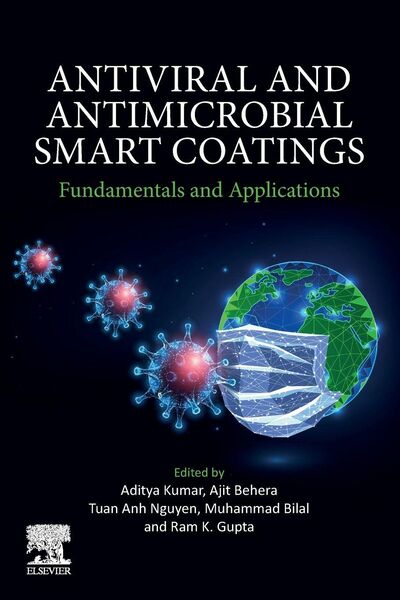
Antiviral and Antimicrobial Smart Coatings Fundamentals and Applications

251,99 €

inkl. gesetzl. MwSt., Versandkostenfrei


Beschreibung

Produktdetails

Einband

Taschenbuch

Erscheinungsdatum

27.01.2023

Herausgeber

Aditya Kumar + weitere

Verlag

Elsevier Science & Technology

Seitenzahl

638

Maße (L/B/H)

22,9/15,2/3,3 cm

Gewicht

842 g

Sprache

Englisch

ISBN

978-0-323-99291-6

Beschreibung

Portrait

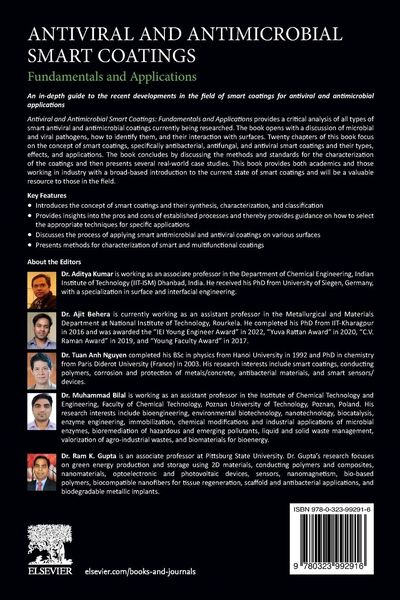
Dr. Aditya Kumar received his Ph.D. in Materials Science and Engineering from the University of Siegen, Germany. His research interests include coating, anti-wetting, functionalized coating, nanotribology, nanotechnology, biotechnology, interfacial phenomena, and materials science. Currently, he is an Assistant Professor at the Indian Institute of Technology (IIT-ISM) Dhanbad, India. He is an author and co-author of more than 55 publications in refereed journals.Dr. Ajit Behera is currently working as an Asst. Professor in the Department of Metallurgical & Materials Engineering at the National Institute of Technology, Rourkela. He completed his PhD at IIT-Kharagpur in 2016. He received the National "IEI Young Engineer Award" in 2022, "Yuva Rattan Award" in 2020, "C.V. Raman Award" in 2019, and the "young faculty award" in 2017. He has also currently, been assigned as The Honorary Secretary of The Institution of Engineers (India), Rourkela. His areas of research include high temperature materials, surface engineering, smart materials, aerospace materials and the characterization of materials.Muhammad Bilal is working as an Associate Professor at the Faculty of Civil and Environmental Engineering, Gdansk University of Technology, Poland. Previously, he served as an assistant/associate Professor at Poznan University of Technology, Poland, and the School of Life Science and Food Engineering, Huaiyin Institute of Technology, Huaian, China. He earned his Ph.D. from Shanghai Jiao Tong University, specializing in bioengineering and applied biotechnology. His main research activities are oriented to Environmental biotechnology, nanotechnology, enzyme engineering, immobilization, chemical modifications, and industrial applications of microbial enzymes, liquid, and solid waste management. He has authored over 700 peer-reviewed articles, 150 book chapters, 25 edited books. Dr. Bilal is the associate editor of Frontiers in Chemical Engineering and Frontiers in Environmental Science (Frontiers), and an editorial board member for several journals. He was listed as a highly cited researcher (Clarivate) in 2021 and holds several "highly cited papers" in WOS.

Ram Gupta is a Professor in the Department of Chemistry at Pittsburg State University, Kansas, United States. His research focus is in green energy production and storage using nanomaterials, optoelectronics and photovoltaics devices, organic-inorganic heterojunctions for sensors, nanomagnetism, conducting polymers and composites as well as bio-based polymers, bio-compatible nanofibers for tissue regeneration, scaffold and antibacterial applications, and bio-degradable metallic implants.

Tuan Anh Nguyen is a Senior Principal Research Scientist at the Institute for Tropical Technology, Vietnam Academy of Science and Technology, Hanoi, Vietnam. He received a BS in physics from Hanoi University in 1992, a BS in economics from Hanoi National Economics University in 1997, and a PhD in chemistry from the Paris Diderot University, France, in 2003. He was a Visiting Scientist at Seoul National University, South Korea, in 2004, and the University of Wollongong, Australia, in 2005. He then worked as a Postdoctoral Research Associate and Research Scientist at Montana State University, United States in 2006-09. In 2012 he was appointed as the Head of the Microanalysis Department at the Institute for Tropical Technology. His research areas of interest include smart sensors, smart networks, smart hospitals, smart cities, complexiverse, and digital twins. He has edited more than 74 books for Elsevier, 12 books for CRC Press, 1 book for Springer, 1 book for RSC, and 2 books for IGI Global. He is the Editor-in-Chief of Kenkyu Journal of Nanotechnology & Nanoscience.
Produktdetails

Einband

Taschenbuch

Erscheinungsdatum

27.01.2023

Herausgeber

Verlag

Elsevier Science & Technology

Seitenzahl

638

Maße (L/B/H)

22,9/15,2/3,3 cm

Gewicht

842 g

Sprache

Englisch

ISBN

978-0-323-99291-6

EU-Ansprechpartner

Elsevier B.V.
Radarweg 29
1043 NX Amsterdam
NL
productsafety@elsevier.com

Herstelleradresse

Elsevier Science & Technology
London Wall 125
EC2Y 5AS London
GB
tradeorders@elsevier.com

Noch keine Bewertungen vorhanden

Verfassen Sie die erste Bewertung zu diesem Artikel

Helfen Sie anderen Kundinnen und Kunden durch Ihre Meinung.

Kundinnen und Kunden meinen

Bewertungen (0)

Die Leseprobe wird geladen.
  • Produktbild: Antiviral and Antimicrobial Smart Coatings
  • Produktbild: Antiviral and Antimicrobial Smart Coatings
  • Section A: Overview on microbes and viruses
    1. Introduction to the microbial world and associated diseases
    2. Fungal and Viral pathogens, classification, and associated diseases
    3. Various materials surfaces and growth of microbes and viruses on it
    4. Identification and culture tests
    5. Microbe- and virus-philic surfaces
    6. Microbe- and virus-phobic surface coating
    7. Industrial environment and microbes/virus growth

    Section B: Smart Coatings 
    8. Introduction to smart coatings
    9. Working principles of various smart coating on microbes/virus growth 
    10. Effect of shape responsive coating on microbes/virus growth 
    11. Electric responsive coating and microbes/virus growth 
    12. Magnetic responsive coating and microbes/virus growth
    13. Synthesis techniques of smart coatings
    14. Smart coatings and biomimetics 
    15. Biomaterials and biomimetics

    Section C: Antibacterial, antifungal and Antiviral smart coatings
    16. Polymeric antibacterial, antifungal and antiviral coatings
    17. Nanotechnology in antibacterial, antifungal and antiviral coatings
    18. Nanomaterials based smart coatings for antibacterial, antifungal and antiviral activities 
    19. Green antibacterial, antifungal and antiviral coatings
    20. Effect of smart coating and durability
    21. Hybrid antibacterial, antifungal and antiviral smart coatings

    Section D: Methods/standards for characterization of smart coatings
    22. Characterization methodologies for smart coating
    23. Screening methods to determine antibacterial activity 
    24. Molecular Network Approach
    25. Gas chromatography coupled to mass spectrometry
    26. Physical and mechanical property measurement of antiviral/ antibacterial smart coating
    27. Erosion property evaluation of antiviral/ antibacterial smart coating 
    28. Chromic property measurement of antiviral/ antibacterial smart coating
    29. Current standards and their limitations/concerns for testing the antibacterial activity of smart coatings

    Section E: Current and predictable scenario
    30. Prediction and optimization of materials surface with respect to bacteria, fungus and virus growth
    31. Role of Smart coating to eliminate COVID infection
    32. Edible and food safe antiviral and antimicrobial smart coatings
    33. Industrialization of antiviral and antimicrobial smart coatings
    34. Antibacterial activity of plant extracts smart coating
    35. Human safety and environmental concerns of antiviral and antimicrobial smart coatings 
    36. Laws and developments to implement antimicrobial coatings